
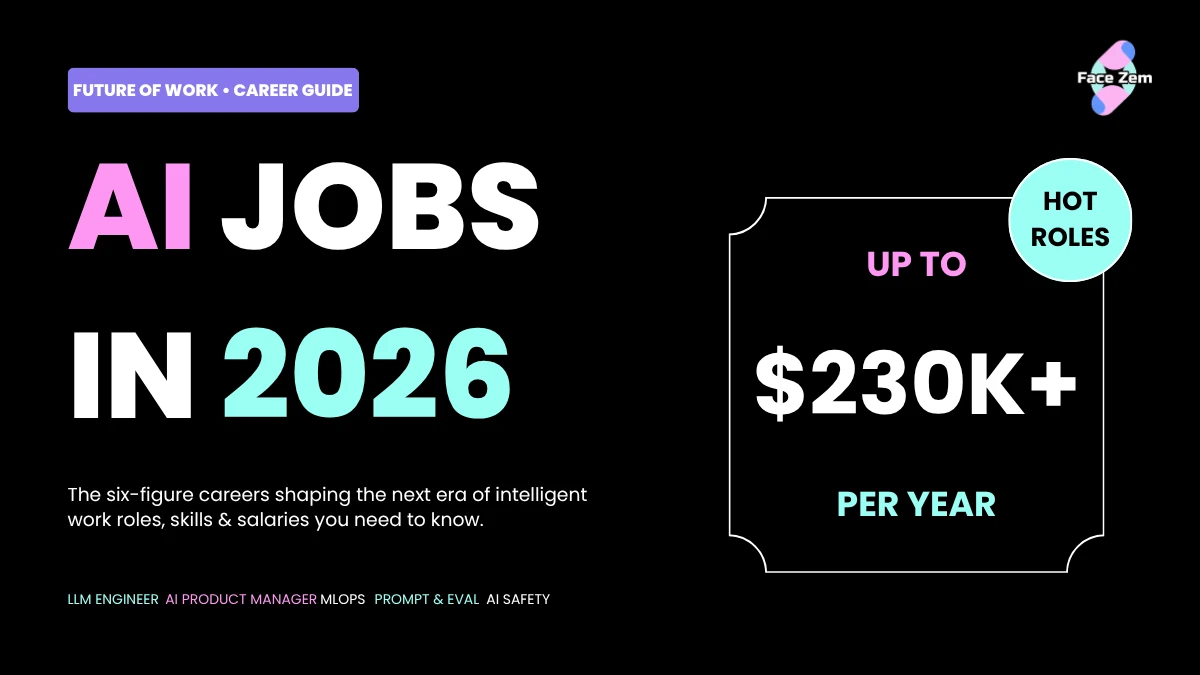
The employment landscape has shifted dramatically over the last few years.
If someone told you in 2023 that companies would aggressively compete to pay multiple six-figure salaries for experts who specialize in talking to algorithms, you might have been skeptical.
Yet, here we are in 2026, and the data proves that AI jobs 2026 have transformed from experimental, niche projects into the foundational drivers of enterprise business strategy.
The initial gold rush of raw experimentation has settled into a structured, highly lucrative job market.
Companies have realized that buying access to foundational models isn’t enough. They need specialized professionals to deploy, secure, optimize, and manage these systems safely.
For forward-thinking career changers and tech professionals, this rapid evolution presents an unprecedented financial and professional opportunity.
If you want to capitalize on high paying AI jobs, you must look beyond traditional tech titles.
This article explores the lucrative future jobs AI has carved out across the global landscape, focusing heavily on emerging AI careers USA dynamics.
Based on recent market data from specialized placement agencies, these roles command premium salaries precisely because the talent supply cannot keep pace with surging corporate demand.
The Six-Figure AI Career Landscape
Before diving into individual roles, it is helpful to look at how compensation is distributed across these freshly minted career tracks.

The following dataset highlights standard compensation structures across the United States in 2026, combining base compensation, performance bonuses, and typical equity or restricted stock units (RSUs).
| Role Title | Estimated Base Range (USD) | Core Skill Requirement | High-Growth Industry |
| LLM Engineer | $165,000 – $230,000 | RAG Architectures, Fine-Tuning | FinTech, Enterprise SaaS |
| AI Product Manager | $140,000 – $195,000 | Non-Deterministic UX, Model Evals | E-commerce, Healthcare |
| AI Safety & Ethicist | $120,000 – $180,000 | Compliance Frameworks, Red Teaming | Defense, Legal Tech |
| Prompt Specialist | $95,000 – $185,000 | Context Window Optimization, Chain-of-Thought | Digital Marketing, Legal |
| MLOps Specialist | $150,000 – $210,000 | Containerization, Pipeline Monitoring | Logistics, Autonomous Systems |
5 High-Paying AI Careers Shattering Six Figures
1. Large Language Model (LLM) Engineer
Three years ago, building applications meant working with predictable, deterministic code APIs.
Today, the Large Language Model (LLM) Engineer occupies the critical junction where raw research meets practical deployment.
These engineers build scalable applications powered by large language models and advanced multimodal frameworks.
Instead of writing logic from scratch, an LLM Engineer focuses heavily on Retrieval-Augmented Generation (RAG) architectures, model fine-tuning, and robust vector database management.
They ensure that an enterprise model pulls accurate corporate context rather than hallucinating facts.
Because businesses require internal knowledge assistants to operate smoothly, search consultants at facezem note that companies are paying top dollar for developers who can reliably control model outputs.
Mid-level base compensation routinely begins at $165,000. Senior engineers at frontier labs see total packages exceeding $350,000 when equity grants clear.
2. AI Product Manager
The explosion of generative platforms highlighted a fundamental design flaw: traditional product management strategies fail when applied to non-deterministic systems.
A standard software application does exactly what it is programmed to do.

An AI product behaves probabilistically, yielding different outputs based on complex user interactions. This reality birthed the specialized AI Product Manager.
These professionals define product strategy for algorithmic features, design user experiences around confidence scores, and manage data collection pipelines.
A major part of their day involves balancing user experience with responsible safeguards.
According to 2026 data analytics from industry trackers like IdeaPlan, product managers with specific machine learning credentials enjoy an estimated 22% salary premium over traditional tech product managers.
This makes it one of the absolute best high paying AI jobs for cross-functional professionals who bridge business goals and engineering workflows.
3. AI Safety Officer & Compliance Ethicist
As legislative frameworks like the EU AI Act and updated federal guidelines in the United States take full effect, corporate liability for biased or rogue models has skyrocketed.
Enterprises can no longer deploy public-facing systems without strict monitoring.This compliance push has created a massive wave of future jobs AI legacy industries never anticipated.
The AI Safety Officer evaluates models for algorithmic bias, designs rigorous red-teaming protocols, and establishes data privacy guardrails. They deliberately try to break internal models to ensure they cannot be tricked into leaking sensitive user data or generating harmful material.
Industry Insight: Legal tech, healthcare, and defense sectors are hiring these compliance experts at a rapid pace. Senior leadership roles in corporate governance routinely scale past $200,000 based on available market data.
4. Advanced Prompt & Evaluation Engineer
When generative systems initially broke into the mainstream, prompt engineering was often dismissed as a temporary trend. By 2026, it has matured into a sophisticated technical discipline.
Casual users write basic text prompts, but professional Prompt Engineers design structured, programmatic instructions that guide autonomous software agents. These specialists utilize advanced techniques like Chain-of-Thought processing, Constitutional AI design, and adversarial testing.

They often build complex prompt chains where one model’s output safely triggers another model’s action.Public aggregate data from Coursera shows that a mid-level Prompt Engineer in the United States brings home a median salary of approximately $126,000.
For elite professionals working directly inside frontier research laboratories, base salaries range from $280,000 to $425,000, making it a standout career track within modern AI careers USA ecosystems.
5. MLOps (Machine Learning Operations) Specialist
Training an AI model in a test laboratory is one thing; keeping that model running smoothly for millions of live users is an entirely different engineering challenge. The MLOps Specialist is the infrastructure engineer responsible for deploying, scaling, and monitoring machine learning systems in production environments.
Models suffer from “data drift” over time, meaning their real-world accuracy degrades as human trends evolve. MLOps specialists build automated monitoring pipelines using tools like MLflow or Kubeflow to detect this degradation and trigger automatic retraining cycles.
Because this role blends deep machine learning knowledge with complex cloud infrastructure engineering, it commands a notable premium.
Recruiters at facezem point out that MLOps roles frequently pay 10% to 15% higher than standard DevOps engineering equivalents, with starting salaries comfortably sitting at $150,000.

Essential Skills for the 2026 AI Job Market
Breaking into these modern career tracks requires a distinct shift in how you build your professional portfolio.
The requirements have moved past abstract theoretical mathematics toward practical implementation and architectural design.
Technical Proficiencies
- Framework Mastery: Hands-on experience with deployment toolkits like LangChain, LlamaIndex, and agentic environments is mandatory.
- Vector Architecture: Deep familiarity with vector databases such as Pinecone, Milvus, or Chroma for high-speed context retrieval.
- Cloud Infrastructure: Competency deploying models across enterprise cloud providers, including AWS SageMaker and Google Vertex AI.
Soft Skills & Business Acumen
- Probabilistic Thinking: Embracing the reality that systems operate on probabilities rather than fixed, binary logic paths.
- Systemic Communication: The ability to explain complex algorithmic behaviors to non-technical corporate stakeholders.
- Risk Evaluation: Identifying hidden failure points in automated customer-facing systems before deployment.
How to Transition Into an AI Career
Transitioning into high paying AI jobs does not necessarily require going back to university for a four-year computer science degree.
The rapid pace of the industry means that recent, verified project portfolios often carry more weight with hiring managers than a legacy degree completed a decade ago.
Build an Applied Portfolio
Theoretical knowledge is easy to claim but difficult to prove. To capture the attention of technical recruiters at platforms like facezem, build functional prototypes.
Deploy a specialized RAG system that analyzes a public financial database, or build an open-source evaluation script that benchmarks open-source models against specific safety metrics. Document your engineering process clearly on GitHub.
Secure Niche Certifications
While general experience is valuable, targeted industry credentials validate your platform specific expertise. Seeking out specialized programs can provide an immediate boost to your profile:
- AWS Certified Machine Learning – Specialty: Validates your ability to build, train, tune, and deploy machine learning models using the AWS cloud ecosystem.
- Google Professional Machine Learning Engineer: Focuses heavily on production operations, architecture design, and model monitoring workflows.
- DeepLearning.AI Architecture Certifications: Widely respected by engineering teams for practical, hands-on application design using modern language frameworks.
The Strategic Outlook for Future Jobs AI
The evolution of AI jobs 2026 signals a permanent transition in the global knowledge economy. Companies are no longer asking if they should integrate intelligent automation; they are actively optimizing how they execute that integration.

This means the premium salaries attached to these positions are tied directly to business efficiencies and revenue generation.
As you plan your next professional pivot within AI careers USA, look for roles that sit between raw computational power and specific industry expertise. Navigating this intersection effectively ensures long-term career sustainability and gives you a definitive edge in an incredibly competitive hiring environment.
Frequently Asked Questions
Do I need a PhD to work in high-paying AI fields?
No. While foundational AI research scientists at elite laboratories often hold a PhD, applied engineering, product management, and prompt roles prioritize practical execution. A strong portfolio of built applications and cloud deployment experience is highly valued in the corporate tech market.
What is the primary difference between an LLM Engineer and a software engineer?
A standard software engineer writes deterministic code where inputs lead to fixed, predictable outputs. An LLM Engineer designs systems that interact with probabilistic language models, using advanced prompt structures, retrieval mechanics, and fine-tuning techniques to guide variable outputs safely.
Are prompt engineering jobs still growing in 2026?
Yes, but the role has become much more technical. Simple text prompting has evolved into programmatic prompt engineering. Today’s professionals write complex, structured scripts that manage data flows across multi-agent systems and optimize how context windows are utilized.
Which programming languages are most valuable for AI careers?
Python remains the undisputed standard language for machine learning, model integration, and data manipulation. Additionally, familiarity with TypeScript is highly beneficial for building modern web-based interfaces and managing API integrations for generative applications.