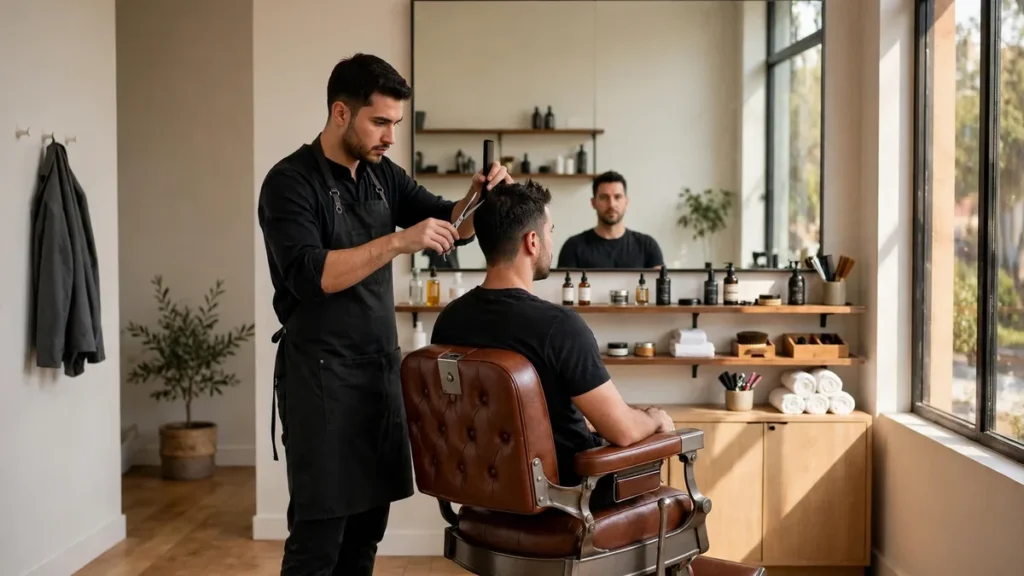
The best AI tools for barbershops in 2026 do one thing above all else: they keep the chairs full without keeping the owner glued to the phone. A good barbershop runs on rhythm. Clients book, sit, pay, rebook and tell their friends, and every gap in that rhythm costs money. When the phone rings while a barber has clippers in hand, when a regular forgets his usual Friday slot, or when a first-time client cannot find a booking link at ten at night, the shop loses revenue it will never get back. The best AI tools for barbershops close those gaps automatically, so the team can focus on the cut instead of the calendar.
That matters more now than it did even two years ago, because client expectations have changed. Most clients under forty expect to book online, pay without cash, get a reminder without being chased, and rebook in two taps. They compare barbershops the way they compare restaurants and hotels, and the shop with the smoothest booking experience usually wins the first visit. The tools in this guide handle online booking, reminders, rebooking prompts, client records, payments, reviews and marketing messages, and the strongest ones do it from a single dashboard instead of five separate apps.
This guide compares the strongest options for barbershops of every size, from a single chair in a rented booth to a multi-location shop with a dozen barbers. Every tool below was judged on the things that decide whether a barbershop actually keeps using it: how easy booking is for clients, how well it fills empty chairs, how it handles no-shows, whether it stores client notes and formulas properly, how it takes payments and deposits, and whether the monthly cost pays for itself in recovered appointments. You will find a comparison table, a practical setup checklist, answers to the questions shop owners ask most often, and a clear recommendation at the end for different shop sizes.
Key takeaways
- The best AI tools for barbershops earn their keep by filling empty chairs, cutting no-shows and recovering bookings that used to be lost to missed calls.
- Online booking with deposits is the single most valuable feature for most shops, because it turns late-night browsers into confirmed appointments.
- Automated reminders and rebooking prompts protect more revenue than any marketing campaign, since returning clients are cheaper to keep than new ones are to find.
- Client notes, cut history and formulas matter as much as the calendar, because a barber who remembers a client’s last cut keeps that client longer.
- Start with one tool that covers booking, reminders and payments, and add marketing automation only after the diary runs smoothly for a month.
What AI Tools Actually Do in a Barbershop
An AI tool in a barbershop is not a robot holding the clippers. It is software that watches the diary, the client list and the phone, and takes care of the repetitive jobs that used to eat the owner’s evenings. When a client books online, the tool checks the right barber’s availability, takes a deposit if you ask for one, sends a confirmation, and adds the appointment to the diary without anyone touching it. When a chair opens up because of a cancellation, it can offer that slot to clients on a waitlist or send a last-minute offer to regulars nearby. When a client has not booked for six weeks, it can send a friendly nudge at exactly the right moment.
The phone is where the change is most visible. A traditional shop loses bookings every day to calls that go unanswered while barbers are cutting hair. An AI receptionist or a smart booking link answers those clients instead, takes the booking, and records it in the same diary the barbers already use. The barber never stops cutting, the client never hears a voicemail, and the owner never spends Sunday night returning calls. If you want the craft-focused view first, our guide to the best AI tools for barbers looks at the same problem from the individual barber’s chair, including tools that suit a solo barber who rents a booth and manages his own book.
The second job is memory. A great barber remembers that a client likes a skin fade with a textured top, takes a number two on the sides, prefers Saturday mornings and always buys beard oil. A good AI tool remembers it too, and it remembers it for every barber in the shop, so a client gets the same cut even when his usual barber is on holiday. Client notes, photos of finished cuts, product history and visit frequency all live in one record, and the tool uses that record to suggest rebooking dates, recommend products and flag clients who are drifting away before they disappear for good.
How We Compared the Best AI Tools for Barbershops
We judged every tool on the same six measures, because a tool that books beautifully but handles payments badly still creates work. First, booking: can a new client find a slot, pick a barber, choose a service and pay a deposit in under two minutes on a phone? Second, no-show protection: reminders, confirmations, deposits and cancellation policies that actually reduce empty chairs. Third, client records: notes, cut history, photos and preferences that survive staff changes. Fourth, payments and payouts: card payments, tips, deposits, and how quickly money reaches the shop. Fifth, marketing: reminders, rebooking prompts, review requests and campaigns that run without daily effort. Sixth, cost and ease of use: a monthly price a small shop can justify, and a setup a busy owner can finish in an afternoon.
We also weighed fit. A tool built for large salons can overwhelm a two-chair shop with features nobody opens, while a simple booking app can frustrate a six-chair shop that needs per-barber calendars, commission tracking and a waitlist. The comparison table below scores each tool against the same measures, and the recommendations at the end match tools to shop size, so you can skip straight to the options that fit your shop.
The Best AI Tools for Barbershops in 2026
These eight tools cover the full range of what a modern barbershop needs, from a free booking page for a new shop to a complete management system for a busy multi-chair business. Each one earns its place for a different reason, and the right choice depends on your shop’s size, your clients and how much of the front desk you want automated.
Booksy
Booksy is the best-known booking app in the barbering world, and its strength is the marketplace. Millions of clients already search Booksy for a barber, so a shop on the platform can be discovered by people who have never heard of it. The diary is built for barbers, with per-barber calendars, service menus, deposits, no-show protection and card payments, and the app handles reminders and rebooking prompts automatically. Booksy also offers Boost, its marketing service, which promotes the shop to nearby clients looking for a cut.
Squire
Squire is built specifically for barbershops, and it shows in the details. The platform covers booking, point of sale, client records and marketing in one system, and it was designed around the way barbershops actually work, with chair rental, booth rental and commission structures handled properly. Its AI features focus on the diary: smart scheduling that fills gaps, automated reminders, and rebooking prompts timed to each client’s usual cycle, so a client who comes every three weeks gets a nudge at exactly three weeks.
Fresha
Fresha is the best value option for a shop that wants a professional booking system without a monthly subscription. Its core booking, calendar and client management tools are free, and Fresha earns money from payment processing and optional marketplace features instead. Clients can book online, receive reminders, pay by card and rebook in a few taps, and the shop gets a clean diary, client records and basic reporting at no monthly cost.
Fresha’s AI features are lighter than the premium tools, and its marketplace is smaller than Booksy’s in some areas, but the free core is genuinely useful rather than a trial in disguise. Shops that sell retail products also get a simple product catalogue and checkout. Fresha suits a new shop, a small team, or an owner who wants to test online booking properly before paying for a premium system, and it scales well enough that many shops never need to leave it.
Square Appointments
Square Appointments suits a barbershop that already takes card payments through Square, because booking and payments then live in one place. Clients book online, pay deposits or full amounts in advance, and receive automatic reminders, while the shop takes payment at the chair through the same Square reader it already owns. The calendar is clean, the client records are solid, and the reporting connects bookings to revenue without any extra work.
The AI layer is practical rather than flashy: smart reminders, no-show protection through deposits, and simple marketing tools that send offers to lapsed clients. Square’s processing fees are transparent, and there is no monthly fee on the free plan, which makes it easy to start. The weakness is that Square is a general business tool rather than a barbering specialist, so features like chair rental accounting and barber-specific service menus need more manual setup than they do on Squire or Booksy.
Vagaro
Vagaro is a full salon and barbershop management platform with booking, point of sale, client records, payroll, inventory and marketing in one system. Its AI assistant helps with the daily grind: drafting marketing messages, suggesting the best times to send campaigns, and flagging clients who have not rebooked. The booking page is professional, the app is popular with clients, and the marketplace brings in new faces in the same way Booksy’s does.
GlossGenius
GlossGenius is built for independent beauty and barbering professionals, and it is the prettiest tool on this list. The booking pages look like a high-end brand site, the client experience is smooth, and the platform covers booking, payments, client records, marketing and a simple website in one subscription. Its AI features write marketing messages, suggest send times, and automate review requests after each appointment, which helps a small shop look far bigger than it is.
GlossGenius charges a flat monthly fee rather than per staff member, which makes it good value for a small team sharing one account, and it includes card processing with fast payouts. It is less suited to a large multi-chair shop that needs detailed per-barber reporting and commission structures, but for a solo barber, a two-chair shop or a small team that cares about presentation, it is hard to beat on polish and simplicity.
Boulevard
Boulevard is the premium choice for a high-end barbershop that sells an experience rather than just a cut. The platform is designed around client experience: a beautiful booking flow, detailed client profiles with notes and preferences, smart scheduling that protects the most valuable appointments, and messaging that feels personal rather than automated. Its AI features focus on the client relationship, surfacing the right offer or reminder for each person at the right time.
AI Receptionist Tools
The eighth option is not a booking system but a layer on top of one: AI receptionist tools that answer the shop phone around the clock. These services use voice AI to greet callers, answer common questions about prices and opening hours, take bookings directly into the diary, and send a summary of every call to the owner. Some also handle text messages and web chat, so a client who messages at midnight still gets an answer and a booking.
An AI receptionist makes the most sense for a shop that already has a booking system but still loses calls during busy hours. The cost is usually a monthly subscription based on call volume, and the quality of the voice and the accuracy of the booking depend heavily on the provider, so a trial is essential. Used well, it closes the last gap in the diary: the bookings that used to vanish into voicemail while every barber was cutting hair.
Comparison Table: Best AI Tools for Barbershops 2026
| Tool | Best for | Booking and reminders | Client records | Payments | Price level |
|---|---|---|---|---|---|
| Booksy | Shops that want marketplace discovery | Excellent | Good | Card and deposits | Mid to high |
| Squire | Growing barbershops with four or more chairs | Excellent | Excellent | Card, deposits and tips | High |
| Fresha | New and small shops on a tight budget | Very good | Good | Card and deposits | Free core |
| Square Appointments | Shops already using Square payments | Very good | Good | Card, deposits and tips | Free to mid |
| Vagaro | Mid-sized shops wanting one system | Excellent | Excellent | Card, deposits and tips | Mid |
| GlossGenius | Solo barbers and small premium teams | Excellent | Very good | Card and fast payouts | Mid |
| Boulevard | Premium shops selling an experience | Excellent | Excellent | Card, memberships and packages | High |
| AI receptionist tools | Shops losing calls at busy times | Good, as a phone layer | Basic | Not applicable | Mid |
Booking and Scheduling: The Heart of the Shop
Booking is where most barbershops win or lose, because it is the first thing a new client experiences and the thing a regular does most often. A good booking flow takes under two minutes on a phone, shows real availability, lets the client pick a barber and a service, and confirms instantly. A bad one asks for an account before showing a single time slot, hides the price until the end, or sends the client to a phone number that nobody answers. Every tool in this guide passes the basic test, but the best ones also handle the awkward cases: a client who wants two services back to back, a walk-in who needs to join the queue, or a regular who always books the same barber at the same time.
Deposits deserve a clear policy, because they are the single most effective no-show defence a shop has. A small deposit, taken at booking and clearly explained, cuts no-shows sharply without putting clients off, and it compensates the shop when a client does cancel late. The tools above all support deposits, and the best ones automate the awkward parts: reminding the client before the cancellation window closes, releasing the deposit fairly when a client rebooks in time, and keeping a record of repeat late cancellers so the owner can have a quiet word. Our roundup of the best AI tools for appointment scheduling compares the booking engines behind these features in detail, including the reminder and waitlist systems that matter most when the diary is tight.
Scheduling the barbers matters as much as scheduling the clients. A good system lets each barber set working hours, block holidays, and manage their own diary within the shop’s rules, while the owner sees the whole week at a glance. It should also show the quiet hours clearly, because a Tuesday morning gap is an opportunity: a well-timed offer to regulars, a social media post, or a waitlist message can fill chairs that would otherwise sit empty. The shops that make the most of these tools treat the diary as something to manage actively, not as a list that fills itself.
Keeping Chairs Full: Reminders, Rebooking and Reviews
Reminders are the cheapest revenue protection a barbershop can buy. A text message the day before, and a short nudge a few hours ahead, cut no-shows dramatically, and the best tools send them automatically with the client’s name, barber, service and time. The message should also make it easy to confirm, reschedule or cancel, because a client who can move an appointment with one tap is far less likely to simply not turn up. Confirmation replies also tell the shop which chairs are safe and which need a standby client from the waitlist.
Rebooking prompts are the quiet earner. Most clients intend to rebook but forget, and a well-timed message at the end of their usual cycle brings them back without any effort from the shop. The smartest tools learn each client’s rhythm: a client who comes every two weeks gets a prompt at two weeks, while a client who comes every six weeks is left alone until week five. The prompt should offer the client’s usual barber and usual time, because removing friction is what turns an intention into a booking. Over a year, these prompts are worth far more than a discount campaign, because they bring back clients who already trust the shop.
What Barbershops Can Learn from Salons
Barbershops and salons solve the same problem with different tools, and the salon world is a few years ahead on chair utilisation. Salon owners have long used automated rebooking, product recommendations and membership packages to smooth out quiet weeks, and the same ideas work in a barbershop with almost no change. A beard trim package, a monthly membership for regulars, or a retail offer at the chair all borrow directly from the salon playbook, and the software that runs them is often the same.
The closest parallel is the nail salon world, where chair time is just as valuable and no-shows just as costly, and the best AI tools for nail salon owners we reviewed solve the same chair-utilisation problem with deposits, reminders and rebooking prompts. The lesson for barbershop owners is simple: borrow what works. If a salon tool’s rebooking flow, review request or membership feature fits your shop, use it, and judge any new tool by whether it fills chairs and keeps clients, not by whether it was built only for barbers.
Pricing, Payments and the Front Desk
Payments should be invisible to the client and instant for the shop. Card payments at the chair, tips on the terminal, deposits at booking and online payment links for gift cards all matter, and the tools in this guide handle them without a separate card machine contract in most cases. The owner should check three numbers before choosing: the monthly subscription, the card processing percentage, and the payout time. A tool with a low monthly fee and slow payouts can cost more in cash flow than a pricier tool that pays out next day, especially for a small shop.
Choosing the Right Tool for Your Shop Size
The right tool depends on the size of the shop and the way it works, not on which one has the longest feature list. A solo barber needs speed and low cost, a mid-sized shop needs coordination and reporting, and a multi-location business needs consistency and control. Match the tool to the shop you have today, with room to grow, and you will actually use it every day.
Single Chair or Two Chairs
A solo barber or a two-chair shop should start with Fresha or GlossGenius. Fresha costs nothing at the core and covers booking, reminders and client records well enough that many small shops never outgrow it. GlossGenius costs more but looks better and handles marketing and review requests with less effort, which matters when the owner is also the receptionist, the cleaner and the marketer. Either way, keep it simple: one booking link, one diary, one way to take payment, and a reminder system that runs itself.
Three to Six Chairs
A three-to-six-chair shop is where the premium tools earn their fee. Squire and Vagaro both handle per-barber calendars, commission and chair rental, waitlists and reporting, and their rebooking and gap-filling features start to pay for themselves once the diary is busy. Booksy is also strong at this size if the shop wants marketplace discovery to bring in new clients. At this scale, the owner should also look at the reporting: which barber is busiest, which hours are quiet, and which services earn most, because those answers decide hiring, pricing and opening hours.
Multi-Location or Growing Fast
A multi-location shop needs one system across every site, with consistent pricing, shared client records and central reporting. Vagaro and Squire both handle this well, and Boulevard suits a premium group that wants a consistent client experience everywhere. The key features at this size are permissions, so each location manager sees their own shop, and central reporting, so the owner can compare locations honestly. An AI receptionist layer also becomes worth the cost at this size, because the phone volume across several shops is too large for any one person to handle.
Setup Checklist: Getting Started in a Week
Moving to a new booking tool feels like a big job, but most shops can do it in a week without closing for a day. Work through this checklist in order, and do not launch the new booking link until the diary, the services and the payments are all tested.
- List every service, price and duration exactly as clients know them, and check that each one takes the right amount of chair time in the new diary.
- Import the client list with phone numbers and emails, and add cut notes and preferences for regulars before the first booking goes live.
- Set the cancellation and deposit policy in plain language, and put it on the booking page where clients see it before they pay.
- Turn on reminders, confirmation messages and rebooking prompts, and test them on your own phone with a trial booking first.
- Connect card payments and tips, run a small test payment, and confirm how quickly the money reaches the shop account.
- Tell every regular client about the new booking link by text, put it on the shop door and social media, and keep the old phone booking running for two weeks as a backup.
Frequently Asked Questions
What is the best AI tool for a small barbershop?
For a small barbershop, Fresha is the best starting point because its core booking, calendar and client tools are free, and it covers reminders, deposits and online booking without a monthly fee. GlossGenius is the best paid option at this size if presentation matters, because its booking pages look premium and its marketing automation runs with very little effort. Either one will fill chairs and cut no-shows, so choose Fresha to keep costs down or GlossGenius for a more polished client experience.
How much do AI tools for barbershops cost?
Costs range from free to several hundred dollars a month. Fresha and the free plan of Square Appointments charge no monthly fee and earn money from payment processing, while mid-range tools like Vagaro and GlossGenius charge a monthly subscription per user or per account. Premium systems like Squire and Boulevard cost more but include deeper reporting, marketing automation and client experience features. Add card processing fees on top of the subscription, and check payout times, because a tool that pays out slowly can cost a small shop more in cash flow than the subscription itself.
Do AI tools really reduce no-shows?
Yes, and the effect is large. Automated reminders alone cut no-shows sharply, because most no-shows are forgotten appointments rather than deliberate cancellations. Adding deposits cuts them further, because a client with money already committed is far more likely to turn up or reschedule in time. The combination of a reminder the day before, a nudge a few hours ahead, and a deposit at booking is the most effective no-show defence a barbershop can buy, and it works from the first week.
Can AI tools handle walk-ins as well as bookings?
Most of the tools in this guide handle walk-ins through a queue or waitlist feature. The barber adds the walk-in to the queue, the client gets an estimated wait time by text, and the system calls them when a chair frees up. Some tools also let a walk-in join the queue by scanning a code at the door. The key is that walk-ins and bookings share one diary, so a walk-in never takes a chair that a booked client is about to use.
Will clients accept booking and paying online?
Most clients now prefer it, especially younger ones who book late at night and expect to pay by card. The shops that struggle are the ones that make online booking hard, by hiding the booking link, asking for an account before showing times, or refusing deposits. Make the link easy to find on social media and search, keep the flow under two minutes, and keep phone booking available for clients who prefer it. Within a month, most regulars will have switched to the link on their own.
Do I still need reception staff if I use an AI tool?
A small shop usually does not, once online booking, reminders and card payments are running well, because the routine work is automated and the barbers can manage the diary from their phones. A larger shop may still want someone on the front desk at busy times to greet clients, handle walk-ins and solve problems the software cannot. The best setup is a hybrid: software for the routine work, and a human for the exceptions, because a client with a genuine problem still wants a person rather than a chatbot.
The Bottom Line
The best AI tools for barbershops in 2026 are the ones that fill chairs, cut no-shows and give barbers their evenings back, and the right choice depends on the size of your shop. A new or small shop should start with Fresha for a free, capable booking system, or GlossGenius for a more polished experience. A growing three-to-six-chair shop will get the best return from Squire or Vagaro, where the diary, reporting and rebooking features pay for the subscription. A premium shop that sells an experience should look at Boulevard, and any shop losing calls at busy times should add an AI receptionist to catch the bookings that still vanish into voicemail.
Whatever you choose, start this week. Set up one tool properly, import your clients, turn on reminders and deposits, and tell every regular where the new booking link lives. The shops that win in 2026 are not the ones with the most features, but the ones whose chairs are full, whose clients rebook without being chased, and whose barbers spend their day cutting hair instead of answering the phone.

Keep what speaks to you.
Leave room for your own perspective.