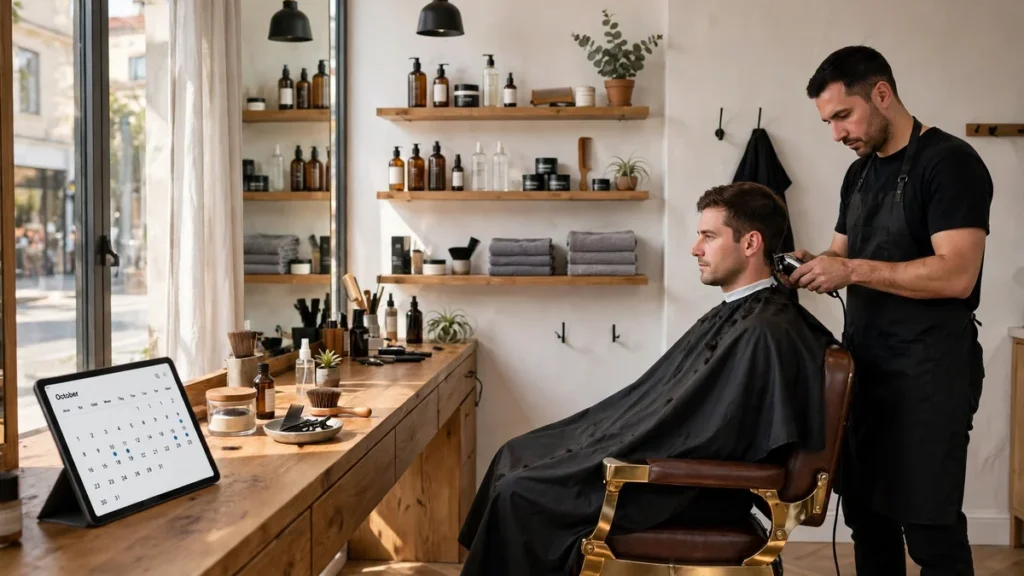
The best AI tools for barbers in 2026 do far more than take bookings. They fill empty chairs, cut no-shows, collect tips automatically, remind clients before they forget, and turn one-time walk-ins into regulars who book every two weeks without being asked. For a busy barbershop, the right software is the difference between a chair that sits empty on a Tuesday afternoon and a chair that earns money from open to close.
Barbers face a problem most service businesses would envy and still struggle with: demand is steady, but the diary is chaotic. Clients message on Instagram at midnight, call while you have clippers in your hand, forget appointments they made three weeks ago, and drift to another shop when they cannot book in thirty seconds. AI tools solve the boring parts of that problem. They answer messages instantly, offer the next free slot, send reminders, take deposits, and learn which clients prefer which barber, which service, and which time of day.
This guide compares the strongest options for barbershops of every size, from a single chair in a rented booth to a multi-chair shop with a waiting list. We looked at booking quality, AI features that actually save time, payments and tipping, review and loyalty tools, pricing per chair, and how easy each tool is to run while you are cutting hair. Every tool below was judged on what it does for a barber, not for a generic salon or a spa.
Key takeaways
- Booking automation is the single most valuable AI feature for barbers, because an empty chair earns nothing and a missed call is a lost client.
- Booksy and Squire lead for barbershops specifically, while Fresha and GlossGenius are strong choices for shops that want low upfront cost.
- Automated reminders, deposits and waitlists together cut no-shows far more than any single feature on its own.
- AI review requests and loyalty rewards bring clients back on a regular cycle, which matters more than one-off discounts.
- Choose one tool, set it up properly, and train every barber on it before adding more software to the shop.
Best AI Tools for Barbers at a Glance
Use this table to narrow the field fast, then read the full reviews below for the detail that matters to your shop. Prices change, so treat the figures as a starting guide and confirm the current plan before you commit.
| Tool | Best for | Standout AI feature | Starting price |
|---|---|---|---|
| Booksy | Barbershops of any size | Smart booking and client messaging | Around $30 per month |
| Squire | Multi-chair barbershops | Chair and commission management | Custom pricing per shop |
| Fresha | Shops watching costs | Automated reminders and marketplace bookings | Free plan, commission on bookings |
| GlossGenius | Booth renters and solo barbers | AI marketing and review requests | Around $24 per month |
| Square Appointments | Shops already using Square | Payments, tips and no-show protection | Free plan available |
| Vagaro | Busy shops with a waitlist | Waitlist filling and daily deals | Around $30 per month |
| Boulevard | Premium and upscale shops | Personalised client experience | Custom pricing |
| TheCut | Barbers who want a simple app | Quick booking and client discovery | Free plan available |
How We Compared These Tools
Barbers need different things from a hair salon or a spa, so we did not judge these tools on features a barber will never use. A barber’s day is built on short appointments, repeat clients, chair turnover, and walk-ins. The best tool handles that rhythm without forcing the shop to change how it works.
We scored each tool on six things: booking quality, AI help, payments, retention, price per chair, and ease of use while working. A tool that costs more than a slow chair earns is a bad deal, and nobody wants to fight software with hair on their hands.
The Best AI Tools for Barbers in 2026
Booksy
Booksy is the most widely used booking platform among barbers, and it shows. Clients already know the app, which means they book faster and cancel less, and barbers get a system built around chairs, services, and repeat visits rather than a generic appointment diary. The booking page is clean, the calendar is easy to read at a glance, and the mobile app works well enough to run the whole shop from a phone behind the counter.
The AI side of Booksy focuses on the jobs that eat a barber’s time. Automated messages confirm bookings, remind clients the day before, and follow up after the cut with a review request. Boost features help fill quiet hours by promoting open slots to nearby clients, and the system learns which services each client books so rebooking takes one tap. The messaging inbox keeps Instagram, text, and in-app messages in one place, so a client who asks about a fade at midnight gets an answer without the barber waking up to reply.
Booksy also handles money neatly: deposits at booking cut no-shows, tips can be added at checkout, and the reporting shows which barber is busiest and which hours sit empty. Paid plans start around $30 per month. For most barbershops, Booksy is the safe first choice.
Squire
Squire is built for barbershops rather than adapted for them, and that focus shows in the details. It understands chairs, booth rental, commission splits, and the way a multi-chair shop actually runs, which makes it the strongest option for a shop with three or more barbers. The booking flow lets clients choose their barber, their service, and their time, and it keeps walk-ins and bookings on the same screen so the front desk never double-books a chair.
The platform includes tools that owners care about and barbers notice. Commission and payroll tracking is built in, so the end-of-week maths takes minutes instead of an evening with a spreadsheet. Client records show cut history, preferences, and notes, which means a new barber can pick up a regular client without an awkward conversation about how they like their fade. Squire also offers a branded booking page and a client app, so the shop keeps its own identity instead of looking like one more listing on someone else’s marketplace.
Pricing is custom and quoted per shop, which makes sense for a busy multi-chair shop that needs proper chair management, though smaller shops may find simpler tools better value. If you run a real barbershop with a team and a diary that never stops, Squire is worth a demo.
Fresha
Fresha is the best option for a barbershop that wants strong software without a monthly bill to worry about. The core booking system is free, and Fresha earns a commission on bookings made through its marketplace instead of charging a flat subscription. That model suits new shops, part-time barbers, and owners who would rather pay when a booking actually arrives than pay every month regardless.
Despite the free starting point, Fresha is a full system. Online booking, automated reminders, client records, and payments are all included, and the marketplace can bring new clients who search for a barber in their area. The reminders alone are worth the switch for many shops, because a text reminder the day before an appointment prevents the empty chair that costs more than a month of software. Fresha also supports deposits and no-show fees, which protect the diary without awkward conversations at the door.
The trade-off is control: marketplace bookings carry a commission, so shops that rely heavily on Fresha to find clients may pay more over time than a flat monthly plan. Even so, for a barber starting out or a shop keeping costs tight, Fresha is hard to beat.
GlossGenius
GlossGenius is a favourite among solo barbers and booth renters, and it is easy to see why. The booking pages look sharp, the setup takes an afternoon rather than a week, and the price starts around $24 per month, which is easy to justify when a single saved booking covers the bill. It is designed for independent professionals who run their own diary, set their own prices, and want software that looks as good as their work.
The AI features focus on marketing and client care. Automated review requests go out after each appointment, and the system helps turn happy clients into public reviews that bring in new bookings. Email and text campaigns can be set up in minutes, with smart suggestions for quiet periods, and the client records keep notes on every regular. Payments, tips, and deposits are handled cleanly, and the app gives a clear view of the day ahead without clutter.
GlossGenius is less suited to a large multi-chair shop that needs commission tracking, because that is not what it was built for. For a solo barber, a booth renter, or a small shop with one or two chairs, it is one of the best choices available.
Square Appointments
Square Appointments is the natural choice for a barbershop that already takes card payments with Square, because the booking diary and the payment terminal become one system. A client books online, pays a deposit, gets reminders, and then pays at the chair with the same account, which means no double entry, no mismatched records, and no separate subscriptions to manage. The free plan covers a single user, and paid plans start around $29 per month for teams.
The AI and automation features are practical rather than flashy. Reminders go out automatically, no-show protection can require a card on file, and the system suggests rebooking at checkout so the client leaves with their next appointment already set. Tips are easy to add on the payment screen, and clients tend to tip more when the prompt appears at the right moment instead of relying on a cash jar. The reporting is clear and honest, showing takings, tips, and no-shows without needing a finance degree to read it.
Square is not the most barber-specific tool here, and its booking pages are simpler than the specialist platforms. But if your shop already runs on Square, adding Appointments is the lowest-friction upgrade available.
Vagaro
Vagaro is a long-standing booking platform that suits busy barbershops with a waitlist and a steady flow of walk-ins. It handles online booking, a digital waitlist, and automated reminders in one place, and its daily deals feature can push a quiet Tuesday by offering a small discount to clients nearby. The waitlist tool is genuinely useful in a barbershop, because it turns a full diary into a queue of clients who will take a cancellation the moment one appears.
The platform covers the full daily routine. Clients book and pay deposits online, the calendar shows every chair at a glance, and staff schedules, holidays, and time off are managed in the same view. Client records hold service history and notes, and the marketing tools support text and email campaigns to fill gaps. Vagaro also runs its own marketplace, so new clients can discover the shop without the owner spending on ads.
Pricing starts around $30 per month, and the feature set is broad enough that most shops will not outgrow it quickly. The interface is busier than the newer tools, but for a barbershop that runs a waitlist every weekend, Vagaro is a strong and proven choice.
Boulevard
Boulevard is aimed at premium shops that sell an experience as much as a haircut, and its tools reflect that. The booking flow is smooth and polished, client profiles are detailed, and the system is designed to make every visit feel personal, from the reminder message to the checkout. It is a good fit for a barbershop that charges higher prices and wants software that matches the standard of the service.
The platform uses client data well. It tracks preferences, visit history, and spending, and it helps the shop send the right message at the right time, whether that is a rebooking nudge for a client who is overdue or a thank-you note after a first visit. The checkout experience is clean, tips are handled gracefully, and the reporting gives owners a clear picture of which services and which barbers drive revenue. The design quality is noticeably higher than most booking tools, which matters when the booking page is the first thing a new client sees.
Boulevard uses custom pricing and suits established shops rather than new ones, but a premium barbershop that wants software to match its prices and standards will find it worth the conversation.
TheCut
TheCut is a simple booking app made for barbers, and its simplicity is the point. Barbers set up their profile, list their services and prices, and clients book in a few taps. There is no heavy setup, no long training session, and no pile of features the shop will never touch. For a barber who wants to stop taking bookings by text message and start taking them through a proper app, TheCut is the fastest way to do it.
The app focuses on discovery and convenience. Clients can find barbers nearby, see real availability, and book without a phone call, which suits younger clients who would rather tap than talk. Barbers can manage their diary, take payments, and keep client notes in the app, and the free plan makes it easy to try without spending anything. The design is clean and the booking flow is quick, which is exactly what a client wants when they decide at lunchtime that they need a cut today.
TheCut is lighter than the full platforms here, without the deep reporting or commission tracking of Booksy or Squire, and a multi-chair shop will outgrow it. But for a solo barber or a new barber building a client list, it is an excellent starting point.
Booking and Scheduling: The Heart of a Full Chair
Every other feature is secondary to the booking diary. A barbershop lives or dies on whether clients can book easily, change easily, and actually turn up, and AI makes each of those steps smoother. The best systems let a client book at 11pm on a Sunday, pick their usual barber, and get a confirmation in seconds, with no phone call and no waiting for a reply. That matters because the client who cannot book in thirty seconds will often book with the shop that lets them.
Good AI tools for appointment scheduling go further than a simple calendar. They answer common questions automatically, such as opening hours, prices, and whether a walk-in slot is free, and they offer the nearest available time instead of leaving the client to hunt through a diary. They also handle the awkward parts: cancellations are filled from the waitlist, gaps are offered to clients who asked for an earlier slot, and reminders go out at the right time so the chair is never empty because someone forgot. If you compare options, look closely at the best AI tools for appointment scheduling and judge them on how little work they leave for the person behind the counter.
Control matters too: a barber should be able to block lunch, set different hours for different days, and limit how far ahead clients can book, all from a phone. Test this before you commit.
Payments, Tips and No-Show Protection
No-shows are the quiet tax on every barbershop. One empty chair an hour costs more over a month than most booking software, so the payment features of an AI tool are not a nice extra but a core part of the decision. Deposits are the single strongest defence: a client who has paid even a small deposit almost always turns up, and if they do not, the shop is not left with nothing.
Tips deserve attention too, because they are a meaningful part of a barber’s income. The best tools prompt for a tip on the payment screen at the right moment, and the split between shop and barber should be recorded automatically rather than worked out at the end of the week.
Look for no-show protection that fits your shop’s style. Some shops charge a fee for late cancellations, others simply require a card on file, and some block repeat no-shows from booking online. The right choice depends on your clients, but the tool should support whichever policy you choose without making regular clients feel punished. A fair, clear cancellation policy, enforced automatically, protects the diary and keeps the relationship with good clients intact.
Reviews, Loyalty and Repeat Clients
A haircut is a repeat purchase, and the shops that win are the ones that turn a first visit into a second, a third, and a twentieth. AI tools help here by doing the follow-up that a busy barber never has time for. A short message after the appointment asking for a review, sent while the client is still happy with their cut, is worth more than any advert, because new clients trust recent reviews more than anything else a shop can say about itself.
Loyalty is the other half of retention. A simple scheme, such as every tenth cut free or a small discount on a birthday, gives clients a reason to return to your chair instead of trying the shop down the road. The best AI tools for loyalty management run this automatically, tracking visits and sending rewards without the barber keeping a paper card or a spreadsheet. They also spot clients who have not booked in six weeks and send a gentle nudge, which is the cheapest marketing a barbershop can do, because winning back a past client costs far less than finding a new one.
Keep it honest and simple: ask for reviews after good visits, reward loyalty without gimmicks, and never pay for fake reviews. A steady stream of genuine reviews fills chairs more reliably than any discount campaign.
Marketing That Fills Empty Chairs
Most barbershops do not need a marketing department. They need a few quiet hours filled and a few new clients each month, and AI tools can do that without a big budget. The simplest approach is to promote open slots: when a cancellation leaves a gap on Thursday afternoon, the system can message clients who wanted that time or offer the slot to nearby clients at a small discount. That single feature can pay for the software on its own.
Social media still matters, because clients choose a barber by looking at their work. Tools that help schedule posts, share before-and-after photos, and collect reviews in one place save time, but the content still has to be real. Post the cuts you actually did, tag the products you actually used, and let the work speak. AI can suggest captions and the best time to post, but it cannot replace a good fade, and clients can tell the difference.
Keep marketing measured: one message a week is plenty, and every message should offer something useful, such as an open slot or a reminder that a regular client is due a cut. The goal is to message at the right moment with the right offer, not to message the most.
Chair Management and Staff Scheduling
As soon as a shop has more than one barber, chair management becomes a real job. Who is working which hours, who is on holiday, who takes walk-ins, and how commission is split all need answers, and a spreadsheet is a poor way to manage them. The stronger tools on this list handle staff scheduling inside the same system as bookings, so a barber who is off sick simply disappears from the bookable hours and their clients are offered the next available chair.
Commission and booth rental need the same care: a tool that tracks who cut whose hair, at what price, and with what tip removes the weekly argument about money. If you rent chairs, look for a tool that separates each barber’s takings cleanly.
Walk-ins deserve a plan too. A good system keeps a live queue so the front of the shop knows who is next, how long the wait is, and which chair will free up first. Clients who can see an honest wait time are far more patient than clients who are guessing, and a barber who can see the queue can pace their cuts instead of rushing the last ten minutes of every appointment.
Pricing: What a Barber Should Expect to Pay
Most barbershop software costs between free and around $30 per month for a solo barber, and between $100 and several hundred per month for a busy multi-chair shop. The maths is simple: if the software saves one no-show a week or fills one empty chair a week, it has paid for itself many times over.
Watch for costs that do not appear in the headline price: marketplace commissions, payment processing fees, text charges, and extra fees for additional barbers can add up. Work out the monthly cost for your actual chairs and bookings, and compare that figure across tools.
Start with a free plan or a trial where one exists, and give it a real two-week test with real clients. A tool that looks good in a demo can still be awkward at 9am on a Saturday, and the only way to know is to run a busy day on it.
How to Choose the Right Tool for Your Shop
Start with the size of your shop. A solo barber or booth renter should choose a simple tool such as GlossGenius, TheCut, or Fresha. A shop with three or more chairs should look at Booksy or Squire, and a shop already running on Square should try Square Appointments first.
Next, list the three problems that cost you the most money today. If no-shows are the issue, deposits and reminders matter most. If empty chairs are the issue, waitlists and gap-filling matter most. If new clients are the issue, reviews and marketplace discovery matter most. Buy the tool that solves your actual problem, not the one with the longest feature list, and check the best scheduling apps for small business to see how each option handles the daily diary before you commit.
Finally, test the client experience yourself. Book an appointment as a client, cancel it, rebook it, and pay a deposit, all from your phone. If any step is confusing, your clients will find it confusing too, and they will not call to tell you. They will simply book somewhere else. The tool that passes that test, solves your biggest problem, and fits your budget is the right tool, whatever the ranking in this guide says.
Setup Checklist
Use this checklist when you set up whichever tool you choose, and do not skip a step because the shop is busy. An hour of setup now saves an hour of fixing later.
- Add every barber, every service, and every price exactly as clients see them on the wall, so the online book matches the real shop.
- Set your hours, lunch breaks, holidays, and how far ahead clients can book, then test a booking from a client phone.
- Turn on deposits or card-on-file for new clients, and write the cancellation policy in plain words on the booking page.
- Switch on automated reminders and review requests, and check the message wording reads like your shop, not a robot.
- Move your regular clients into the system with their cut notes and preferences, so no barber starts from zero.
- Train every barber on the calendar, the waitlist, and the payment screen before the first live day, and keep the old diary as a backup for week one.
Frequently Asked Questions
What is the best AI tool for barbers in 2026?
Booksy is the best all-round choice for most barbershops, combining easy booking, strong reminders, deposits, and tools to fill quiet hours. Squire suits larger multi-chair shops, while GlossGenius and Fresha suit solo barbers and shops watching costs.
Do AI tools really reduce no-shows in a barbershop?
Yes, and the effect is large. Automated reminders alone cut no-shows noticeably, and adding a deposit or a card on file reduces them further. The strongest results come from combining reminders, deposits, and a waitlist.
How much should a barber pay for booking software?
A solo barber can start free or pay around $24 to $30 per month for a solid tool. A multi-chair shop should expect to pay more, often $100 or more per month, but that is small next to the value of a single saved booking each week.
Can AI tools help a barbershop get more reviews?
Yes. The best tools send a short review request automatically after each appointment, while the client is still happy with their haircut. A client asked on the day is far more likely to leave a review than one asked a week later.
Is it hard to switch booking systems?
Switching takes an afternoon of setup and a week of getting used to the new routine: add services and prices, set hours, move regular clients across with their notes, and tell clients where to book next. Keep the old diary as a backup for the first week.
Do barbers need a marketplace or just their own booking page?
Both help, for different reasons. Your own booking page keeps regular clients booking directly and costs less per booking, while a marketplace can bring new clients searching for a barber nearby.
Bottom Line
The best AI tools for barbers in 2026 are the ones that keep chairs full, clients reminded, and payments simple, without adding admin to a working barber’s day. Booksy is the strongest all-round pick for most shops, Squire leads for multi-chair teams, and Fresha or GlossGenius are the smart choices for solo barbers and tight budgets. Pick the tool that solves your biggest problem, set it up properly with deposits, reminders, and review requests switched on, and give it a real two-week test on busy days. The software will not cut hair for you, but the right one will make sure there is always someone in the chair waiting for a cut.

Keep what speaks to you.
Leave room for your own perspective.