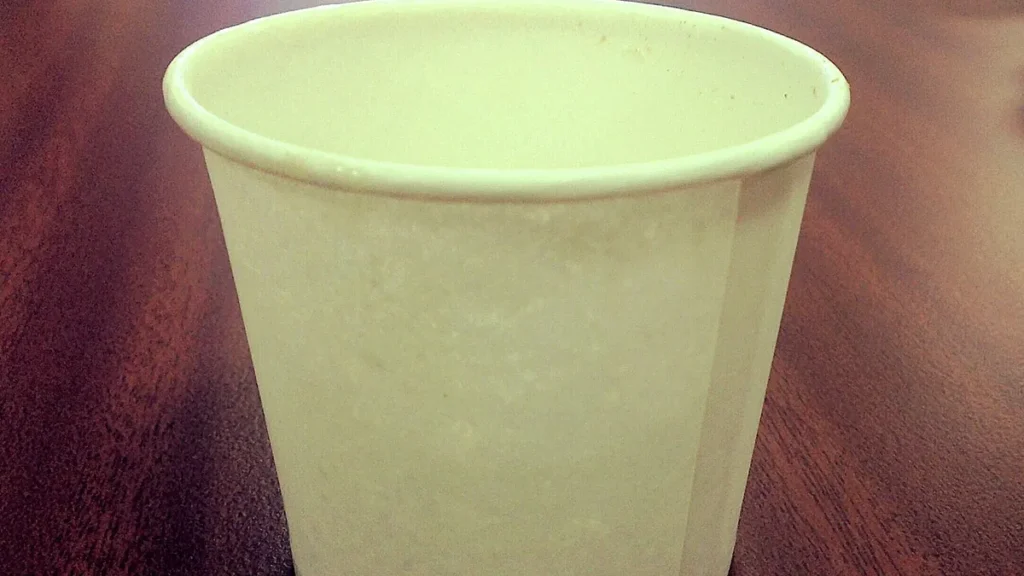
I did not stop buying takeaway coffee because I stopped liking coffee. I stopped because of the cup — the cardboard sleeve, the plastic lid, the little splash stick. It had quietly become one of the most expensive things in my week, and I had never once thought of it as spending at all.
For years, my mornings ran on a small, unexamined routine. I left the house, joined the queue at the café on the corner, and walked out holding a warm paper cup. It felt like nothing — less than a sandwich, less than a bus fare. The cup was so cheap it never registered as a decision, so I never questioned it. I just kept buying it, four times a week, the way you keep breathing.
Then one grey Tuesday I added it up on paper, with the actual prices from my bank statement. The cup was not a small treat. It was a subscription I had never signed up for, and I had been paying it for years.
The cup costs more than the coffee
My usual takeaway cup, a flat white in the middle size, costs $4.75 at the café near my house. I was buying it four times a week — Monday, Tuesday, Thursday, and Friday — skipping Wednesday, my work-from-home day. Four cups at $4.75 is $19 a week, $76 a month, and $912 a year.
Nine hundred and twelve dollars — for paper cups thrown away before nine in the morning.
The comparison is what made it sting. My home-brewed coffee costs about 36 cents a cup: roughly 22 cents of beans and 14 cents of milk. Four cups a week at home costs $1.44, a month $5.76, a year about $69. The difference is $4.39 a cup, $17.56 a week, and $843 a year.
| What I pay for | Takeaway cup | Home brew |
|---|---|---|
| One cup | $4.75 | $0.36 |
| Four cups a week | $19.00 | $1.44 |
| One month | $76.00 | $5.76 |
| One year | $912.00 | $69.12 |
I only spotted the leak once I started tracking my spending properly, instead of guessing at it. Guessing always flatters you; the statement does not. The cup had been hiding among the small charges, too ordinary to notice and too regular to question.
What I was actually buying
The honest truth is that I was never really paying for coffee. I was paying for the cup in my hand. Walking down a cold street holding a warm paper cup feels like a small upgrade to an ordinary morning: the sleeve keeps your fingers warm, the lid keeps the heat in. It is a prop, and a very good one.
I was also paying for the queue. Standing in line for four minutes, phone in my pocket, nobody asking me for anything, was the calmest part of my day. That feeling is real. But it is not worth $843 a year, because the feeling was never in the cup. It was in the pause, and the pause is free.
Once I understood that, the swap became obvious. I did not need to give up the walk, the warm cup, or the quiet minutes — only the price tag. That is the same lesson behind why I stopped buying things I don’t need: we want the feeling, and we keep buying the object wrapped around it.
The swap: one travel mug and a kettle
My replacement is almost embarrassingly simple. I bought one good travel mug — the kind with a lid that actually seals — for $18, and I brew my coffee at home and pour it straight in. The mug goes in the same hand the paper cup used to go in, and I take the same walk down the same street. I still get the warm cup and the quiet minutes. The only thing that changed is what it cost.
The $18 mug paid for itself in less than four takeaway cups, and it keeps the coffee hot for hours, so the last sip is as warm as the first. I stopped drinking through a little hole in a plastic lid and started drinking it properly again, even on the move.
The routine took three days to settle. On the first morning, I forgot the mug and nearly bought a takeaway cup out of habit. By the third morning, the mug was by the kettle, the kettle was on, and the whole thing took four minutes. The habit I thought was about coffee turned out to be about the walk.
Where the $843 goes now
Saving money only matters if the money goes somewhere better, so I gave the $843 a job before I stopped buying the cups. Every Friday, I move $17.56 — the week’s saving — into my emergency fund. After a month, it is $70.24. After a year, it is $843: the same money, doing something useful instead of dissolving into steam before nine in the morning.
That weekly rhythm matters more than the yearly total. A yearly saving sounds like a promise you will keep later; a weekly transfer is a habit you keep now. Saving money on a weekly basis is what made this stick, because the win arrives often enough to feel real.
The three times I still pay for the cup
I have not banned takeaway coffee from my life. I have rules for it, and the rules make the whole thing work. There are three times I still happily pay $4.75 for a paper cup.
The first is at a train station before a long journey — a warm cup in my hand is worth every cent. The second is when I am meeting a friend: sitting across a table from someone you like, each of you holding a cup, is one of life’s small pleasures. The third is the day the kettle breaks, or the power goes out. Some mornings are hard enough without a rule making them harder.
Those exceptions add up to maybe two cups a month, about $9.50. Against $76 a month, that is a rounding error, and it keeps the arrangement honest. A rule with no exceptions is a rule you will break.
Frequently asked questions
Does the saving include the travel mug?
Yes. The mug cost $18, less than four takeaway cups. It paid for itself in the first week and has lasted more than a year. Even if I replace it every year, the saving is still over $820.
What if my takeaway cup only costs $3?
Then your maths is kinder than mine, but it still adds up. Four $3 cups a week is $624 a year, against about $69 at home — still more than $550 a year for a cup you throw away.
Do you still drink as much coffee?
More, if anything. Home coffee is so cheap I never ration it, and because the mug keeps it hot for hours, I finish every cup instead of letting the last third go cold in a paper cup.
Is this not just the latte factor again?
It is, and that is the point. The latte factor gets mocked because it sounds small, but small is why it works. A $4.75 cup is easy to quit because no single cup matters, and the saving is large because every cup adds up.
I still love coffee — the walk, the warm cup, the quiet minutes. I just stopped paying $4.75 for a paper cup to get them. The travel mug gives me all of it for 36 cents, and the $843 a year goes into a fund that will be there when I need it. The cup was never the point. The point was noticing what I was really buying, and deciding to buy it cheaper.

Keep what speaks to you.
Leave room for your own perspective.


