
Cryptocurrency is digital money that exists only online. It is not printed by a government, it is not stored in a bank vault, and it does not travel through the payment systems most of us use every day. Instead, it lives on a shared digital record called a blockchain, it is secured by cryptography, and it can be sent from one person to another anywhere in the world without a bank standing in the middle. This guide explains what it is, how it works, the main types of coins, how wallets keep them safe, and the risks.
Key Takeaways
- Cryptocurrency is a digital asset secured by cryptography and recorded on a blockchain, a shared ledger kept by thousands of computers.
- No central bank or company is in charge of most cryptocurrencies. The network itself checks transactions and keeps the record honest.
- A crypto wallet does not hold your coins. It holds the private keys that prove you own them and let you send them.
- Crypto prices can move sharply in days or even hours, and losing a private key or seed phrase usually means losing the coins for good.
What Is Cryptocurrency?
Cryptocurrency is a form of digital money that uses cryptography, the science of secret codes, to secure transactions and control the creation of new units. Unlike the dollars in your bank account, which are entries in a bank’s private database, cryptocurrency is recorded on a public ledger that no single party controls.
The first cryptocurrency was Bitcoin, introduced in 2009 by a person or group using the name Satoshi Nakamoto. It was designed as electronic cash that could move directly between people over the internet, without banks or payment companies taking a cut. Thousands of others have followed since, but Bitcoin remains the largest and best known.
You do not need to buy a whole coin. One bitcoin can be divided into 100 million smaller units called satoshis, so a purchase of twenty or fifty dollars buys a real slice of a bitcoin.
How Cryptocurrency Works
The Blockchain
A blockchain is a shared digital ledger. Every transaction is grouped with others into a block, and once a block is checked and confirmed, it is linked permanently to the block before it, forming a chain that stretches back to the very first block. Thousands of computers around the world, called nodes, each hold a full copy of this ledger and update it together. Because so many independent copies exist, no one can quietly rewrite the record.
Cryptography and Keys
Every cryptocurrency owner has two linked pieces of information: a public key and a private key. The public key produces a public address that works like an account number. Anyone can send crypto to that address. The private key works like a password, except that it cannot be reset. It proves you own the coins at your address and signs transactions to send them.
When you send cryptocurrency, your wallet uses your private key to create a digital signature on the transaction. The network checks the signature, confirms that the coins have not already been spent, and records the transfer in a new block. The coins themselves never leave the blockchain. What moves is the record of who controls them.
Consensus: How the Network Agrees
With no bank in charge, the network needs a way to agree on which transactions are valid. That is the job of a consensus mechanism. Bitcoin uses proof of work, in which specialised computers called miners compete to solve difficult puzzles. The first to solve one earns the right to add the next block and receives newly created bitcoin as a reward.
Ethereum, the second-largest cryptocurrency, uses proof of stake instead: validators lock up their own ether as a deposit, and a validator that tries to cheat can lose its stake. Bitcoin’s total supply is capped at 21 million coins by its code, and the mining reward halves roughly every four years.
The Main Types of Cryptocurrency
Coins
Coins are the native currency of their own blockchain. Bitcoin runs on the Bitcoin network and ether runs on Ethereum. These coins usually pay for transactions on their network, and they are the assets most people mean when they say they own crypto.
Tokens
Tokens are built on top of an existing blockchain rather than having their own. Thousands of tokens run on Ethereum, using its network and security. Some represent a share in a project, some give access to a service, and some are simply speculative. Tokens are easier to create than coins, which is why so many of them fail.
Stablecoins
Stablecoins are designed to hold a steady value, usually one dollar per coin. They are backed by reserves such as cash and short-term government bonds held by the issuer. The best-known examples are Tether and USD Coin. People use stablecoins to move money between exchanges, to hold value without selling back to dollars, and increasingly to make payments. In the United States, the GENIUS Act, signed into law in July 2025, created the first federal framework for payment stablecoins. The law takes effect in January 2027.
Bitcoin and Ethereum: The Two That Matter Most
Bitcoin and Ethereum dominate the market, and they do different jobs. Bitcoin was built to be money: a scarce, borderless store of value and a way to send value without permission. It has done that one job without interruption since 2009.
Ethereum was built to be programmable. Its blockchain runs smart contracts, programs that execute automatically when their conditions are met. That is what makes decentralised finance, digital collectibles, and tokenised assets possible. Together, the two account for the majority of the crypto market’s value, and most beginners who buy crypto start with one or both.
What Is a Crypto Wallet?
A crypto wallet is not a place where coins are stored. Your cryptocurrency always lives on the blockchain. What the wallet stores are your private keys, the credentials that prove ownership and let you send funds. Lose the keys, and you lose access to the coins, even though the coins still exist on the ledger.
Custodial wallets are managed by a platform, usually an exchange, which holds the keys for you. This is convenient, because you can log in like any other account, but it means you are trusting the platform with your money. If the platform is hacked, freezes withdrawals, or fails, your funds are at risk.
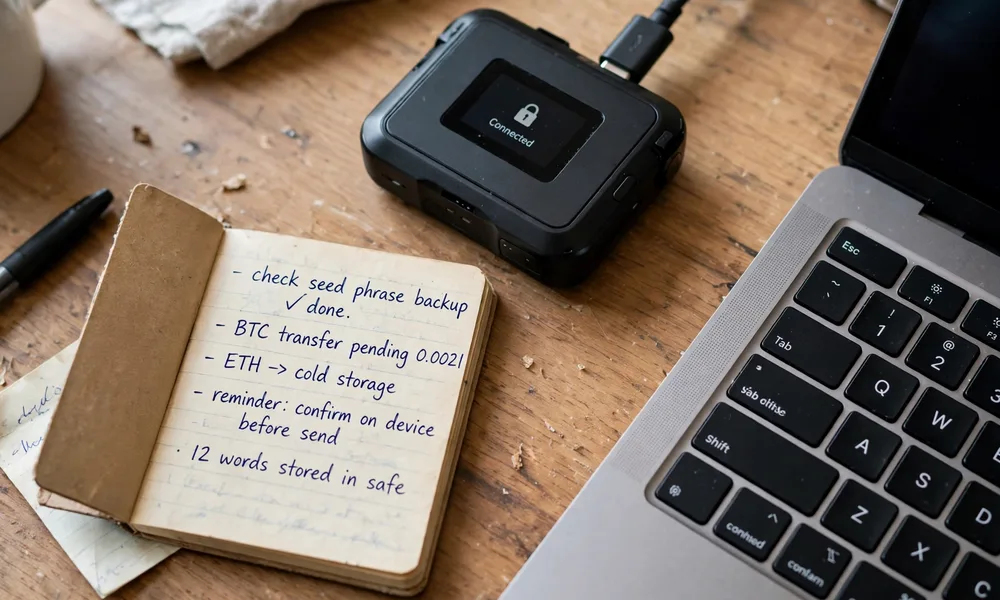
Non-custodial wallets give you full control of the keys. They can be software on your phone or computer, known as hot wallets, or dedicated hardware devices, known as cold wallets because they keep keys offline. Hardware wallets are the safest option for larger amounts, but they come with a serious responsibility: when you set one up, it gives you a recovery phrase, usually 12 or 24 words. Anyone who has those words can take your coins, and if you lose them, no company can help you recover them. Write them on paper and store them somewhere safe.
How People Use Cryptocurrency in 2026
Most people who own cryptocurrency hold it as an investment, hoping its value rises over time. Some use it to send money across borders, where it can be faster and cheaper than a traditional wire transfer. Some use stablecoins for everyday payments in countries where the local currency is unstable.
A growing number of people gain exposure through their ordinary brokerage account, because spot Bitcoin exchange-traded funds have traded on United States stock exchanges since January 2024, with spot Ether funds following in July 2024. These funds hold actual bitcoin and ether, so investors can buy shares without managing a wallet.
How Crypto Fits in a Portfolio
Cryptocurrency is a high-risk, high-volatility asset, and that is its defining feature. Bitcoin’s price traded around $81,000 in late October 2026, after having been above $100,000 earlier in the year, a swing of roughly a fifth in a matter of months. Moves like that are normal in crypto and would be extraordinary in a stock index.
That is why most financial guides treat crypto as a small satellite holding rather than the core of a portfolio. The core is usually built from diversified, lower-cost investments, and the best index funds for beginners in 2026 are where most people start. Crypto, if it belongs at all, sits on top of that foundation in an amount the owner can afford to lose. The best ETFs for long-term growth in 2026 show the same idea in a different form: broad exposure first, concentrated bets second. And for money that must be there in retirement, the best retirement accounts for beginners in 2026 are a better home than a volatile asset.
The Risks Every Beginner Should Know
Price volatility is the most obvious risk: double-digit moves in a single day happen regularly, and there is no circuit breaker to stop them. A coin can lose half its value in weeks and take years to recover, or never recover at all.
Security risk is just as important. Exchanges have been hacked, and users have lost funds to phishing emails, fake apps, and scams promising guaranteed returns. No legitimate project will ever ask for your private key or your seed phrase. And because crypto transactions cannot be reversed, a mistake, a wrong address, or a scam is usually permanent.
Regulation is a third risk. Rules differ by country and are still changing, and some countries have banned crypto trading outright. Finally, there is the risk of the project itself. Thousands of cryptocurrencies have been launched, and most have faded to nothing. A coin with no users, no developers, and no real purpose can fall to zero and stay there.
How Cryptocurrency Is Taxed
In the United States, the Internal Revenue Service treats cryptocurrency as property, not as currency. Selling crypto for more than you paid for it creates a capital gain, and swapping one crypto for another or spending crypto on goods also counts as a taxable event. Gains on crypto held for a year or less are taxed at ordinary income rates, while gains on crypto held for more than a year qualify for the lower long-term rates of 0, 15, or 20 percent.
Earning crypto, whether from mining, staking rewards, or being paid in crypto for work, is generally taxed as ordinary income at its fair market value when received. Brokers are now required to report crypto transactions. The details are worth checking with a tax professional, because the rules around cost basis and reporting have been changing.
Cryptocurrency in 2026: Where Things Stand
By late 2026, cryptocurrency is no longer a fringe experiment. Spot Bitcoin funds trade in ordinary brokerage accounts, the first federal stablecoin law is on the books in the United States, and large companies hold bitcoin on their balance sheets. At the same time, the market remains volatile, scams remain common, and the broader law that would settle how most crypto is regulated in the United States has not yet passed Congress.
Frequently Asked Questions
Is cryptocurrency real money?
It is a real digital asset, but in most countries it is not legal tender, which means nobody is obliged to accept it as payment. You can own it, trade it, and spend it where it is accepted.
Do I need to buy a whole bitcoin?
No. One bitcoin divides into 100 million satoshis, so you can buy a fraction worth twenty dollars, fifty dollars, or any amount a platform allows.
What happens if I lose my private key?
In most cases, the coins are lost permanently. There is no password reset for a self-custody wallet. That is why the recovery phrase must be stored offline and kept private.
Is cryptocurrency safe?
The underlying technology has proved resilient: the Bitcoin network has run without interruption since 2009. The danger is usually not the blockchain itself, but the platforms, wallets, and people around it. Exchanges can fail and scams are common, so safety depends far more on your own habits than on the technology.
The Bottom Line
Cryptocurrency is digital money secured by cryptography and recorded on a shared ledger called a blockchain. It lets people send value across the world without a bank in the middle, and it has grown from a 2009 experiment into a major asset class. It is also volatile, irreversible, and full of scams, which is why the boring parts, wallets, keys, taxes, and position size, matter more than the exciting parts.
Understand the technology first, start small, keep your keys safe, and treat crypto as one piece of a wider financial plan rather than the whole plan.

Keep what speaks to you.
Leave room for your own perspective.


