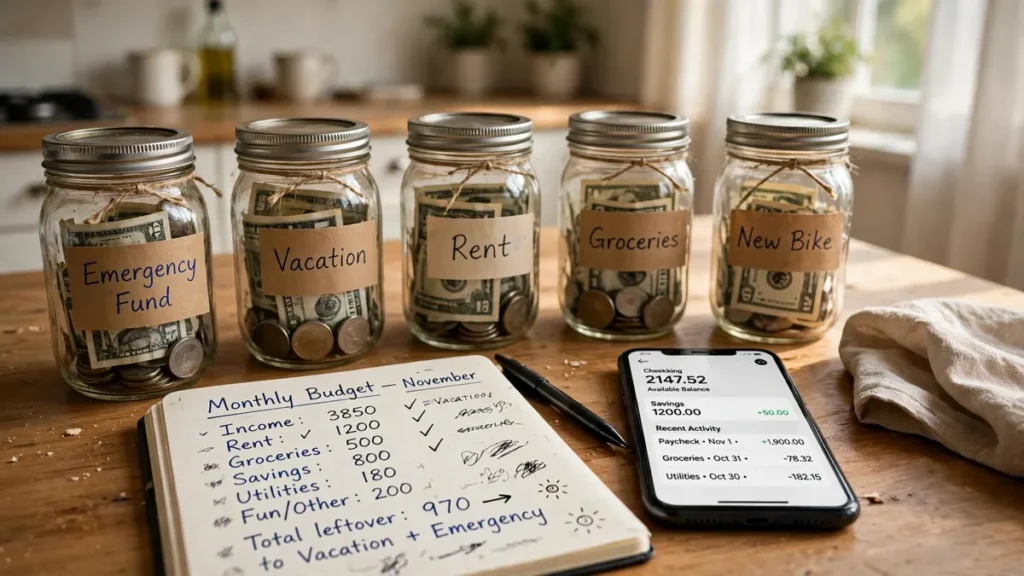
Every year, the same bills arrive like clockwork. The car insurance premium lands in the same month as the property tax, and the holidays arrive in December, right after the car needs new tyres. None of these expenses is a surprise, yet they feel like one every single time, because the money was never set aside in advance. A sinking fund is the simple system that fixes this. It turns big, irregular costs into small, regular savings, so the bill arrives and the money is already there.
A sinking fund is money you save gradually for a planned expense you know is coming. You take the total cost, divide it by the number of months you have, and put that smaller amount aside every month. When the expense arrives, you pay it from the fund instead of from that month’s pay cheque or a credit card. This guide explains what a sinking fund is, how one works, how it differs from an emergency fund, the categories worth funding, and how to set up your first one in 2026.
Key Takeaways
- A sinking fund is a dedicated pot of money saved gradually for a specific planned expense, such as car insurance, holidays, or a new roof.
- Sinking funds cover costs you can predict; emergency funds cover costs you cannot. You need both, and they should never be mixed.
- The formula is simple: divide the total cost by the number of months until you need it, and save that amount every month.
- Keep each sinking fund in a separate savings account, automate the transfer on payday, and only spend it on the expense it was built for.
What Is a Sinking Fund?
A sinking fund is a strategy where you put money away, a little at a time, for a future expense you already know about. The name comes from the corporate world, where companies have long set aside money gradually to pay off a bond or a loan when it comes due. Instead of facing one enormous payment at maturity, the company saves in small instalments, and the debt slowly sinks away. Personal finance borrowed the same idea and applied it to household costs.
Here is the idea in one sentence: if you know you will spend a certain amount on a certain date, start saving for it now, in monthly pieces, so the full amount is ready when the date arrives. If your car insurance costs $1,200 a year, a sinking fund turns it into $100 a month. If you plan to spend $1,800 on the holidays, saving $150 a month for twelve months covers it in full.
The power of the method is psychological as much as financial. A $1,200 bill feels like a crisis. A $100 monthly transfer barely registers. Sinking funds remove the feast-and-famine cycle that derails so many budgets: the months where everything is fine, followed by the month where three big bills land at once and the credit card takes the hit. With a sinking fund, every irregular expense becomes an ordinary monthly line item. Note what a sinking fund is not: it is not an investment account, and it is not a general savings pot. Each fund has one job, one target, and one date. That specificity is the whole point.
Sinking Fund vs Emergency Fund
The most common confusion about sinking funds is how they differ from an emergency fund. The distinction is simple, and it matters: a sinking fund covers expenses you can predict, while an emergency fund covers expenses you cannot.
Your emergency fund is for genuine surprises: a job loss, a medical crisis, a burst pipe in the middle of winter. Experts commonly recommend keeping three to six months of expenses in an emergency fund, and the Federal Reserve’s 2024 survey found that only 55 percent of adults had set aside money to cover three months of expenses. The emergency fund is your safety net, and it should only be touched when something truly unexpected happens.
A sinking fund, by contrast, is for the expenses you can see coming from a long way off: car maintenance, holiday gifts, annual insurance premiums, back-to-school costs, a new washing machine, a family wedding. These are not emergencies. They are predictable, and planning for them is what keeps your emergency fund intact for the real thing.
Mixing the two is the mistake that causes the most damage. If you pay for new tyres from your emergency fund, the money is gone when a genuine emergency arrives, and you have to start rebuilding from zero. Keeping the two funds separate is a small act of discipline with a large payoff.

How a Sinking Fund Works
A sinking fund works in four steps. First, you name the expense. Second, you work out what it will cost. Third, you divide that cost by the number of months until you need the money. Fourth, you move that amount into the fund every month, automatically, until the date arrives.
Take a real example. Your car insurance renews every year at $1,200. Twelve months before the renewal, you open a sinking fund and set up an automatic transfer of $100 on payday. By renewal day, the fund holds $1,200 plus a little interest, and you pay the premium in full. The alternative is finding $1,200 in the month the bill arrives, which usually means cutting spending sharply, draining savings, or putting it on a card and paying interest for months afterwards.
The same maths works for any expense. A $900 holiday fund needs $75 a month over twelve months, or $150 a month over six. A $2,400 home repair fund needs $200 a month over a year. The formula never changes: total cost divided by months remaining equals the monthly contribution.
Where you keep the money matters too. A separate savings account is the standard choice, and a high-yield savings account is better still, because the money earns interest while it waits. Many banks now let you open several sub-accounts or savings buckets inside one account. The key rule is separation: the fund money should not sit in your everyday spending account, where it will quietly be spent on something else.
Common Sinking Fund Categories
The most useful sinking funds cover the irregular expenses that blow up budgets most often. Car costs are usually the biggest. Bankrate’s 2024 study of the hidden cost of car ownership found that hidden vehicle costs, including maintenance, insurance, and repairs, averaged $6,684 per year. A set of sinking funds turns that $6,684 into roughly $557 a month in planned, automated transfers, which is far easier to live with than a surprise $900 repair bill.
Home costs come next. A home needs a new roof, a new boiler, or a new appliance every few years, and each one costs thousands. Saving a small amount every month for home maintenance means the next repair is an inconvenience rather than a crisis.
Seasonal spending is the third big category. The holidays, birthdays, back-to-school supplies, and summer trips all arrive on the same dates every year, and they all cost more than people remember. A holiday fund started in January means December arrives with the money already saved. The same logic applies to gifts: list every birthday and holiday you celebrate, estimate what you will spend on each, add it up, and divide by twelve.
Insurance premiums are a fourth category, and often the easiest place to start. Car, home, and health premiums are usually billed annually or twice a year, and the amount is printed on the bill, so there is no guessing. Other popular categories include pet care and technology, with a new phone or laptop every few years. Some people run a dozen funds at once, each small. The number does not matter. What matters is that every predictable cost has a home.
How to Start a Sinking Fund in 2026
Starting a sinking fund takes an afternoon, and most of the work is a single honest look at your last twelve months of spending. List every expense that does not arrive monthly but does arrive regularly. Go through your bank statements for the past year and highlight every payment that surprised you. Almost all of them will turn out to be predictable costs you simply had not planned for.
Next, estimate the cost of each one. Use last year’s bill as your starting point, and add a little for price increases. If your car insurance was $1,100 last year, budget $1,200 this year. Underestimating is the most common beginner mistake, and a small buffer is cheaper than a shortfall.
Then work out the monthly contribution for each fund. Divide each total by the number of months until you need it. Add the contributions together, and check the total against your budget. If the total is more than you can afford, extend the timeline for the expenses that can wait, or reduce the target for the ones that can shrink. A holiday fund can be smaller. An insurance premium cannot.
Now set up the accounts. Open a separate savings account, or create sub-accounts if your bank supports them, and name each one after its purpose: car insurance, holidays, home repairs. A fund called “holidays” is much harder to raid for a takeaway than a fund called “savings”. Set up automatic transfers on payday, track the funds with a simple spreadsheet or budgeting app, and restart each fund the month after you spend it, so it is ready for next year.
Why Sinking Funds Work So Well
Sinking funds work because they match the way real life actually happens. Most budgets fail on the irregular expenses, not the regular ones. Rent, utilities, and groceries are predictable, and most people plan for them. It is the irregular costs, the ones that arrive three or four times a year, that break the budget, because the monthly plan never included them. They also reduce stress: knowing the insurance premium is covered and the car repair will not touch your emergency fund removes a whole layer of worry. The best money habits of millionaires in 2026 show the same pattern: wealthy people plan for predictable costs in advance. The best books on wealth in 2026 and the best books on investing in 2026 return to the same idea: financial success is rarely about one big decision, it is about small, repeated decisions made in advance.
Frequently Asked Questions
How many sinking funds should I have?
Start with three: the three predictable costs that surprise you most often, usually car, home, and holidays. Add more as the habit becomes automatic. The right number is the one you can track without effort.
How much money should go into a sinking fund?
As much as the expense requires, divided by the months you have. There is no percentage rule. Add up all your funds, and if the total monthly contribution is more than you can afford, extend a timeline or shrink a target rather than skipping the fund altogether.
Can a sinking fund replace my emergency fund?
No. A sinking fund covers costs you can predict, and an emergency fund covers costs you cannot. They serve different purposes, and one cannot do the other’s job. Build both, keep them separate, and never spend emergency money on a predictable cost.
Where should I keep my sinking fund money?
In a separate savings account, ideally a high-yield savings account, so the money earns interest while it waits and stays out of your spending account. If your bank offers sub-accounts or savings buckets, use one per fund.
What happens if I miss a month?
Nothing terrible. Divide the remaining amount by the remaining months and adjust the contribution. The fund is a plan, not a contract, and a missed month is only a problem if it becomes a habit.
The Bottom Line
A sinking fund is one of the simplest money systems that exists, and one of the most effective. Name the expense, work out the cost, divide it by the months you have, and save that amount automatically. The car insurance, the holidays, the home repairs, and the vet bills stop being surprises and start being plans. Start with three funds, automate the transfers on payday, and give the system a year. By this time next year, the bills that used to wreck your budget will arrive, get paid, and barely register.

Keep what speaks to you.
Leave room for your own perspective.