A debit card looks and feels like a credit card and works at the same checkouts, but it spends different money. A credit card borrows from the issuer and bills you later. A debit card pulls money straight out of your own checking account, usually within a day or two. That one difference drives everything else about the card: its fees, its fraud rules, and when it is the right card to use.
Almost every checking account comes with a debit card, and most people use one daily without thinking about how it works. This guide explains what a debit card is, how it moves your money, what it costs, how the law protects you, and how it compares with a credit card.
Key Takeaways
- A debit card spends your own money from checking, while a credit card spends the issuer’s money and bills you later.
- Debit cards charge no interest, because nothing is borrowed, but they can still cost you out-of-network ATM fees, overdraft fees, and foreign transaction fees.
- Under Regulation E, fraud liability is $0 if you report before any unauthorized use, up to $50 within 2 business days, up to $500 after that, and can be unlimited more than 60 days after the statement.
- Debit card use does not build your credit score, because debit activity is not reported to the credit bureaus.
- Credit cards carry stronger federal protection: Regulation Z caps fraud liability at $50 and gives you a merchant-dispute right debit cards do not have.
- Use debit for everyday spending and ATM cash, and credit for online shopping, travel, and large purchases.
What Is a Debit Card?
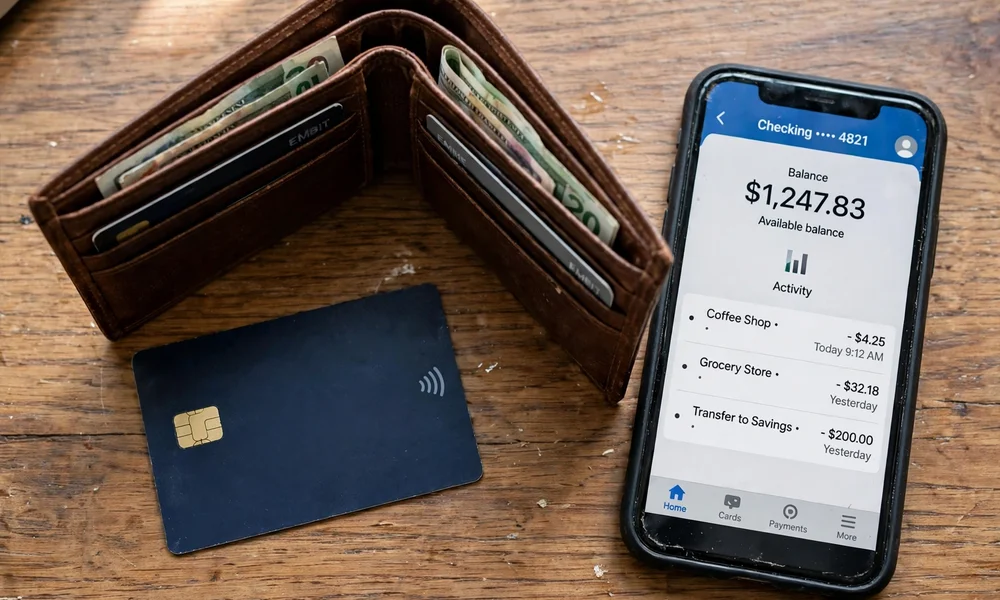
A debit card is a payment card linked to your checking account. When you swipe, tap, or insert it, your bank checks your balance, authorizes the amount, and takes the money out. The amount is ring-fenced at authorization and leaves the account when the transaction settles, usually within a day or two. You can also use the card at ATMs to withdraw cash, check your balance, and deposit money at your own bank’s machines.
The card carries the network logo, Visa or Mastercard in most cases, plus a 16-digit number, an expiry date, and a security code, which is why it works everywhere credit cards work. The difference is invisible at the till: the merchant is paid from your deposit account, not from a line of credit. If there is not enough money in the account, the purchase is usually declined, unless you have opted into overdraft coverage, which lets the bank cover the shortfall and charge you for it.
How a Debit Card Works
Every debit purchase follows the same path. You present the card, the terminal sends the amount to your bank, the bank places a hold on the funds, and the merchant gets an approval. The hold usually becomes a completed withdrawal within one or two business days, though hotels, car rental firms, and gas stations can place larger temporary holds that take longer to clear. Those holds can tie up your balance, so know they exist before a trip.
You can authorize a purchase in three ways: with your PIN, with a signature, or contactless, by tapping the card or your phone. PIN transactions are verified on the spot. Signature and contactless transactions are routed through the card network and verified later. Either way, the money comes from the same place. Most banks let you set daily limits, turn the card off in the app if you lose it, and get instant alerts for every transaction, the simplest fraud defenses you have.
Types of Debit Cards
The standard debit card is the one your bank issues with a checking account, and it is the type this guide is about. Most standard cards now support contactless payment and work with Apple Pay and Google Pay, so the physical card rarely leaves your pocket. Some banks also issue business debit cards for company accounts, which work the same way but draw on a business checking account and often come with higher limits and spending controls.
Prepaid debit cards look similar but are different. A prepaid card is loaded with money in advance, is not linked to a checking account, and usually charges activation and reload fees. It can help someone without a bank account shop online, but it does not carry the same fraud protections. Virtual debit cards are another option: a temporary number your bank generates for online purchases, which can be cancelled without replacing your physical card.
What Does a Debit Card Cost?
A debit card itself is usually free with a checking account, and purchases cost nothing extra at the till. The costs come from the account around it. Out-of-network ATM fees are the most common: using another bank’s machine typically costs a few dollars per withdrawal, and your own bank may add its own fee. Monthly maintenance fees range from nothing to around $15, though many banks waive them with a minimum balance or direct deposit.
Overdraft fees are the expensive one. If you spend more than your balance and have opted into overdraft coverage, the bank may cover the purchase and charge a fee, often around $30 or more per item. If you have not opted in, the purchase is simply declined, which costs nothing but can be embarrassing. Foreign transaction fees also apply when you spend abroad or shop on a foreign website, usually a small percentage of each purchase. The cheapest way to use a debit card is simple: use your own bank’s ATMs, keep a buffer in checking, and skip overdraft coverage.
Fraud Protection: What Regulation E Says
Debit card fraud is governed by the Electronic Fund Transfer Act and its Regulation E, and your maximum loss depends on how fast you tell your bank. If you report a lost or stolen card before any unauthorized use, you owe nothing. If you report within 2 business days of learning of the loss, your liability is capped at $50. If you report later, it rises to $500. And if you wait more than 60 days after the statement that first showed the charge, your liability can be unlimited.
One exception: if only your card number was used and you still have the card, you owe nothing when you report within 60 days of the statement that first showed the charge. Regulation E also sets the bank’s timeline: it must investigate within 10 business days, or provisionally credit your account while it takes up to 45 days to finish. Because the money has already left your account, a debit dispute leaves you short until the bank credits it back, the biggest practical difference from a credit card dispute. Check your statements monthly, and report anything unfamiliar the day you see it.
Debit Card vs Credit Card
| Feature | Debit card | Credit card |
|---|---|---|
| Whose money you spend | Yours, from checking | The issuer’s, repaid later |
| Interest | None | Charged on balances carried past the due date |
| Federal fraud liability cap | $0 to $50 to $500, or more, depending on how fast you report | $50 maximum under Regulation Z |
| Merchant dispute right | No, Regulation E covers transfer errors only | Yes, under Regulation Z |
| Builds credit history | No | Yes, on-time payments are reported |
| Rewards | Rare | Common: cash back, points, miles |
| Cash during a dispute | Already gone until the bank credits it back | Stays in your bank; you do not pay the disputed amount while it is investigated |
| Common fees | Out-of-network ATM, overdraft, maintenance | Annual fee on some cards, late fee, cash advance fee |
The protection gap is the key point. Under Regulation Z, liability for unauthorized use of a credit card cannot exceed $50, and in practice Visa and Mastercard zero-liability rules usually make it $0. A credit card also gives you a merchant-dispute right: if goods never arrive or are not as described, you can dispute the charge with the issuer. Regulation E does not give debit cardholders that right. It covers whether the transfer happened correctly, not whether the goods or services were as agreed, so a debit card is a weaker tool for online shopping and large purchases.
When to Use a Debit Card, and When Not To
A debit card is the right tool for everyday spending you have already budgeted for: groceries, fuel, coffee, and small purchases. It keeps you honest, because you can only spend what is in the account, and it costs nothing in interest. It is also the only card that gets you cash from an ATM, and the right tool for anyone who carries a credit card balance, since it removes the temptation to borrow.
Reach for a credit card instead for online shopping, travel bookings, hotel deposits, car rentals, and any large purchase. Stronger fraud protection, the merchant-dispute right, and your cash staying in the bank during a dispute all matter more there. The best books on wealth in 2026 make the same point from a different angle: the rich treat payment tools as strategy, not habit, and match the card to the risk of the purchase. The best books on investing in 2026 and the best money habits of millionaires in 2026 agree that the goal is never to pay interest you can avoid, and a debit card is the simplest way to make sure of that.
Staying Safe With a Debit Card
Most debit card fraud is preventable. Turn on transaction alerts so you see every purchase the moment it happens. Check your statement at least once a month, and report anything unfamiliar the same day, because the Regulation E clock is already running. Never use your debit card on a website you do not trust, and prefer a credit card or a virtual card number for online orders. At ATMs and gas pumps, check for loose card readers, cover the keypad when you enter your PIN, and use machines inside a bank branch when you can.
If your card is lost or stolen, call your bank immediately, confirm in writing, and ask for the card to be frozen or replaced. If you see a charge you did not make, report it the same way and keep a record of the date, who you spoke to, and any case number. If the bank takes more than 10 business days to investigate, it should provisionally credit your account. Keep a second way to pay, a credit card or a small cash reserve, so a frozen debit card never leaves you stranded.
How to Get a Debit Card
Getting a debit card is as simple as opening a checking account. Compare accounts on fees, minimum balance requirements, ATM networks, and overdraft policies before you choose, since the account matters more than the card. Most banks issue the card when you open the account, and it arrives by mail within a week or two. Activate it, set a PIN you do not use anywhere else, and turn on alerts before your first purchase.
Frequently Asked Questions
Does a debit card build credit?
No. Debit activity is not reported to the credit bureaus, so it neither helps nor hurts your score. If you want to build credit, you need a credit account, such as a secured credit card, that reports your payments.
Can I use a debit card online?
Yes, anywhere Visa or Mastercard is accepted. Just be careful: online purchases have weaker protection on a debit card, so use a credit card or a virtual card number for unfamiliar sellers and large orders.
What happens if I spend more than my balance?
Without overdraft coverage, the purchase is declined and nothing happens. If you have opted in, the bank may cover it and charge an overdraft fee, often around $30 or more per item.
Is a debit card safer than cash?
Yes. Cash that is lost or stolen is gone, while a debit card can be frozen, replaced, and its unauthorized charges disputed under Regulation E, as long as you report promptly.
The Bottom Line
A debit card is the simplest payment tool most people own: it spends your own money, charges no interest, and works everywhere. Its weaknesses are real, though: fraud protection depends on how fast you report, your cash is gone during a dispute, and there is no merchant-dispute right or credit building. Use it for everyday spending and ATM cash, where those weaknesses rarely matter, and use a credit card you pay in full for online shopping, travel, and large purchases. That split, debit for the everyday and credit for the risky, gets you the best of both cards in 2026.

Keep what speaks to you.
Leave room for your own perspective.