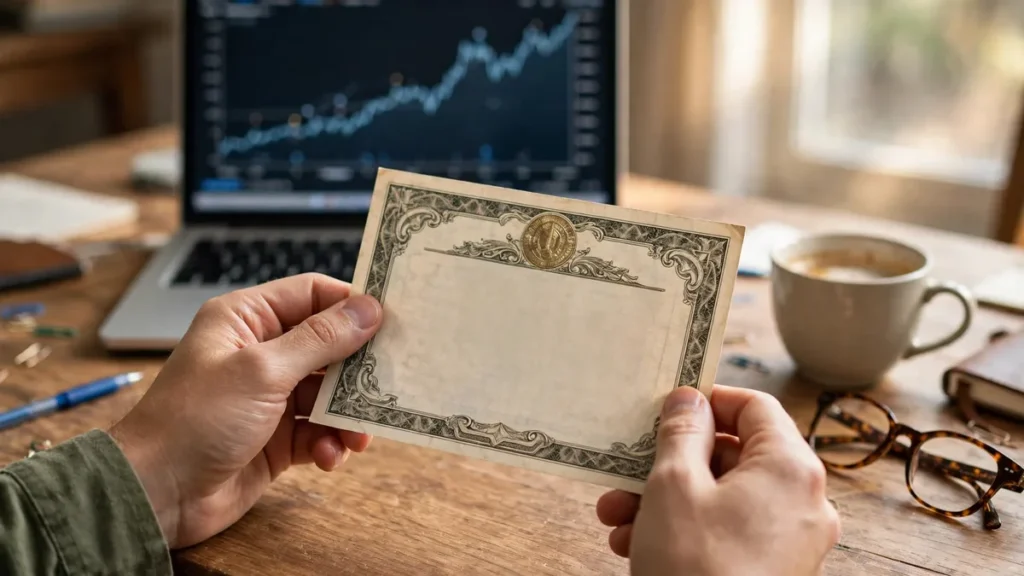
When a government needs to build roads or a company needs to build a factory, they borrow from thousands of investors at once by issuing bonds. When you buy a bond, you are the lender: you hand over your money, the borrower pays you interest, and at an agreed date it hands your money back. That exchange sits at the heart of the largest financial market on earth.
That gap matters more in 2026 than it has in years. Bond yields are the highest in a generation, so bonds are finally paying real income again. The 10-year Treasury yield rose from 4.19 percent in January 2026 to about 5.12 percent by mid-November, touching 5.31 percent in October, its highest since 2002. This guide explains what a bond is, how bonds work, the main types, what they pay in 2026, and the risks.
Key takeaways
- A bond is a loan you make to a government or a company, repaid with regular interest and your principal back at maturity.
- Bond prices move opposite to interest rates: when rates rise, existing bond prices fall, and when rates fall, prices rise.
- US Treasury bonds are generally the safest bonds in the world; corporate bonds pay higher yields for higher default risk.
- In late 2026, the 10-year Treasury yields around 5.1 percent, the 2-year around 4.8 percent, and new Series I bonds pay 5.51 percent through April 2027.
- Bonds are not risk-free: inflation, rising rates and default can eat into returns.
What is a bond?
A bond is a written promise to repay borrowed money with interest. The issuer, a government, company or local authority, sells the bond to investors. The investor, the bondholder, lends the money. The issuer pays interest, called the coupon, usually every six months, and repays the full amount borrowed, the face value or principal, on a set date, the maturity date.
It is the mirror image of a stock. A stock buys a small piece of ownership, and your return depends on the company’s profits. A bond buys no ownership: you are a creditor, not an owner. If the company does well, you still only receive your agreed interest. If it struggles, you stand ahead of shareholders for repayment. That trade, limited upside for steadier income and a stronger claim, is the whole point of bonds.
How a bond works
Every bond is defined by three numbers: the face value, the coupon and the maturity date. The face value, also called par, is the amount repaid at maturity, usually 1,000 dollars per bond. The coupon is the annual interest rate as a percentage of face value, and the maturity is the day the loan ends.
On 16 November 2026, the US Treasury issued 42 billion dollars of new 10-year notes paying 5 percent a year until 15 November 2036. A buyer who pays the 1,000-dollar face value receives 25 dollars every six months, 50 dollars a year, for ten years, then gets the 1,000 dollars back. Buyers actually paid about 998.40 dollars, because the auction yield was 5.020 percent, a touch above the coupon.
Yield is the number that matters most once a bond starts trading, because it is rarely the same as the coupon. The coupon is fixed, but the price moves: buy below face value and your yield is higher than the coupon; buy above it and your yield is lower. Yield to maturity is the total return if you hold to maturity, combining every coupon with any gain or loss on the price.
Bond prices and yields: the inverse relationship
The most important thing to understand about bonds is that prices move opposite to interest rates. When rates rise, existing bond prices fall. When rates fall, prices rise. The coupon is fixed, so a bond only becomes attractive at a price where its old coupon delivers the new, higher market return.
Imagine you hold a 10-year bond with a 4 percent coupon, and new bonds are now issued at 5 percent. Nobody will pay full price for your 4 percent bond when they can buy a new one paying 5 percent. Your bond’s price falls until its yield matches the market. A 10-year bond paying 4 percent would fall to about 922 dollars per 1,000 dollars of face value if market rates rose from 4 to 5 percent.
Duration measures the swing: roughly the percentage change in a bond’s price for each 1-point change in rates. A 2-year Treasury has a duration near 1.9, so a 1-point rise cuts its price by about 1.9 percent; a 10-year Treasury has a duration near 7.4, so the same rise costs about 7.4 percent. Long bonds pay more income but swing much harder when rates move.
The main types of bonds
Bonds are grouped by issuer, because the issuer decides the risk. US Treasuries come from the federal government and are widely regarded as the safest bonds in the world. Treasury bills mature in a year or less, in terms of 4, 8, 13, 17, 26 and 52 weeks; notes mature in 2 to 10 years, and bonds in 20 to 30 years. Treasury interest is subject to federal tax but generally exempt from state and local tax.
Two Treasury types protect against inflation. Treasury Inflation-Protected Securities, or TIPS, adjust their principal with inflation. Series I savings bonds combine a fixed rate with an inflation rate: I bonds bought from November 2026 through April 2027 earn a 5.51 percent composite rate, including a 1.40 percent fixed rate for the life of the bond.
Corporate bonds are issued by companies to fund operations and expansion, and pay higher yields because companies can fail. Investment-grade corporate bonds yielded about 5.22 percent on average in 2026. High-yield bonds, also called junk bonds, come from weaker companies and pay considerably more, but carry a real risk of default. Municipal bonds are issued by states and cities, and many pay interest exempt from federal income tax.
Most beginners never buy an individual bond. They buy bond funds, which pool money from many investors to own hundreds of bonds at once. A bond fund has no maturity date, so it never hands your principal back on a set day, and its value moves with the market. It pays interest monthly, and the payments can fluctuate. The best ETFs for long-term growth in 2026 covers the exchange-traded side in more detail.
Bonds in 2026: a dated snapshot
Yields in 2026 are high by the standards of the last fifteen years. The figures below are a snapshot from October and November 2026, not a permanent fact. Short-term rates stay elevated because the Federal Reserve has held its target range at 3.75 to 4.00 percent since 28 October 2026, and the 6-month Treasury bill paid about 4.25 percent in late October 2026.
Further out the curve, the 2-year Treasury yielded about 4.83 percent on 16 November, the 5-year about 4.93 percent and the 10-year about 5.12 percent. The Bloomberg US Aggregate Bond Index returned 7 percent in 2025 and now offers a starting yield of 4.7 percent. A diversified bond portfolio in late 2026 pays roughly 4.5 to 5 percent a year in income, before inflation and tax.

Why investors buy bonds
Investors buy bonds for three reasons. The first is income: a bond pays a known coupon on a known schedule, useful for retirees and for savers building a house deposit. The second is stability: bonds usually fall less than stocks in a crash, and government bonds often rise when stocks fall, as investors flee to safety. A portfolio that is 60 percent stocks and 40 percent bonds has historically lost far less in a crash than an all-stock portfolio.
The risks to understand
Bonds are steadier than stocks, but they are not risk-free. Interest rate risk is the biggest: if rates rise after you buy, your bond’s market value falls, and selling before maturity can mean a loss. That is what happened to long-term bondholders through much of 2026, as the 10-year yield climbed from 4.19 percent in January to 5.31 percent in October.
Inflation risk is quieter but just as real. A bond paying 5 percent a year leaves a real return of about 2 percent if inflation runs at 3 percent. TIPS and I bonds exist to fight this, but ordinary bonds have no protection. Credit risk is small for the US government but real for companies; when a company defaults, bondholders usually recover some money and stand ahead of shareholders, but losses can be severe.
Do bonds belong in your portfolio?
It depends on your age, time horizon and tolerance for volatility. The old rule of thumb was to hold your age as a percentage in bonds: a 30-year-old holds 30 percent bonds, a 60-year-old holds 60 percent. Many advisers now call that too conservative, and suggest holding 20 to 40 percent in bonds through your working years, raising it as retirement approaches.
Time horizon is the sharper test. Money needed within three years belongs in cash or short-term bonds, not stocks; money needed in three to ten years suits intermediate bonds; money untouched for decades can stay mostly in stocks. Interest from most bonds is taxed as ordinary income, so bonds usually belong inside a tax-advantaged retirement account. The best retirement accounts for beginners in 2026 explains which accounts shelter bond income from tax. Municipal bonds are the exception: their federal tax exemption suits taxable accounts, especially for higher earners.
For most beginners, the simplest route is a low-cost, broad bond fund rather than individual bonds: it holds hundreds of government and corporate bonds, spreads the default risk, and can be bought with a small sum. If you want the same low-cost approach on the stock side, the best index funds for beginners in 2026 covers the funds most new investors start with. Pairing a broad stock index fund with a broad bond fund, rebalanced once a year, is a complete portfolio for most people.
Common mistakes beginners make
The most expensive mistake is reaching for yield without checking the risk behind it: a bond paying 9 percent is paying 9 percent for a reason, usually a real chance of default. The second is buying long-term bonds with money needed soon, since a 30-year bond can fall 15 percent or more in a bad year for rates. The third is forgetting that bond funds never mature, so there is no date when your principal is guaranteed to come back. The fourth is selling in a panic when rates rise: a bond that falls in price still pays its coupon, and holding to maturity returns your principal, assuming no default.
Frequently asked questions
What is a bond in simple terms?
A bond is a loan you make to a government or a company. The borrower pays you interest on a regular schedule and returns your money on a set date, the maturity date.
Are bonds safe?
US Treasury bonds are generally considered the safest investments in the world, but no bond is entirely safe: rising rates can cut market value, inflation can erode real returns, and corporate issuers can default.
How much money do you need to buy a bond?
Individual corporate bonds usually have a 1,000-dollar face value, and Treasuries can be bought from the government from 100 dollars. Bond funds and ETFs often have no minimum beyond one share.
Do bonds pay monthly income?
Individual bonds usually pay interest every six months; bond funds and ETFs usually pay monthly.
What happens to bonds when interest rates rise?
Existing bond prices fall, because new bonds pay higher rates. Holding an individual bond to maturity still returns all interest and principal, assuming no default, but a bond fund has no maturity date, so its value can stay lower for longer.
Are bonds better than stocks?
Neither is better in general: stocks offer higher growth with bigger swings, bonds offer steadier income with lower returns. Most portfolios hold both.
The bottom line
A bond is a loan with a promise attached: regular interest, and your money back on a set date. That promise makes bonds the steady half of most portfolios, paying real income in 2026 for the first time in years, with the 10-year Treasury and investment-grade corporates both yielding above 5 percent. But the promise has limits: rising rates cut bond prices, inflation eats real returns, and issuers can fail. Buy bonds for steady income and stability, match maturity to the date you need the money, favour low-cost diversified funds, and hold them inside a tax-advantaged account where you can.

Keep what speaks to you.
Leave room for your own perspective.