
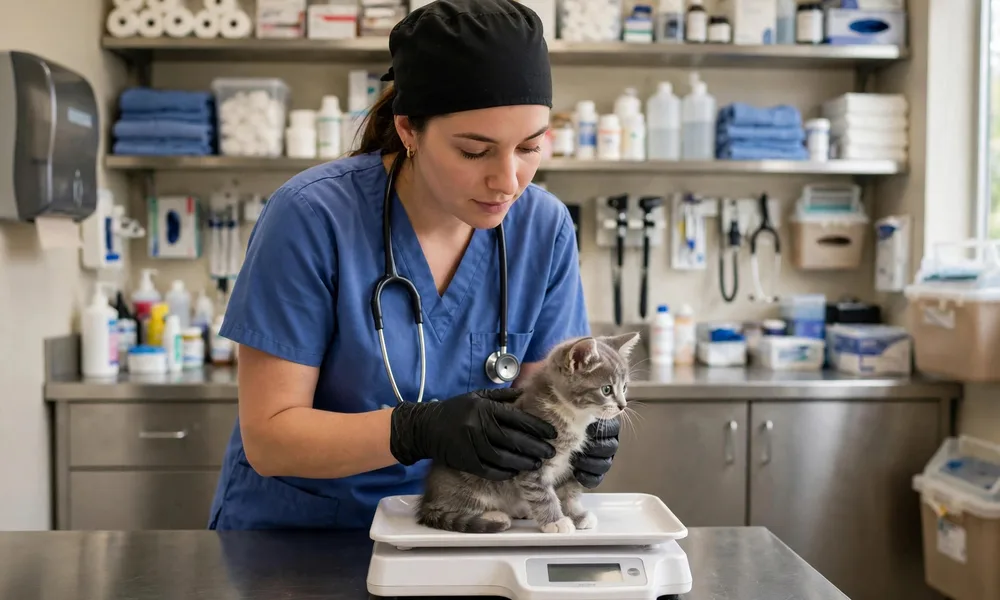
A veterinary assistant is the person who keeps a clinic running: restraining a nervous dog for an exam, drawing up vaccines, running in-house lab work, comforting an owner, and restocking the treatment room before the next patient arrives. It is hands-on, physical, and often emotional work, and it is also one of the easiest ways into animal care, because no state requires a degree or a licence to start. The question most people ask before they apply is a simple one: what does it actually pay?
The short answer is that the median veterinary assistant earned $38,150 a year in May 2025, or $18.34 an hour, according to the U.S. Bureau of Labor Statistics. That is the national median for veterinary assistants and laboratory animal caretakers, the occupation the Bureau groups together under one code, so it is a benchmark rather than a promise about any single clinic. Where you work, what kind of practice you join, and how much experience you bring can move your pay by several thousand dollars a year in either direction. This guide breaks down the numbers in full, from the state tables to the setting that pays most, and if you are weighing a first job in animal care against other entry-level work, our guide to the Best Remote Jobs for Beginners 2026 is a useful comparison, even though most assistant jobs are firmly in person.
Key takeaways
- The national median for veterinary assistants was $38,150 a year, or $18.34 an hour, in May 2025, according to the Bureau of Labor Statistics.
- The middle half earned between $35,660 and $45,710 a year, while the lowest tenth earned under $30,120 and the top tenth earned over $49,150.
- Rhode Island paid the most at a $49,770 median, while Mississippi paid the least at $30,360, a gap of nearly $19,400 a year.
- Assistants in veterinary services earned a median of $37,930, while research and education settings paid far more.
- A credentialed veterinary technician earned $47,380 at the median, $9,230 more than an assistant.
The National Picture in 2026
The Bureau of Labor Statistics counted about 126,580 veterinary assistants and laboratory animal caretakers working in the United States in May 2025. Their median annual wage was $38,150, which works out to $18.34 an hour on a full-time schedule of 2,080 hours a year, or about $734 a week and $3,179 a month before tax. The mean wage was a little higher, at $40,340 a year, because a smaller number of well-paid assistants in research and university settings pulls the average up above the middle of the range.
The spread around that median is narrower than in many healthcare support jobs, because there is no credential ladder inside the assistant role itself. The lowest tenth earned under $30,120 a year, or $14.48 an hour, while the highest tenth earned over $49,150, or $23.63 an hour. The middle half earned $35,660 to $45,710 a year, or about $17.14 to $21.98 an hour. If you are offered a starting wage, that middle range is the most useful comparison: a first job near $17 an hour is typical, and a job near $22 an hour is already at the top of the middle range.
Veterinary Assistant Salary by State
Location is the single biggest factor in assistant pay. The highest state median in May 2025 was Rhode Island at $49,770 a year, followed by the District of Columbia at $49,080, Massachusetts at $46,670, California at $46,260, and New Jersey at $46,160. Maine, Minnesota, Maryland, New York, and Oregon rounded out the top ten, all above $44,000. At the other end, Mississippi had the lowest median at $30,360, Louisiana was next at $30,480, then West Virginia at $32,350, Kentucky at $34,140, and Arkansas at $34,570.
The states with the most assistant jobs tell a different story from the highest-paying states. California employed by far the most, with 16,080, followed by Texas with 8,440, North Carolina with 6,910, Florida with 6,790, and New York with 5,790. Texas is a good example of why job volume and pay do not move together: it has the second-most assistant jobs in the country, yet its median of $34,850 sits more than $3,000 below the national median. Florida is similar, with a median of $37,830, just below the national figure, while California combines the largest workforce with the fourth-highest median. The table below lists the medians for the states most readers will compare, all from the Bureau of Labor Statistics May 2025 release.
| State | Median Annual Pay | Median Hourly Pay | Assistants Employed |
|---|---|---|---|
| Rhode Island | $49,770 | $23.93 | 380 |
| District of Columbia | $49,080 | $23.60 | 240 |
| Massachusetts | $46,670 | $22.44 | 2,130 |
| California | $46,260 | $22.24 | 16,080 |
| New Jersey | $46,160 | $22.19 | 3,270 |
| Maine | $45,510 | $21.88 | 690 |
| Minnesota | $45,280 | $21.77 | 1,450 |
| Maryland | $44,770 | $21.52 | 2,220 |
| New York | $44,750 | $21.52 | 5,790 |
| Oregon | $44,370 | $21.33 | 3,170 |
| Washington | $44,150 | $21.23 | 4,380 |
| Connecticut | $44,250 | $21.28 | 1,390 |
| Florida | $37,830 | $18.19 | 6,790 |
| North Carolina | $37,070 | $17.82 | 6,910 |
| Texas | $34,850 | $16.75 | 8,440 |
| Arkansas | $34,570 | $16.62 | 1,460 |
| Kentucky | $34,140 | $16.41 | 1,840 |
| West Virginia | $32,350 | $15.55 | 730 |
| Louisiana | $30,480 | $14.65 | 1,230 |
| Mississippi | $30,360 | $14.60 | 560 |
Pay by Setting: Clinic, Hospital, Shelter, and Research
Most veterinary assistants work in general practice clinics, and that is where the benchmark figure comes from: assistants employed in veterinary services earned a median of $37,930 a year in May 2025. A small general practice is the most common first employer, and it is also where pay is most likely to sit near the bottom of the range, because a small clinic has a small payroll and the assistant does a bit of everything rather than specialising. Research and university settings pay more still, at medians of $49,230 and $47,860.
Emergency and specialty hospitals are the clearest step up inside clinical work. They post higher assistant ranges than general practice, they pay overnight and weekend differentials, and they are more likely to pay for continuing education. The work is harder and less predictable, with critical cases and long shifts, but for an assistant who wants to earn more without going back to school, an emergency hospital is usually the best-paid clinical option. Animal shelters generally pay the least: shelter work is rewarding and varied, but most shelters run on tight charitable budgets, so their assistant wages often sit below the clinic median, and a shelter with health cover and paid time off can still be worth more than a slightly higher hourly rate at a clinic with no benefits.
What Experience and Certificates Are Worth
No state requires a certificate to work as a veterinary assistant. The Bureau lists a high school diploma or equivalent as the typical entry requirement, with short-term on-the-job training, which is why the role is such a popular first step into animal care. Most clinics hire people with no clinic experience at all and train them on restraint, cleaning, lab work, and client communication over the first few months..
Experience is still the main way pay rises inside the role. A new assistant typically starts near the 25th percentile, around $35,660 a year nationally, and moves toward the median and beyond as they learn to place catheters where state law allows, run in-house lab work, take radiographs, and handle anaesthesia recovery. Most clinics have an informal ladder from kennel attendant to assistant to senior assistant, and each step comes with a raise. Voluntary certificates can help a first application stand out: the NAVTA Approved Veterinary Assistant designation is the best known, and Fear Free certification, which covers low-stress handling, is valued by clinics that want to reduce fear and injury. Neither will transform your pay on its own, but together with a year or two of experience they make you a stronger candidate for the better-paying emergency and specialty roles.
Veterinary Assistant Versus Veterinary Technician
The most important pay comparison for any assistant is with the veterinary technician, the credentialed role one step up. Credentialed veterinary technicians and technologists earned a median of $47,380 a year in May 2025, which is $9,230 more than the assistant median of $38,150. That gap is the return on a two-year accredited degree and the Veterinary Technician National Examination, and spread over a career it runs well into six figures, which is why so many assistants enrol in part-time or distance technician programmes while they keep working. For a broader sense of how training pays off, our guide to the Best Online Courses for Making Money 2026 compares the cost and return of short courses across several industries.
The gap varies a lot by state. It is widest in Washington, where technicians earn $15,590 more than assistants at the median, followed by Virginia at $14,640 and California at $14,370. A wide gap usually means the state regulates the technician title and reserves tasks for credentialed technicians, so clinics pay for the credential. The gap is narrowest in Rhode Island, where technicians actually earned $4,460 less than assistants at the median, a quirk of a very small workforce, followed by Wyoming at $770 and Alabama at $790..
How to Earn More as a Veterinary Assistant
The fastest way to a higher wage is to change the setting rather than to wait for a raise in the same clinic. Moving from a small general practice to an emergency or specialty hospital, a university teaching hospital, or a research facility can add several thousand dollars a year, and those employers are also the ones most likely to offer shift differentials for nights and weekends. If you are willing to work overnights, the differential alone can be worth $2 to $4 an hour, which adds up to $4,000 or more over a full-time year.
Finally, keep the long view in mind. The Bureau projects employment of veterinary assistants and laboratory animal caretakers to grow 9 percent from 2025 to 2035, with about 23,200 openings a year, most of them replacing people who move up to technician roles or leave the field. That steady turnover means clinics hire year-round and often train from scratch, so a good assistant is rarely short of options. The role will not make you rich, but it is a reliable entry point into a growing field, and for many people it is the first step toward a technician qualification and the $9,230 pay rise that comes with it. If you are also considering freelance work alongside a clinic job, our guide to the Best Freelance Jobs 2026 covers flexible options that fit around shift work.
Frequently Asked Questions
What is the average veterinary assistant salary in 2026?
The Bureau of Labor Statistics reports a national median of $38,150 a year, or about $18.34 an hour, and a mean of $40,340 as of May 2025. The middle half earn $35,660 to $45,710 a year.
Which state pays veterinary assistants the most?
Rhode Island has the highest median at $49,770 a year, followed by the District of Columbia at $49,080, Massachusetts at $46,670, California at $46,260, and New Jersey at $46,160. Mississippi pays the least at $30,360.
Do veterinary assistants need a certificate?
No state requires one. The Bureau lists a high school diploma or equivalent as the typical entry requirement, with short-term on-the-job training. Voluntary certificates such as the NAVTA Approved Veterinary Assistant designation can help a first application stand out.
How much more do vet techs make than veterinary assistants?
Nationally the gap at the median is $9,230 a year: $47,380 for credentialed veterinary technicians and technologists against $38,150 for assistants, both from the Bureau of Labor Statistics May 2025 release.
Is being a veterinary assistant worth it?
It depends on what you want. The pay is modest and there is a ceiling without further training, but it is one of the easiest ways into animal care, clinics hire year-round, the Bureau projects 9 percent growth to 2035 with about 23,200 openings a year, and it is a direct route into a technician qualification that pays $9,230 more at the median.
The Bottom Line
A veterinary assistant earned a median of $38,150 a year in May 2025, but that single number hides a range of almost $20,000 between the highest- and lowest-paying states, and a further gap between a small general practice and a research facility. Your state, your setting, and your experience decide where you land in that range.
If you are starting out, compare every offer against your state median, favour full-time roles with benefits, and keep the technician route in mind from day one..

Keep what speaks to you.
Leave room for your own perspective.


