
Ask what a translator earns and you will get answers that span a surprisingly wide range. Some translators earn a steady staff salary working for a hospital or a government agency. Others run a freelance business from home, charging by the word and earning far more per hour than any staff job would pay. The gap between the bottom and the top of this profession is driven by language pair, specialization, and how the work is sold.
The official numbers give a useful anchor. The U.S. Bureau of Labor Statistics puts the median annual wage for interpreters and translators at $60,170 in May 2025, or $28.93 an hour. That figure covers employed translators only, not the self-employed, and about 27 percent of people in this occupation work for themselves. This guide breaks down translator pay in 2026: the official figures, pay by language and industry, staff versus freelance earnings, and what moves the number up. If you are weighing translation against other ways of earning from home, our guide to the Best Freelance Jobs 2026 puts it in context.
Key takeaways
- The median annual wage for interpreters and translators was $60,170 in May 2025, or $28.93 an hour, according to the U.S. Bureau of Labor Statistics.
- Government translators earn the most among major industries at a $74,320 median, followed by hospitals at $63,000.
- Freelance translators typically charge $0.08 to $0.16 per word for general work and $0.20 to $0.50 for legal, medical, and technical specialties.
- Japanese, Chinese, Korean, and Arabic command the highest per-word rates, while Spanish pays less because competition is heavier.
- About 27 percent of translators are self-employed, and specialization plus direct clients, not more hours, is what lifts freelance income most.
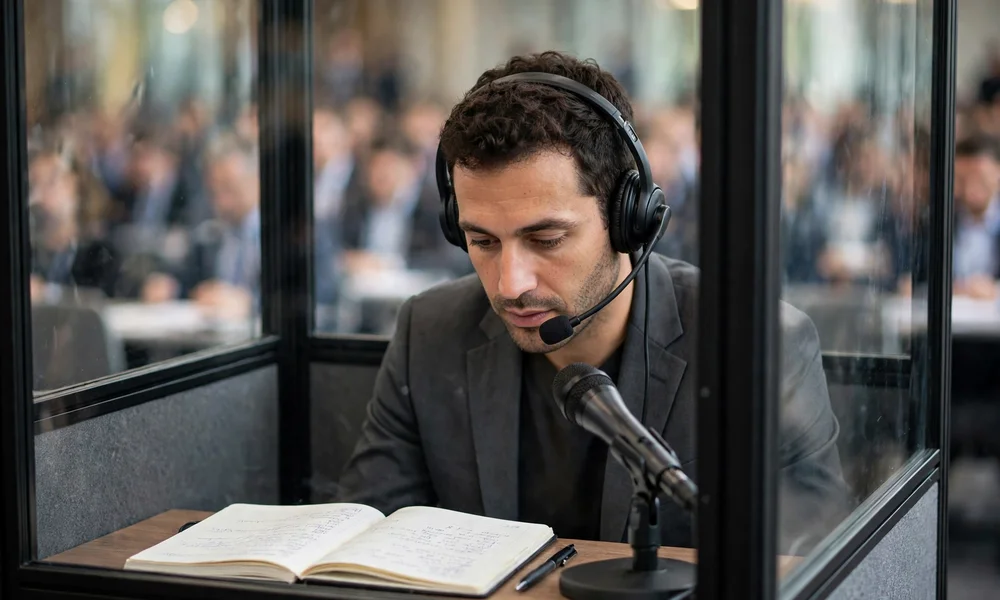
How Much Do Translators Earn in 2026?
The most reliable starting point for translator pay is the Bureau of Labor Statistics, which publishes wage estimates for interpreters and translators as a single occupation. In its May 2025 Occupational Employment and Wage Statistics release, the median annual wage was $60,170, with a median hourly wage of $28.93. Half of all employed interpreters and translators earned more than that figure, and half earned less.
That figure needs two important qualifications. First, it covers wage and salary workers only. The Bureau’s wage estimates exclude the self-employed, and roughly 27 percent of interpreters and translators work for themselves, so more than a quarter of the profession is missing from the headline number. Second, the occupation blends two different jobs. Interpreters work with spoken language in real time, while translators work with written text, and the Bureau does not publish separate medians for the two. For context, the median wage for all occupations in the United States was $50,980 in May 2025, so translators sit about $9,000 above the typical American worker.
Translator Salary by Industry
Where a translator works matters almost as much as what languages they speak. The Bureau publishes median wages for the largest industries employing interpreters and translators, and the spread between the best and the rest is more than $13,000 a year. Government work pays the most by a clear margin. Federal, state, and local government agencies outside education and hospitals pay a median of $74,320, reflecting security clearances and specialist subject matter.
Hospitals come next at $63,000. Medical translators work with patient records and clinical trial documents, where a mistake can have real consequences. Educational services pay a median of $61,230, while professional, scientific, and technical services, the largest private-sector employer of translators, pay $60,850, almost exactly the national median. The lesson is straightforward: the closer the work sits to regulated, high-stakes content, the better it pays.
Translator Pay by Language
For freelance translators, the language pair is the single biggest determinant of the rate. Translation is usually priced per source word, and the rate reflects how many qualified translators work in a pair and how much commercial demand exists for it. Spanish to English is the largest market in the United States and the most competitive. General work typically pays $0.08 to $0.14 per word, rising to $0.14 to $0.22 for technical, legal, or medical content. French to English sits a little higher at $0.10 to $0.16 for general work and $0.16 to $0.26 for specialist content.
German to English pays $0.12 to $0.20 for general work and $0.18 to $0.30 for specialist work. The Asian pairs command the highest rates. Japanese to English typically pays $0.14 to $0.22 per word for general content and $0.22 to $0.35 for specialist work. Chinese to English runs $0.12 to $0.18 for general work and $0.18 to $0.30 for specialist content. Korean to English pays $0.15 to $0.30, and Arabic to English runs $0.14 to $0.22 for general work and $0.22 to $0.32 for specialist work. Rare pairs such as Finnish or Icelandic can reach $0.20 to $0.32 for general work and $0.28 to $0.45 or more for specialist work.
The American Translators Association’s benchmark rate, often quoted as a rough industry standard for professional work, sits around $0.25 to $0.30 per word. At that rate, a standard 1,000-word document earns $250 to $300. The same skill, sold into a different market, is worth three times as much.
Translator Rates by Language Pair at a Glance
| Language pair | General rate | Specialist rate |
|---|---|---|
| Spanish to English | $0.08 – $0.14 | $0.14 – $0.22 |
| French to English | $0.10 – $0.16 | $0.16 – $0.26 |
| German to English | $0.12 – $0.20 | $0.18 – $0.30 |
| Chinese to English | $0.12 – $0.18 | $0.18 – $0.30 |
| Korean to English | $0.15 – $0.30 | $0.22 – $0.35 |
| Japanese to English | $0.14 – $0.22 | $0.22 – $0.35 |
| Arabic to English | $0.14 – $0.22 | $0.22 – $0.32 |
| Rare pairs (e.g. Finnish, Icelandic) | $0.20 – $0.32 | $0.28 – $0.45+ |
Staff Translator vs Freelance Translator
A staff translator gets a predictable salary, benefits, paid leave, and a fixed schedule. The median of $60,170 is a fair picture of what that life pays, with government and hospital roles at the top. The ceiling is real, though. Staff translators rarely double their salary, and the path upward usually means moving into project management or quality assurance rather than translating more. If you are weighing the freelance route against other independent income models, our guide to the Best Online Business Ideas 2026 compares the options.
Freelancing has a wider range and a higher ceiling. Salary aggregators put the average freelance translator in the United States at roughly $57,200 a year, close to the staff median, but that average hides an enormous spread. Entry-level freelancers on platforms often earn $15 to $25 an hour, while experienced specialists charging $0.20 to $0.50 a word can earn $70,000 to $90,000 or more, and top earners in the most demanding niches report incomes above $130,000. The difference is not hours worked. It is rate, specialization, and client mix. A freelancer translating 2,500 words a day at $0.10 a word earns $250 a day. The same output at $0.35 a word earns $875.
What Moves a Translator’s Pay
Five factors decide where a translator lands in the pay range. First is specialization. Legal, medical, and technical translation pay more than general content in every language pair, because the client needs subject knowledge as well as language skill. Legal work pays $0.25 to $0.50 a word where general work pays $0.08 to $0.15. Second is the language pair itself, as the previous section showed. Third is certification. The American Translators Association certification is the most recognized credential in the United States market. The exam costs $525, takes three hours, and has a pass rate below 20 percent, which is exactly why it carries weight. Certified translators typically command a premium of 15 to 30 percent over non-certified peers, and some legal clients will only hire certified translators.
Fourth is the client channel. Direct clients pay 30 to 60 percent more than agencies for the same work, because there is no intermediary taking a margin. Fifth is speed and tooling. Professional translators use computer-assisted translation tools and translation memory. A translator who can reliably produce 2,500 to 3,500 words a day with those tools earns far more per hour than one working at half that pace.
Job Outlook and the Effect of AI
The Bureau projects employment for interpreters and translators to grow about 2 percent from 2024 to 2034, from 75,300 jobs to 76,600, slower than the 3 percent projected for all occupations. The profession is still expected to generate about 6,900 openings a year through 2034, mostly from people leaving the occupation. Demand drivers include a more diverse population, increasing globalization, and the ongoing need for military and national security linguists.
The honest complication is machine translation. Automated tools now handle high-volume, routine content competently, and that has pushed general per-word rates down. What the machines cannot do is the work that pays best: legal contracts where a mistranslation creates liability, medical documents where accuracy is a safety issue, and any content where tone and cultural judgment matter. Machine translation post-editing pays less than full translation, typically $0.05 to $0.15 a word. The translators who thrive in 2026 are the ones who move upmarket, into the work machines cannot credibly do.
How to Raise Your Translator Salary
If you are already translating and want to earn more, the highest-return moves are specific. Pick a specialization and commit to it. Legal, medical, and technical translation pay double or triple general rates, and a year of focused study in one field changes your rate card more than five years of general work. Choose the field by demand and by your own background. Get certified: the American Translators Association exam is hard, with a pass rate below 20 percent, but the $525 cost typically pays for itself within a month or two of premium work.
Build direct clients deliberately. Every agency client you convert into a direct relationship raises your effective rate by a third or more. Raise your rates on a schedule, since translators who never raise their rates lose ground to inflation every year. Finally, track your effective hourly rate, not just your per-word rate. A $0.30-a-word job that takes twice as long per word as a $0.15-a-word job pays the same per hour. Translation memory, glossaries, and a well-organized workflow are what turn a good per-word rate into a good income.
Frequently Asked Questions
What is the average translator salary in 2026?
The U.S. Bureau of Labor Statistics puts the median annual wage for interpreters and translators at $60,170 in May 2025, or $28.93 an hour. Freelance translators earn anywhere from $30,000 to well over $100,000 depending on language pair, specialization, and client mix.
Which language pays the most for translators?
Japanese, Chinese, Korean, and Arabic are among the highest-paying pairs in 2026, with specialist rates of $0.22 to $0.35 per word or more. Rare pairs such as Finnish or Icelandic can pay $0.28 to $0.45 or more per word for specialist work, because very few qualified translators work in them.
Do translators make good money freelance?
It depends on the niche. General freelance work at $0.08 to $0.15 a word pays modestly, but specialists in legal, medical, or technical translation charging $0.20 to $0.50 a word commonly earn $70,000 to $100,000 or more.
Is translation a good career with AI?
Employment is projected to grow about 2 percent from 2024 to 2034, with about 6,900 openings a year, mostly from replacement. Machine translation has pushed general rates down, but legal, medical, and other high-stakes work still needs human translators.
How much do translators charge per word?
General translation typically costs $0.08 to $0.16 per word. Legal translation runs $0.25 to $0.50, medical $0.20 to $0.40, and technical $0.20 to $0.45.
The Bottom Line
A translator’s salary in 2026 is best understood as a range, not a number. The official median of $60,170 a year describes the middle of the staff market, but the real story is the spread around it. Government and hospital translators earn $63,000 to $74,000, and the difference between a common pair and a rare one, or between agency work and direct clients, can double or triple the income from the same hours.
If you are choosing this career, choose the niche as carefully as the language. Specialize in legal, medical, or technical work, get certified, build direct clients, and treat rate increases as routine. To compare translation with other ways of earning from your phone and laptop, our guide to the Best Money Apps 2026 is a useful next read.

Keep what speaks to you.
Leave room for your own perspective.


