
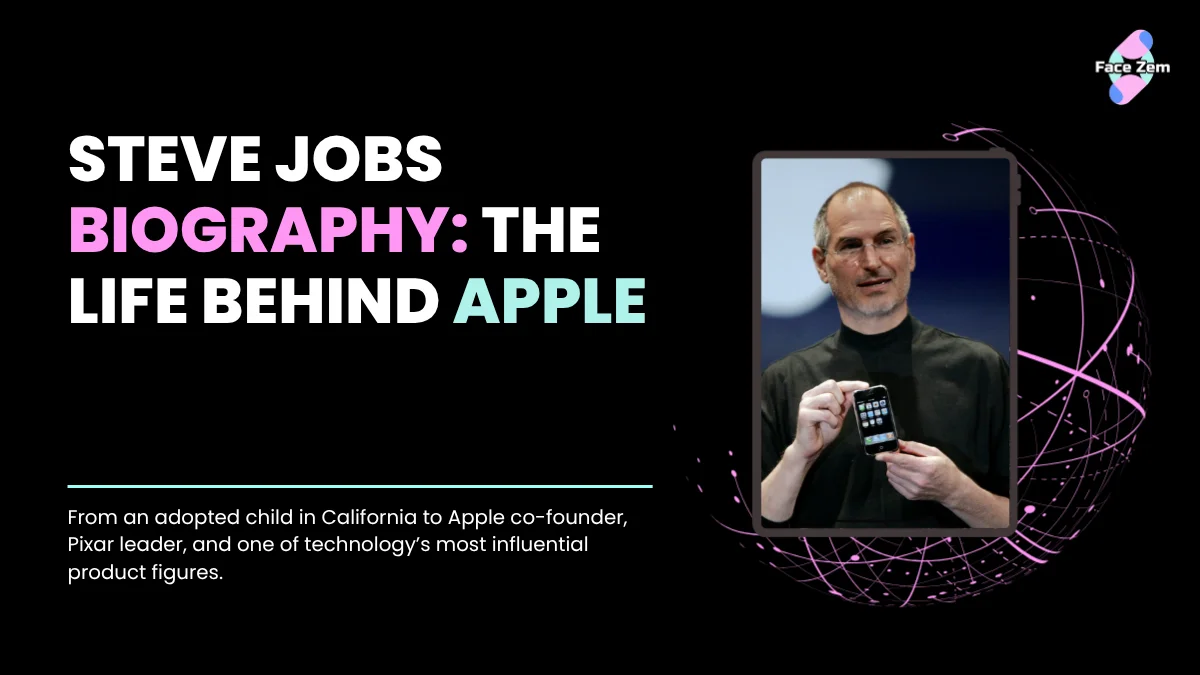
Steve Jobs was the co-founder of Apple and one of the most influential figures in the history of consumer technology. Born in 1955, he helped build Apple with Steve Wozniak, left the company after a major power struggle in 1985, and then spent the next decade building NeXT and becoming a major shareholder in Pixar.
When Apple acquired NeXT in the 1990s, Jobs returned and led the company through the Macintosh revival, iPod, iPhone, and iPad eras. He died in 2011 at age 56.
What makes a Steve Jobs biography especially interesting is that his career wasn’t a straight line of success. It included an early breakthrough, a painful departure from the company he helped create, years of experimentation outside Apple, and then an extraordinary second act at the company.
Key Takeaways
- Steve Jobs was born in San Francisco in 1955 and adopted by Paul and Clara Jobs.
- He co-founded Apple with Steve Wozniak in 1976.
- Jobs helped turn Apple from a small computer company into a major technology brand.
- He left Apple in 1985 after a power struggle with the company’s leadership.
- During his years away from Apple, he founded NeXT and became a major figure in Pixar’s development.
- Apple acquired NeXT in 1996, bringing Jobs back to the company.
- His return led to a major product-focused transformation at Apple.
- Jobs’ influence came from product vision, design direction, marketing, and leadership, but his achievements depended on large teams and collaborators.
Steve Jobs’ Early Life and Childhood
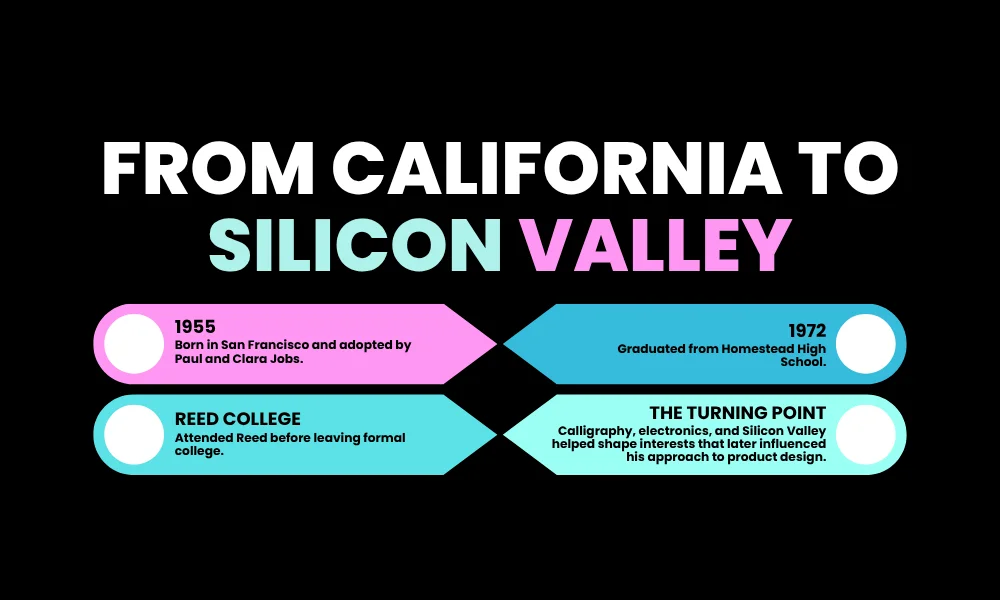
Steve Jobs was born on February 24, 1955, in San Francisco, California. His biological parents were Joanne Schieble and Abdulfattah Jandali, but he was adopted by Paul and Clara Jobs.
The Jobs family later lived in Mountain View, California, in what became known as Silicon Valley. His father, Paul Jobs, worked with machinery and taught Steve how to build, repair, and understand physical objects. This early exposure influenced Jobs’ interest in both engineering and design.
Jobs attended Homestead High School in Cupertino. During his teenage years, he became interested in electronics and technology. He also met people who were connected to the growing computer culture in the area.
Education and Reed College
After high school, Jobs enrolled at Reed College in Oregon. He left the college after a short period but continued attending selected classes.
One of the classes he studied was calligraphy. At the time, calligraphy seemed unrelated to business or computers. However, Jobs later said that this experience influenced the typography and visual design of the Macintosh computer.
His time at Reed also reflected a pattern that continued throughout his life: he often followed subjects that interested him even when their practical value was not immediately clear.
How Steve Jobs Started Apple
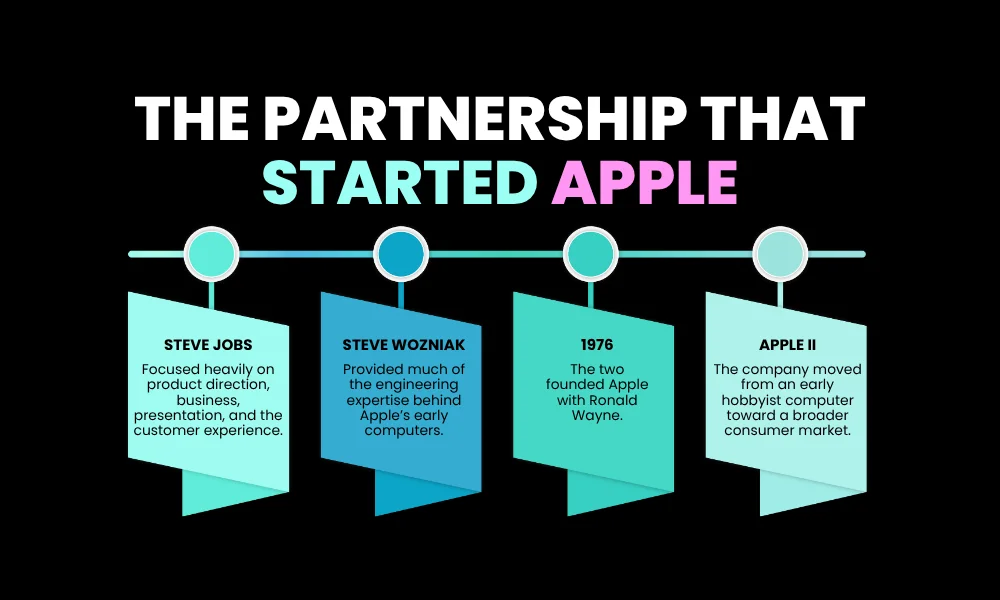
Steve Jobs met Steve Wozniak through mutual friends and shared an interest in electronics and computers. Wozniak was an experienced engineer and computer designer, while Jobs had a strong interest in product direction, business, presentation, and the potential market for personal computers.
In 1976, Jobs, Wozniak, and Ronald Wayne helped establish Apple Computer.
The company’s first product was the Apple I, a computer designed primarily by Wozniak. Jobs helped see the commercial potential of the machine and worked on presenting it as a product that could be sold.
The Apple II became a much larger success. It was one of the early personal computers that appealed to a wider audience because it was relatively easy to use and could be used at home, in schools, and in businesses.
Jobs did not single-handedly invent the personal computer. His importance came from combining technology with product presentation, design, business strategy, and a clear vision of what computers could become.
Steve Jobs and the Macintosh
Apple introduced the Macintosh in 1984. The computer emphasized graphical interaction, visual design, and ease of use rather than requiring users to rely mainly on typed commands.
Jobs strongly supported the Macintosh project and pushed the team toward a product that felt different from conventional computers. Its graphical user interface, mouse-based navigation, typography, and attention to industrial design helped make it culturally significant.
The Macintosh was not an immediate commercial success on the scale Apple had hoped. However, it helped establish ideas that later became central to consumer technology:
- Computers should be easier for ordinary people to use.
- Design should be part of the product, not an afterthought.
- Hardware and software should work together.
- Technology could be presented as a consumer experience rather than only as a technical tool.
Why Did Steve Jobs Leave Apple?
In 1985, Jobs became involved in a serious power struggle with Apple’s leadership. John Sculley, whom Jobs had helped recruit as CEO, became one of the central figures in the conflict.
Jobs had lost much of his operational influence, and he eventually left the company.
His departure was a major turning point. Apple continued operating without him, while Jobs began building new projects outside the company. The experience also gave him time to develop different ideas about software, animation, management, and product development.
Steve Jobs at NeXT
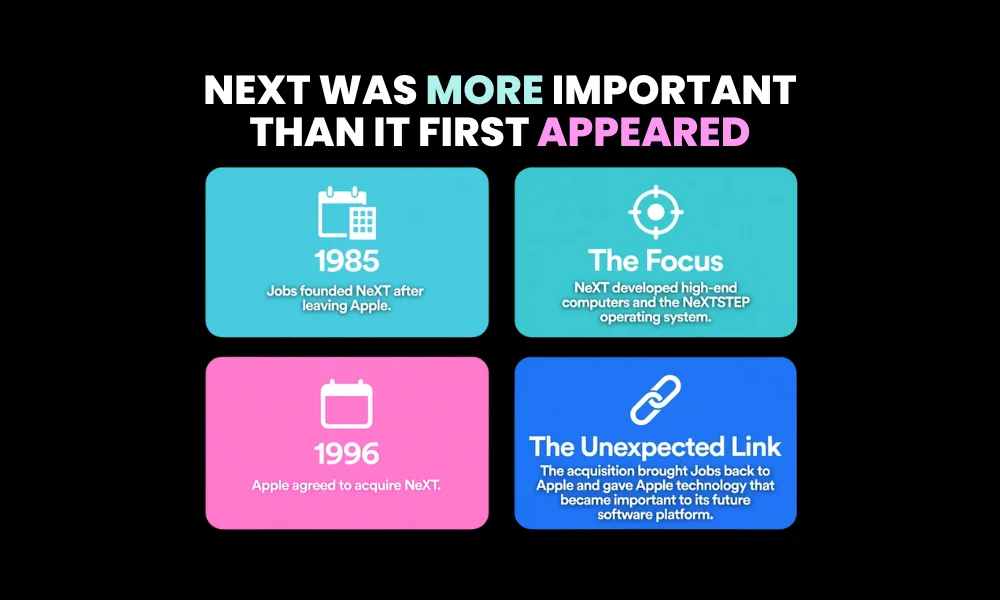
After leaving Apple, Jobs founded NeXT in 1985. The company focused on powerful workstations designed mainly for higher education, research, and business users.
NeXT computers were not a major mass-market success, partly because of their high prices and limited market. However, the company developed advanced software, including the NeXTSTEP operating system.
NeXTSTEP later became extremely important because it provided the technological foundation for much of the software used in Apple’s later operating systems.
NeXT also helped Jobs develop a more mature approach to product development. He continued to demand strong design and technical quality, but the company’s experience showed how difficult it was to turn advanced technology into a widely adopted commercial product.
Steve Jobs and Pixar
In 1986, Jobs purchased the computer-graphics division of Lucasfilm. He developed it into an independent company that became known as Pixar.
At first, Pixar focused on computer graphics hardware and software. Over time, its animation work became more important. The company’s breakthrough came with Toy Story, released in 1995 as the first fully computer-animated feature film.
Jobs was not the animator who created the film. Pixar’s creative and technical achievements depended on people such as John Lasseter, Ed Catmull, and many artists, engineers, and production teams. Jobs’ role was primarily as a business leader, investor, and major shareholder who helped guide the company and prepare it for growth.
Pixar’s success made Jobs a significant figure in the entertainment industry as well as technology. It also demonstrated that computer technology could transform an established creative field.
Why the NeXT and Pixar Years Mattered
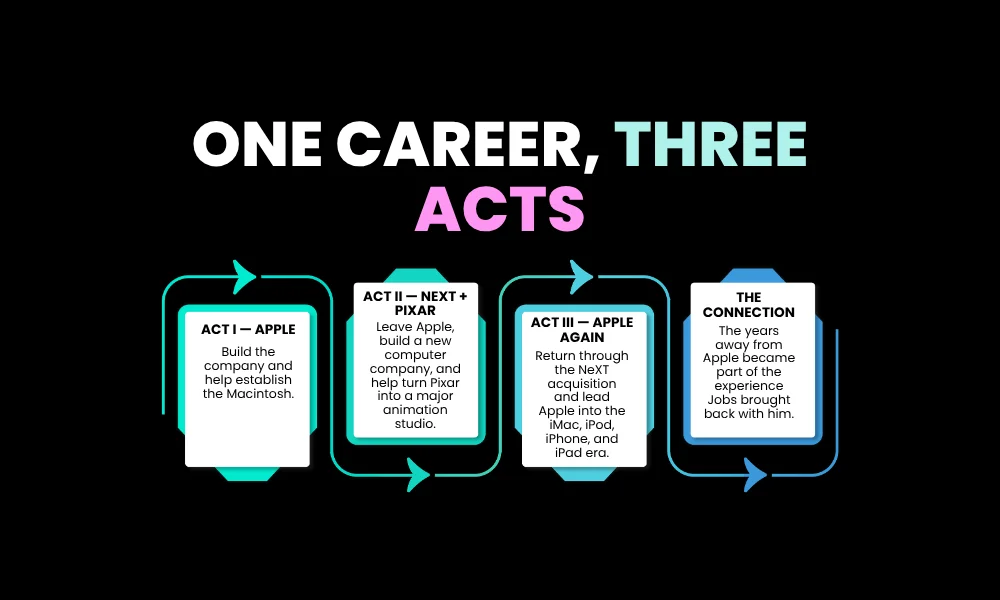
Jobs’ years away from Apple were not simply a period between two Apple careers. They shaped his later work in several ways.
NeXT gave him experience with advanced software and operating systems. Its technology eventually became part of Apple after the company was acquired.
Pixar gave Jobs experience in creative production, storytelling, collaboration, and building a business around high-quality products.
These experiences helped prepare him for his return to Apple. Instead of returning with only the ideas he had developed in the 1970s and 1980s, he returned with a broader understanding of technology, software, entertainment, and business.
Steve Jobs Returns to Apple
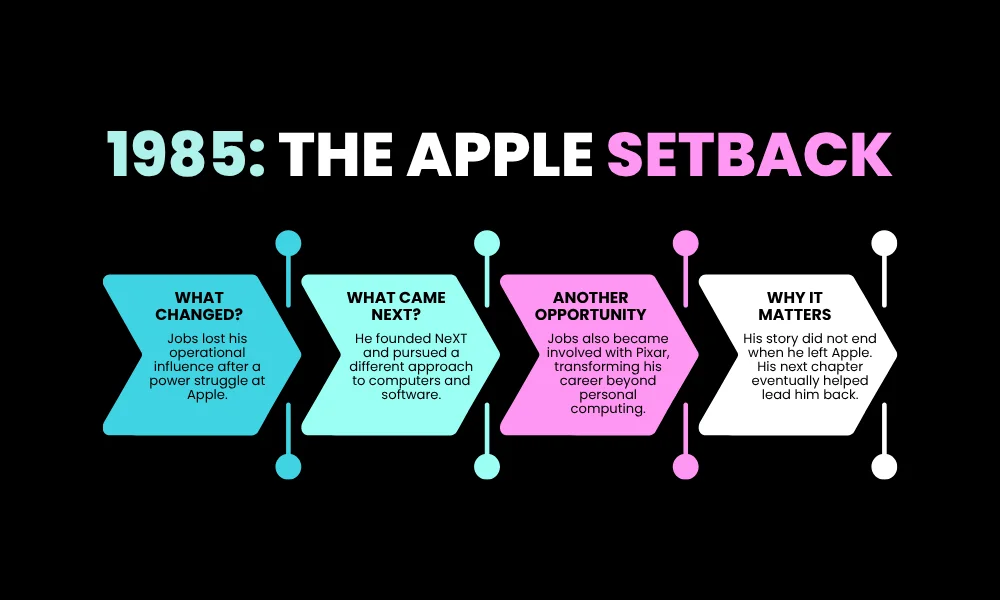
Apple announced its acquisition of NeXT in late 1996. The deal brought Jobs back to the company he had helped create.
He initially returned as an adviser and became interim CEO in 1997. The interim title was later replaced by the permanent CEO position.
At the time, Apple had a complicated product lineup and faced strong competition. Jobs responded by simplifying the company’s focus and reducing the number of products it worked on.
His approach was based on a simple idea: Apple needed to concentrate its resources on a smaller number of products that were easier to understand and more carefully designed.
The iMac and Apple’s New Direction
The iMac arrived in 1998. Its colorful design, all-in-one form, and consumer-friendly presentation helped make it a visible symbol of Apple’s renewed direction.
The iMac was important not only because of its appearance. It represented a broader change in how Apple approached products:
- Fewer products with clearer purposes
- Stronger integration between hardware and software
- Greater attention to packaging and presentation
- Easier setup and use
- A stronger connection between technology and lifestyle
The iMac helped rebuild interest in Apple and created momentum for later products.
Steve Jobs’ Major Products
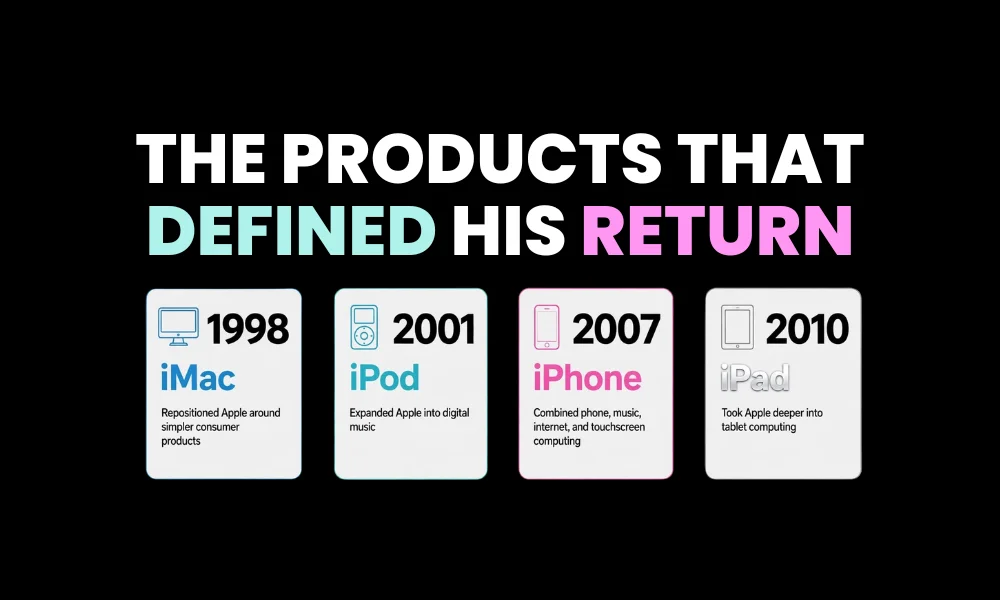
| Product | Year | Why It Mattered |
| Apple II | 1977 | Helped bring personal computers to homes, schools, and businesses |
| Macintosh | 1984 | Popularized a design-focused, graphical approach to personal computing |
| iMac | 1998 | Marked Apple’s renewed focus on simple, consumer-friendly design |
| iPod | 2001 | Made portable digital music easier to organize and carry |
| iPhone | 2007 | Combined phone, internet, and touchscreen computing in one device |
| iPad | 2010 | Helped establish the modern tablet market |
The iPod and iTunes
Apple introduced the iPod in 2001. The device became closely connected to iTunes, allowing users to organize and manage digital music.
The iPod was not the first digital music player. Its importance came from the combination of hardware, software, design, and a simple user experience. Apple made digital music easier for mainstream consumers to understand and use.
The iPhone
Apple introduced the first iPhone in 2007. Jobs presented it as a combination of a phone, an iPod, and an internet communication device.
The iPhone changed the smartphone market by emphasizing a large touchscreen, software integration, web access, and a simplified interface. Its long-term impact extended beyond the device itself, helping create a large mobile-app economy and changing how people use the internet.
The iPhone was developed by large teams of engineers, designers, software developers, and manufacturing partners. Jobs’ contribution was mainly in product direction, prioritization, presentation, and insisting on a unified user experience.
The iPad
Apple introduced the iPad in 2010. It was designed as a device between a smartphone and a traditional computer.
The iPad helped make tablets more familiar to consumers and was used for activities such as reading, browsing, watching videos, gaming, education, and creative work.
What Did Steve Jobs Actually Do?
Jobs is often described as an inventor, but that description is incomplete. His work was broader than personally designing every technical component.
His major responsibilities and strengths included:
- Defining the overall product vision
- Deciding which products Apple should develop
- Pushing teams toward simpler user experiences
- Working closely with designers and engineers
- Connecting hardware, software, and services
- Presenting products to the public
- Building a strong brand around design and usability
- Making difficult decisions about what Apple would not produce
- Recruiting and directing talented teams
At the same time, Apple’s products were created through the work of many people. Steve Wozniak, Jony Ive, software engineers, hardware engineers, designers, marketers, manufacturing partners, and other executives all contributed to Apple’s achievements.
A useful way to understand Jobs is as a product leader who helped coordinate technology, design, business, and storytelling around a unified goal.
Steve Jobs’ Final Years and Death
Jobs continued leading Apple through the launches of the iPhone and iPad. His health problems became increasingly visible during his final years, but he remained involved in major company decisions.
On August 24, 2011, Jobs resigned as Apple’s CEO. Tim Cook became CEO, while Jobs became chairman of the board.
Steve Jobs died on October 5, 2011, at the age of 56.
His death led to tributes from Apple, technology leaders, business figures, and people across the entertainment industry. Apple described him as a visionary leader whose work changed several industries.
Steve Jobs’ Legacy
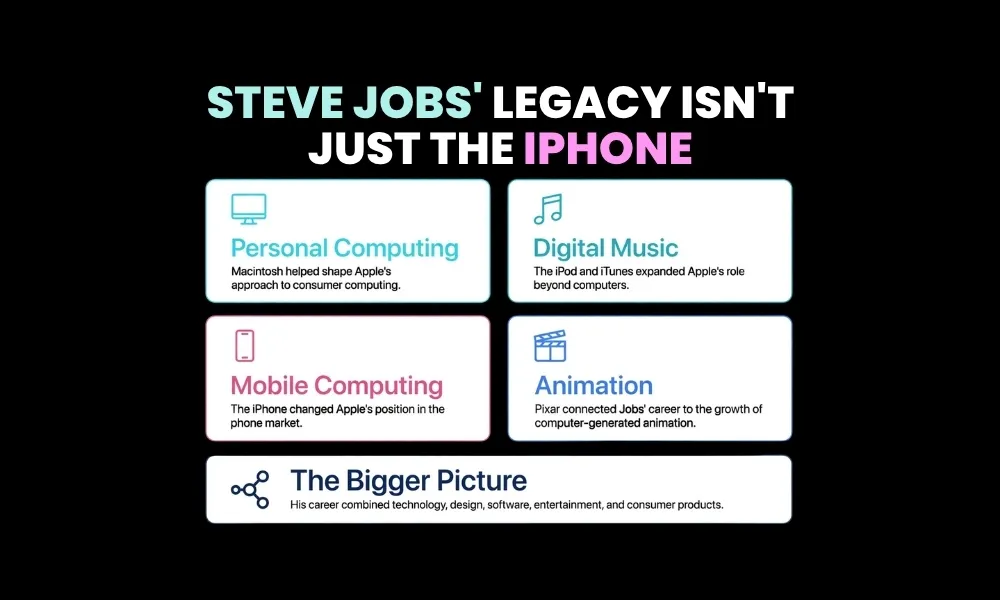
Steve Jobs’ legacy extends across more than one company or product category.
Personal Computing
Through Apple and the Macintosh, Jobs helped promote the idea that computers could be designed for ordinary consumers rather than only for specialists.
Digital Music
The iPod and iTunes helped change how people purchased, organized, and listened to music.
Smartphones
The iPhone influenced smartphone design, mobile software, touchscreen interfaces, and the growth of app-based services.
Tablets
The iPad helped establish tablets as a mainstream category for entertainment, communication, education, and productivity.
Animation
Through Pixar, Jobs became part of the development of computer-generated feature animation. Pixar’s success showed how technology and creative storytelling could work together.
Product Design and User Experience
Jobs placed unusual emphasis on the complete experience of a product. This included its appearance, interface, packaging, marketing, and relationship with other products.
His career also included conflict, failed products, difficult management decisions, and periods of professional uncertainty. For that reason, his life is more useful to study as a story of ambition, collaboration, failure, reinvention, and long-term influence than as a simple success story.
Conclusion
Steve Jobs’ biography is the story of a technology entrepreneur who helped create Apple, lost his position there, built new companies, and returned to lead one of the most influential product transformations in modern business.
His achievements were not the work of one person alone. They came from the combination of his product vision and the skills of engineers, designers, artists, executives, and other collaborators. His lasting influence can be seen in personal computers, digital music, smartphones, tablets, animation, and the way technology companies think about design.
Frequently Asked Questions
Who was Steve Jobs?
Steve Jobs was an American entrepreneur and the co-founder of Apple. He also founded NeXT and became a major figure in Pixar’s development. He helped lead Apple during the creation of products such as the Macintosh, iMac, iPod, iPhone, and iPad.
When was Steve Jobs born?
Steve Jobs was born on February 24, 1955, in San Francisco, California.
Was Steve Jobs adopted?
Yes. Steve Jobs was adopted by Paul and Clara Jobs shortly after his birth. He grew up with them in California.
Who was Steve Wozniak to Steve Jobs?
Steve Wozniak was Jobs’ early business partner and the main technical designer behind the Apple I and Apple II. Jobs and Wozniak combined engineering, product vision, and business development when they founded Apple.
Why did Steve Jobs leave Apple?
Jobs left Apple in 1985 after a power struggle with the company’s leadership. He had lost much of his operational influence before departing.
What did Steve Jobs do after leaving Apple?
After leaving Apple, Jobs founded NeXT and purchased the computer-graphics division that became Pixar. NeXT developed advanced software, while Pixar became known for computer-animated films such as Toy Story.
How did Steve Jobs return to Apple?
Apple acquired NeXT in 1996. The acquisition brought Jobs back to Apple, where he became interim CEO in 1997 and later returned as the company’s permanent CEO.
What is Steve Jobs most famous for?
Steve Jobs is most famous for co-founding Apple and helping lead the development and launch of products such as the Macintosh, iPod, iPhone, and iPad. He is also known for his role in Pixar’s growth and for emphasizing design and user experience.
When did Steve Jobs die?
Steve Jobs died on October 5, 2011, at the age of 56.