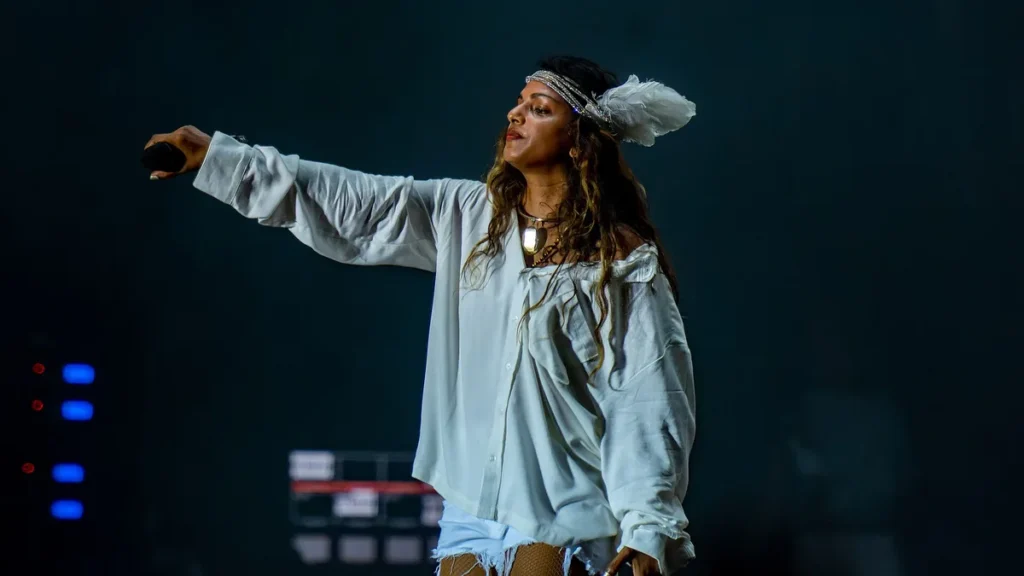
M.I.A. has never followed a straight path to wealth. The British rapper, born Mathangi Arulpragasam, built her fortune the way she built her sound: by mixing things that were never supposed to sit together. Music, visual art, fashion, film work and bold business moves all feed into a career that has lasted two decades without settling into one lane.
Her net worth in 2026 is estimated at around $10 million, reflecting hit records, touring, art sales, fashion lines and soundtrack work rather than a single blockbuster payday.
What makes her money story interesting is how it was made. M.I.A. earned it as an outsider who turned refugee roots, art-school training and a global ear for sound into a brand that labels, galleries, fashion houses and film directors all wanted.
Key takeaways
- M.I.A.’s net worth in 2026 is estimated at around $10 million, built across music, art, fashion and film.
- Paper Planes turned a global hit into lasting royalties, sync deals and touring.
- She trained as a visual artist first, and art and design remain a real income stream.
- Fashion ventures, including her MOHARA line, turned her visual style into a business of its own.
- Film and soundtrack work, including an Academy Award nomination, added pay and prestige beyond the charts.

The 2026 Estimate
Published estimates place M.I.A.’s net worth at roughly $10 million in 2026, drawn from reported record sales, touring history and business ventures, not from a public financial statement. The true figure could sit a little higher or lower.
What the estimate captures is a career that has stayed commercially alive far longer than most one-hit wonders. Paper Planes still earns through streaming, radio and film placements, nearly two decades after its release. That long tail is the backbone of her wealth.
From Refugee Roots to Paper Planes
M.I.A. was born in London in 1975 to Sri Lankan Tamil parents and spent part of her childhood in Sri Lanka during its civil war before the family returned to Britain as refugees. That background shaped her lyrics, her global sound and her visual language.
She studied fine art and film at Central Saint Martins, aiming to become a visual artist and documentary maker. Music came later, almost by accident, after she documented the band Elastica on tour. Her debut album Arular arrived in 2005 and Kala in 2007, both built on a collage of hip hop, electronic dance music, baile funk and Tamil film music. Like many hip hop pioneers, she shared a spirit with earlier innovators such as Biz Markie, whose playful approach opened the door for artists who refused to sound like anyone else.
Then came Paper Planes. Built around a sample of The Clash and a chorus about visas and passports, the song became a worldwide hit in 2008 and earned a Grammy nomination for Record of the Year. It remains her biggest commercial asset.
Art First: The Visual Career
Before she was a rapper, M.I.A. was a painter, graphic designer and filmmaker, and she has never stopped being one. Her album covers, videos and stage designs carry her own visual hand, and her artwork has been shown in galleries and published in books, earning money through exhibitions, print sales and commissions.
Fashion and Business Ventures
M.I.A. turned her visual world into fashion early, launching the MOHARA clothing line, built on the same bold prints and political graphics as her artwork, and later OHMNI, which mixed fashion with commentary on surveillance and modern life.
She has also worked with major fashion houses on collaborations that pay in fees and royalties. Like fellow hitmaker T-Pain, who rebuilt his career on his own terms after mainstream fame, she has treated independence as a financial strategy, not just a creative preference.
Film Work and Soundtracks
M.I.A.’s film career has brought her both prestige and pay. She co-wrote O Saya with A.R. Rahman for Slumdog Millionaire, earning an Academy Award nomination for Best Original Song in 2009. That nomination opened doors to further soundtrack work.
Her music has appeared in dozens of films, television shows, adverts and video games, each placement paying sync fees on top of streaming royalties. As an artist who moves between music and screen, she shares ground with multi-talented performers such as Lola Kirke, whose career likewise spans acting and music.
Where the Money Comes From
Her fortune is a patchwork, and the table below shows how the pieces fit together. No single stream dominates, which is exactly why her finances have proved durable.
| Income source | What it includes | Role in her wealth |
|---|---|---|
| Music royalties | Streaming, sales and radio across six albums | Steady base, led by Paper Planes |
| Touring and live shows | Festival slots and tours worldwide | Largest paydays in active years |
| Sync and soundtracks | Film, TV, advertising and game placements | High-value repeat earner |
| Art and design | Exhibitions, prints, books, video direction | Smaller but consistent income |
| Fashion and business | MOHARA, OHMNI, brand collaborations | Upside beyond music |
The pattern is clear: music provides the foundation, but art, fashion and film keep the total growing.
Spending, Lifestyle and Public Stances
M.I.A. has never lived like a conventional pop star. She has spoken openly about spending on her art and her independence rather than on the usual trappings of fame, and her public image has always been closer to activist-artist than luxury celebrity. Fame has still carried costs, including a long-running legal dispute with the NFL after her 2012 Super Bowl halftime appearance.
Her outspoken political positions have sometimes cost her commercially, with cancelled shows and strained label relationships. Yet that outspokenness is the core of her brand, and it keeps her audience loyal.
Six Lessons From M.I.A.’s Money Story
- Build more than one income stream, so a slow year in music is not a slow year overall.
- Own your visual identity, because a recognisable look sells across art, fashion and film.
- Protect your catalogue, since one enduring hit can pay for decades through royalties and sync deals.
- Stay independent when it matters, and use major partners for reach rather than control.
- Turn your story into your brand, because authenticity keeps fans following you between projects.
- Accept that principles have a price, and budget for the cost of saying what you believe.
Frequently Asked Questions
What is M.I.A.’s net worth in 2026?
Around $10 million, based on her music royalties, touring, art, fashion and film work. The figure is an estimate, not a confirmed total.
How did M.I.A. make her money?
Across several fields: hit records led by Paper Planes, touring, soundtrack and sync licensing, visual art, and fashion ventures including MOHARA and OHMNI.
What is M.I.A.’s biggest hit?
Paper Planes, released in 2007 and a global hit in 2008. It earned a Grammy nomination and remains her most valuable recording.
Was M.I.A. nominated for an Oscar?
Yes, for Best Original Song at the 2009 Academy Awards for O Saya, co-written with A.R. Rahman for Slumdog Millionaire.
Is M.I.A. still making music?
Yes. She released her sixth studio album, MATA, in 2022, and she continues to perform at festivals and work on art and fashion projects.
What is M.I.A.’s real name?
Her real name is Mathangi Arulpragasam. She performs as M.I.A., a name drawn from the term Missing in Action.
Bottom Line
M.I.A.’s estimated $10 million fortune is the result of a career that refused to stay in one box. Music gave her the hit, art gave her the identity, fashion gave her a business, and film gave her a global stage. Together they explain why she is still earning, still relevant and still independent two decades after her debut.
Note: Net-worth figures here are estimates from publicly reported information, not confirmed financial statements.

Keep what speaks to you.
Leave room for your own perspective.