Starting an online business in 2026 is simpler than it has ever been. You can register a business, build a website, take payments, and reach customers on the other side of the world without leaving your desk. The tools are cheap, the platforms are mature, and you can test an idea with a small amount of money before you commit to it.
An online business is any business that finds its customers, takes orders, or delivers its product mainly over the internet. That covers an online store, a digital product such as a course or template, a service delivered by video call, a subscription, or a content business built around an audience. This guide walks through the steps in order, from the idea to the first sale.
Key Takeaways
- Validate demand before you spend money: get people to prove they want what you plan to sell, with a pre-order, a sign-up, or a deposit.
- Pick one business model and one customer, then build a simple offer around them instead of trying to serve everyone at once.
- Form the business properly: choose a structure, register it, get a free EIN from the IRS, and open a separate business bank account.
- Launch with a small, working version of your website and offer, then improve it based on what real customers do.
What Counts as an Online Business?
An online business is not a website. A website is a tool. The business is the exchange: someone has a problem or a want, you offer something that solves it, and they pay you for it. The internet is simply where the finding, the selling, and often the delivery happen.
Most online businesses fall into a few clear models. An ecommerce store sells physical products and ships them. A digital product business sells downloads such as courses, ebooks, or templates. A service business sells your time and skill, such as design, writing, coaching, or consulting. Each model has different costs and a different daily routine, so choosing one is a real decision.
Step 1: Find a Problem Worth Solving
Every successful online business starts with a problem, not with a product. List the problems you understand well: the ones you have lived through, the ones people already ask you for help with, and the ones in a field where you have real experience.
Then check whether the problem is real and shared. Search for the questions people ask about it, read the reviews of existing products and look at the complaints, because complaints are a map of unmet needs, and talk to ten people who have the problem. Ask what they have tried and what they would pay for a better answer.
Step 2: Pick One Customer and One Model
Beginners fail most often by trying to serve everyone. A business that serves everyone serves no one well, because its message is vague and its product is a compromise. Pick one specific customer: a busy parent who needs quick healthy meals, a new manager who needs help leading a team, a small shop owner who needs a better website. Build for that person alone.
With the customer clear, pick one model and commit to it for at least six months. A store needs inventory and shipping. A course needs content and a platform. A service needs clients and a booking system. The best remote jobs for beginners in 2026 can help you test which kind of online work you enjoy before you build a business around it.
Step 3: Validate Before You Spend
Validation means proving that strangers will pay before you spend serious money. It is the step most beginners skip, and the step that saves the most money. Describe your offer on a single page, share it where your customer already spends time, and ask for a concrete action: a pre-order, a paid deposit, or a booking for a paid trial.
Set a clear target first: ten pre-orders, fifty email sign-ups, or three paying trial clients. If you hit the target, build the business. If you miss it badly, change the offer, the customer, or the price, and test again. This is not failure. It is cheap information. The expensive version of the same lesson is a finished website and a full inventory that nobody wants.
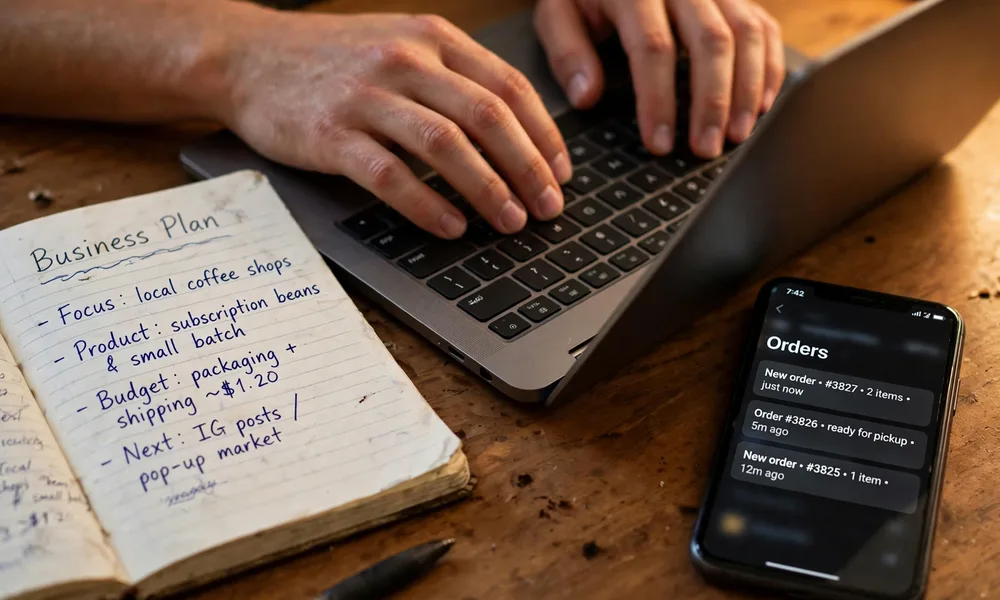
Step 4: Write a One-Page Business Plan
You do not need a fifty-page business plan. You need one page that answers the questions that matter. Who is the customer? What problem do you solve? What exactly do you sell, and at what price? How will customers find you? What will it cost to run each month? How much must you sell to cover those costs?
The one-page plan also forces you to face the numbers. Add up the fixed monthly costs: website and platform fees, payment processing, software, and a small marketing budget. Then work out how many sales at your price cover that total. If the number looks impossible, the price is too low, the costs are too high, or the offer needs rethinking.
Step 5: Choose a Structure and Register
In the United States, most new online businesses choose between two structures. A sole proprietorship is the default: if you start selling under your own name and file nothing, that is what you are. It is simple and cheap, but there is no separation between you and the business, so you are personally responsible for its debts. A limited liability company, or LLC, is a separate legal entity that protects your personal assets from business debts in most cases,. The Small Business Administration notes that registration costs are usually under $300, though fees vary by state.
Register in the state where you live and work, which is where most online owners register. The filing is usually done through your Secretary of State’s office, often online, and you will need a business name, a business address, and a registered agent, a person or company with a physical address in the state who can receive legal notices.
Once the business is formed, apply for an Employer Identification Number, or EIN, from the IRS. An EIN is your business’s federal tax ID, needed for bank accounts, tax filings, and hiring. It is free, and the IRS states clearly that you never have to pay a fee for one. Apply after your state filing is complete, so the EIN is issued in the business’s correct legal name. Then open a separate business bank account,.
Step 6: Handle Licences and Taxes
Selling online does not remove the need for licences. Whether you need one depends on your business type, your location, and what you sell. Many cities require a general business licence, and some products, such as food, cosmetics, or children’s items, carry their own rules. Check your state and city requirements before your first sale.
Sales tax is the other area to handle early. If you sell physical products, you may need to collect sales tax in states where you have a tax presence, and the rules differ from state to state. Many store platforms can calculate and collect it for you, but the responsibility to register and file is yours. Remember too that online business income is taxable, and self-employed owners usually need to pay estimated tax during the year rather than waiting until April.
Step 7: Build Your Website and Store
Your website is your shop front, your salesperson, and your checkout, all in one. Keep the first version simple. You need a clear home page that says what you sell and who it is for, a product or services page, an about page that builds trust, and a working checkout. That is enough to launch.
Choose a platform that fits your model. A hosted store platform handles hosting, payments, and security for a monthly fee and is the fastest route for most product sellers. A website builder with a store add-on suits service businesses and digital products. Pick one, build the four pages above, and launch. Your checkout must work well on a phone, because that is where most of your visitors will arrive. Test the whole journey yourself before you tell anyone the site exists.
Step 8: Find Your First Customers
Customers do not arrive because a website exists. They arrive because you put your offer in front of them, repeatedly, in the places they already spend time. Pick one marketing channel and work it properly for the first three months. If your customers search for solutions, that channel is search and helpful content. If they scroll social media, it is short video or posts on the platform they use most.
Your first ten customers matter more than your first thousand visitors. Talk to them. Ask how they found you, what nearly stopped them buying, and what they would tell a friend about your product. Their answers will improve your website, your offer, and your marketing faster than any course. The best online courses for making money in 2026 can help you learn a channel properly,.
Step 9: Deliver Well and Track the Numbers
The first sale is the start, not the finish. Deliver quickly, communicate clearly, and follow up after the purchase. A customer who has a good experience will buy again, tell a friend, and leave a review. A customer who is ignored will do the opposite, loudly.
Once the business is running, watch a small set of numbers every week. How many visitors came, and where did they come from? How many bought, and what did they spend? What did each sale cost you to win? What is left after costs? These numbers tell you whether the business is healthy, and where to fix it when it is not. Free analytics tools are enough to start,.
Common Mistakes to Avoid
The most common mistakes are easy to name and easy to avoid. Spending months perfecting a website before testing demand. Trying to be on every platform at once. Copying a competitor’s prices without knowing their costs. Spending the first profit on branding instead of on reaching more customers.
Another mistake is doing everything alone for too long. As soon as the business earns steady money, buy back your time: a bookkeeper for the accounts, a freelancer for the tasks you are slow at, or a tool that automates the repetitive work. The best freelance jobs in 2026 show how many skilled people are available to help.
Frequently Asked Questions
How much money do I need to start an online business in 2026?
It depends on the model. A service or digital product business can start for the cost of a domain, a website, and a few tools, often a few hundred dollars. A store selling physical products needs inventory and shipping, so the starting cost is higher.
Do I need an LLC to start an online business?
Not always. You can start as a sole proprietor, which is the default when you sell under your own name. Many owners form an LLC as soon as the business earns real money, because it separates personal and business liability.
Is an EIN free?
Yes. An EIN is free from the IRS, and you can apply online after your business is formed with your state. You should never pay a third party for one, and you should be wary of any service that charges a fee for it.
How long does it take to make money from an online business?
Most new online businesses take several months to earn steady income, and many take a year or more. The timeline depends on the model, the price, and how consistently you market.
Do I need a business licence to sell online?
It depends on where you live and what you sell. Many cities require a general business licence, and some products have their own rules. Check your state and city requirements before your first sale.
The Bottom Line
Starting an online business in 2026 comes down to a clear order of steps: find a real problem, pick one customer and one model, prove that people will pay, write a one-page plan, form the business and get your EIN, handle licences and taxes, build a simple website, find your first customers, deliver well, and track the numbers. Start small, launch before you feel ready, and let real customers teach you what to build next.

Keep what speaks to you.
Leave room for your own perspective.