
UX design is one of the most welcoming ways into a well-paid tech career. You do not need a computer science degree or ten years of experience before anyone will hire you. What you need is a clear understanding of how people use products, the ability to turn that into designs that feel effortless, and a portfolio that proves you can do it. In 2026, companies are still hiring, and the typical designer earns a six-figure salary. This guide walks through the whole path, from the first skill to the first job offer.
What Does a UX Designer Actually Do?
A UX designer, short for user experience designer, makes digital products easy and pleasant to use. When you open a banking app and find the transfer button in seconds, or a hospital portal lets you book an appointment without calling anyone, a UX designer shaped that experience. The work starts long before any screen is drawn: designers interview users, watch how people struggle, and map the journey from opening an app to finishing a task. Only then do they sketch flows, build wireframes, design the screens, and test with real users.
At a large firm, a designer might spend weeks refining one part of a product with researchers and engineers. At a startup, the same person might research, design and test a whole feature in a week. Common tasks include user interviews, personas and journey maps, wireframes, clickable prototypes, usability tests, and handing polished designs to developers. The thread through all of it is empathy: caring more about the user’s experience than about how clever a design looks.
How Much Do UX Designers Earn in 2026?
The Bureau of Labor Statistics puts the median pay for web and digital interface designers, the occupation that covers UX designers, at 104,000 dollars a year in its May 2025 release. The middle half earn between 73,290 and 158,820 dollars, and the top tenth earn 201,550 dollars or more. The UXPA International 2026 salary survey of 383 UX professionals found a median of 70,285 dollars for zero to two years of experience, 100,000 dollars at three to four years, 117,125 dollars at five to seven years, and 172,560 dollars at eleven to fifteen years.
| Experience level | Typical salary range | UXPA 2026 median |
|---|---|---|
| Junior, 0 to 2 years | 65,000 to 85,000 dollars | 70,285 dollars |
| Mid-level, 3 to 5 years | 85,000 to 120,000 dollars | 100,000 to 117,125 dollars |
| Senior, 5 to 10 years | 120,000 to 180,000 dollars | 140,000 dollars |
| Lead and principal, 10 years and more | 160,000 to 260,000 dollars | 172,560 dollars |
Demand is steady. The Bureau of Labor Statistics projects employment to grow about 6 to 7 percent over the coming decade, with roughly 8,000 to 9,000 openings a year. Entry-level hiring is competitive, while experienced designers remain in short supply. The plan here is built around that reality: get good fast, prove it with real projects, and target employers who actually hire juniors.
The Skills You Need to Become a UX Designer
UX design rests on five core skills. The first is user research: interviewing people and spotting patterns in what they say. The second is information architecture: organising a product so people can find things without thinking, with clear navigation and sensible labels. The third is interaction design: deciding how screens connect and how the product responds when something goes wrong. The fourth is visual design: typography, colour, spacing and layout. The fifth is prototyping and testing: building a clickable version, watching real users try it, then fixing what confuses them.
Three softer skills separate the designers who get hired from those who do not: communication, because designers constantly explain choices to non-designers; curiosity, because the job is mostly asking why people behave as they do; and comfort with feedback, because your work will be criticised daily and the fastest improvers treat criticism as data. None requires born talent; each improves with repetition.
The Tools UX Designers Use in 2026
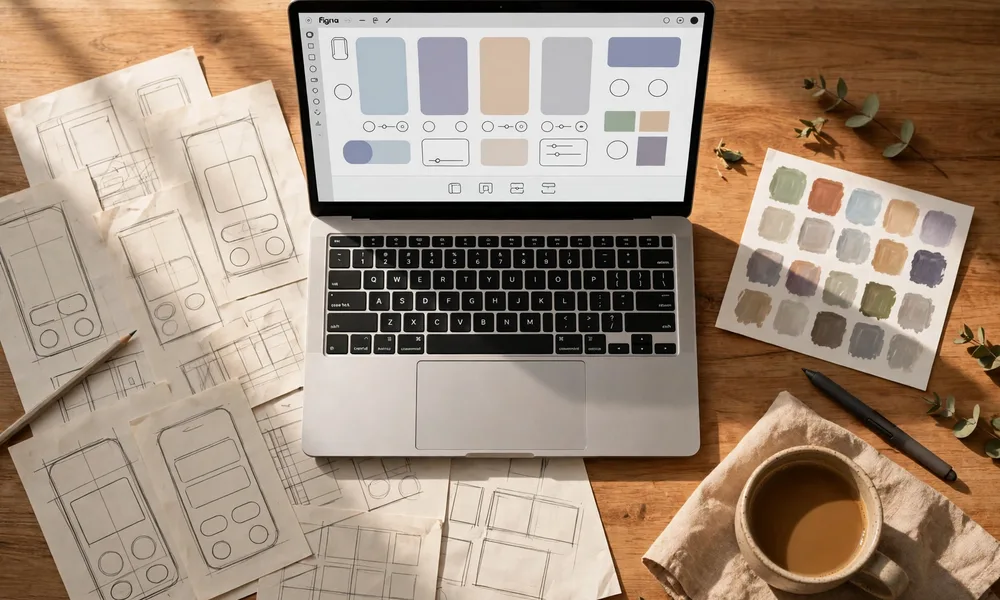
The toolset is smaller than beginners fear. Figma is the industry standard, and it is the one tool you must know well: almost every job listing mentions it, and its free plan is enough to learn on. Learn frames, auto layout, components, variants and prototyping deeply. A designer who truly knows Figma is more employable than one who knows five tools shallowly. After Figma, add a whiteboard tool such as Miro or FigJam and a research tool for surveys and usability tests. AI tools help with first drafts, but they do not replace the judgement of a designer who understands users.
Do not spend money on expensive software while learning. Figma’s free tier covers everything a beginner needs; the money is better spent on a short course or a portfolio review. Do not collect certificates from a dozen tools either. Hiring managers glance at tools for ten seconds and look at your portfolio for ten minutes. One tool mastered and three case studies done well beat a long list of badges every time.
Do You Need a Degree to Become a UX Designer?
No, and this is one of the field’s real advantages. Most UX designers do not hold a design degree. Many come from psychology, marketing, teaching, customer service or graphic design, and employers care far more about what you can show than about what you studied. A degree can help, but it is neither required nor the fastest route. Hiring managers look for two or three strong case studies, a clear process, and evidence you tested your work with real users.
There are three realistic learning routes. A bootcamp costs several thousand dollars and takes three to six months full-time, or six to nine months part-time, with structure and a cohort to keep you moving. Self-study is nearly free and flexible, built from online courses, books and practice projects, but it demands real discipline and takes most people nine to twelve months to reach job-ready. A university degree takes years and costs far more, and it is rarely sensible for a career changer. Whichever route you pick, the work that gets you hired is the same: structured learning plus real projects with real users. If you are comparing options, the best online courses for making money in 2026 show how different courses are structured and priced.
Your Step-by-Step Plan to Become a UX Designer
Here is the plan in order, for someone starting from zero and studying part-time. The journey typically takes nine to twelve months, or six months full-time.
Step 1: Learn the foundations, months 1 to 2
Start with the fundamentals: what UX is, how users think, and the principles of hierarchy, consistency and feedback. Take one structured beginner course and finish it completely rather than starting five. Look at the apps you use daily with a designer’s eye: where do you get stuck, and how would you fix it? Keep a notebook of these observations; they become your first project ideas.
Step 2: Master Figma, months 2 to 3
Follow Figma’s own tutorials, then rebuild the screens of an app you like from scratch. Rebuilding teaches spacing, type scales and component thinking faster than any lecture. Then redesign one screen that frustrates you and explain why your version is better. By the end of this stage you should be able to build a clean set of screens without a tutorial.
Step 3: Run your first real project, months 3 to 5
Pick a real problem, not a made-up one: redesign a local business booking flow, improve a charity donation page, or fix an app friends complain about. Interview five real users, even if they are friends and family. Sketch, wireframe, prototype, test with three to five people, and iterate at least twice. Document the problem, the research, the tests, and what changed. This becomes your first case study, and real users make it far stronger than a classroom exercise.
Step 4: Build a portfolio of three case studies, months 5 to 8
Complete two more projects, ideally in different areas, such as one mobile app and one website. Each case study should tell a story: the problem, what users actually did, what you tried, what the tests showed, and the result. Keep each one focused, with clear headings and plenty of visuals. Three strong case studies are enough; hiring managers prefer depth over volume.
Step 5: Apply strategically, months 8 to 10
Apply to junior UX designer, product designer and UX associate roles, and to internships even if you are changing careers. Tailor each application, mentioning something specific about the company’s product. Expect a slow start: many beginners send fifty to a hundred applications before the first interview. That is normal. Between applications, keep designing.
Step 6: Interview and negotiate, months 10 to 12
UX interviews usually include a portfolio walkthrough, a design exercise, and questions about feedback and trade-offs. Practise talking through your case studies out loud, explaining not just what you designed but why, what you tested, and what you would change next. For the design exercise, think aloud and show your process. When an offer arrives, remember the salary data here: a junior offer of 65,000 to 85,000 dollars is typical in most American cities, higher in expensive tech hubs. Negotiate politely but firmly, using the ranges for your city and level as evidence.
Freelance, Full-Time or Remote?
Most beginners should aim for a full-time job first. A steady salary, a team to learn from, and a senior designer reviewing your work will accelerate your growth more than anything else. Freelance UX work can pay well, with experienced freelancers charging 75 to 150 dollars an hour or more, but it is a hard way to start: clients expect you to already know what you are doing, and a third of your week disappears into finding work and admin. A good middle path is a full-time job with occasional freelance projects on the side. If freelancing appeals to you, compare it with the best freelance jobs of 2026 first.
Remote work is realistic in UX, and many teams are fully distributed, but beginners should be careful. Remote roles are harder to land without experience, and learning is slower when you cannot watch a senior designer work. A hybrid role is often the best of both worlds for a first job. Before applying, check the best remote jobs for beginners in 2026 to see which roles genuinely hire people at the start of their careers.
Key Takeaways
- You do not need a design degree; a portfolio with three strong case studies matters far more than any qualification.
- The median UX designer earns about 104,000 dollars a year, according to the Bureau of Labor Statistics, with juniors typically starting at 65,000 to 85,000 dollars.
- Master Figma deeply, and learn user research, information architecture, interaction design, visual design and testing.
- Real projects with real users beat classroom exercises: interview five people, test with three to five, and document what changed.
- Expect nine to twelve months from zero to job-ready part-time, fifty to a hundred applications before the first offer, and a full-time or hybrid role first.
Frequently Asked Questions
How long does it take to become a UX designer?
Most beginners reach job-ready in nine to twelve months part-time, or around six months full-time.
Can I become a UX designer without a degree?
Yes. Most UX designers do not have a design degree; employers hire on portfolio quality and demonstrated process, not qualifications. Three strong case studies with real user research open more doors than a diploma alone.
Is UX design still a good career in 2026?
Yes. The median salary is about 104,000 dollars, demand grows 6 to 7 percent a year, and every industry now competes on digital experience. Entry-level hiring is competitive, so a strong portfolio matters more than ever.
Do UX designers need to know how to code?
No, coding is not required for most UX roles, though basic HTML and CSS help you communicate with developers. Designers who can code earn more in some roles, but it is a bonus, not a requirement.
How much does it cost to learn UX design?
Self-study can cost under 500 dollars for courses and books, while a bootcamp typically costs several thousand. Figma’s free tier covers everything a beginner needs, so the biggest cost is your time.
The Bottom Line
Becoming a UX designer in 2026 is realistic for anyone willing to put in nine to twelve months of focused work. Learn the fundamentals, master Figma, run real projects with real users, and build a portfolio of three strong case studies.

Keep what speaks to you.
Leave room for your own perspective.


