Cars are getting more complex every year, and the people who can fix them are in short supply. The United States is projected to need about 66,200 new automotive service technicians and mechanics every year through 2035, according to the Bureau of Labor Statistics. That demand makes becoming a mechanic one of the most reliable skilled-trade careers you can choose: no four-year degree is required, training takes months rather than years, and you can earn while you learn.
This guide covers the whole path: what the job involves, the training routes and their real costs, the ASE certification employers look for, the tools you need, and how to land your first job.
Key Takeaways
- A high school diploma or GED is the only formal education requirement to start as a mechanic.
- Certificate programmes take 6 to 12 months and typically cost $5,000 to $15,000; associate degrees take two years.
- ASE certification is the industry standard: about $34 registration per order plus $62 per test in 2026, valid for five years.
- Most ASE certifications require about two years of hands-on experience, or one year with a relevant two-year degree.
- Automotive service technicians earned a median of $50,620 a year in May 2025, according to the Bureau of Labor Statistics.
What Does a Mechanic Actually Do?
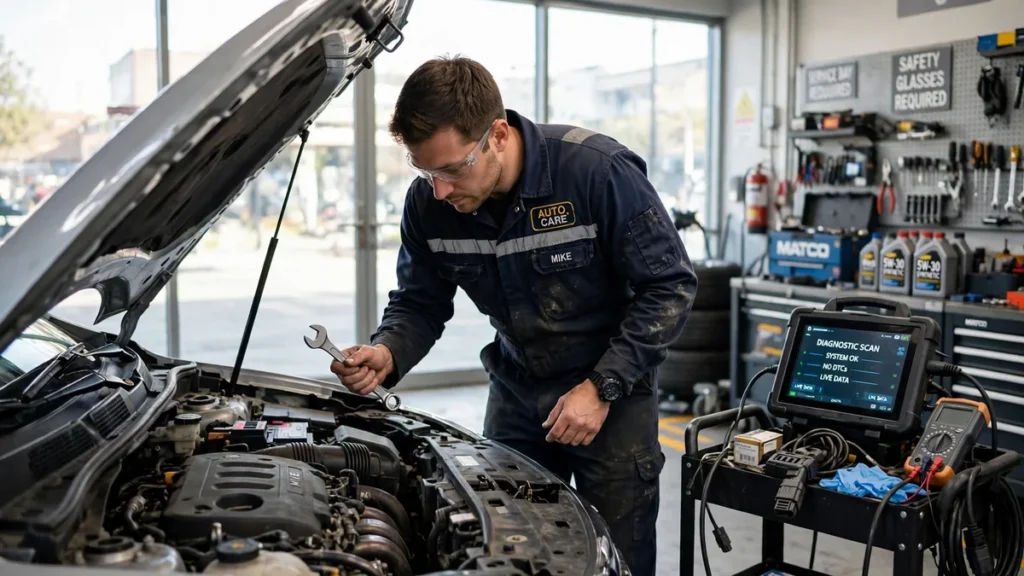
An automotive service technician inspects, maintains, and repairs cars and light trucks. A typical day mixes routine work, such as oil changes, tyre rotations, brake jobs, and inspections, with diagnostic work: tracking down a warning light, a strange noise, or a performance problem. Modern cars are computers on wheels, so diagnosis now means plugging in a scan tool, reading fault codes, and testing sensors and wiring as often as it means turning a wrench.
Mechanics work in dealerships, independent repair shops, fleet garages, and tyre and service centres. The work is physical: you spend the day on your feet, lifting parts and working under vehicles on a lift. It is also social in a way people do not expect. You explain problems to customers, write up what a repair will cost, and sometimes show a worn part to a customer who wants to understand what they are paying for.
The trade keeps changing. Electric vehicles, hybrid systems, and driver-assistance features are now part of everyday repair work, and the mechanics who learn those systems early are the ones whose pay rises fastest.
Do You Need a Licence to Become a Mechanic?
There is no national licence to become a mechanic in the United States, and no state issues a general mechanic’s licence. What employers ask for instead is training and ASE certification. ASE, the National Institute for Automotive Service Excellence, is the credential most shops look for. It is not a licence, but in practice it functions as the trade’s proof of competence, and certified technicians earn more and get promoted faster.
A few states and employers add their own requirements. Some states require an emissions or safety inspection licence for technicians who perform state inspections, usually a short course and a test. Refrigerant handling requires an EPA Section 609 certification, a short online course and test that most training programmes include.
How to Become a Mechanic in 2026: 7 Steps
Step 1: Finish High School and Build the Basics
A high school diploma or GED is the baseline requirement for nearly every mechanic job and training programme. The most useful school subjects are maths, physics, and any shop or automotive class your school offers. If your school has a vocational programme, take it: working on real cars before you graduate gives you a head start.
Step 2: Choose a Training Route
There are four main routes into the trade, and the right one depends on your budget and how fast you want to start earning. A certificate programme at a community college or trade school takes 6 to 12 months, costs roughly $5,000 to $15,000, and gets you job-ready quickly. An associate degree in automotive technology takes two years, costs roughly $15,000 to $25,000, and covers more theory, including electronics and hybrid systems. A paid apprenticeship lets you learn on the job from day one, earning a wage while a senior technician trains you, though these take three to four years to reach journey-level skill. The fourth route is starting as a lube technician or tyre technician with no formal training and working your way up.
Whichever route you choose, look for a programme accredited by the ASE Education Foundation. Accreditation means the curriculum matches what employers and the ASE tests expect, and it can also count toward the work experience ASE requires for certification.
Step 3: Get Hands-On Experience
Classroom learning only goes so far in this trade. The real skill is built with your hands on real cars, and employers hire for it. If you are in a programme, take every shop hour seriously and ask for the difficult jobs. If you are learning on the job, volunteer for work outside your comfort zone and watch how the senior technicians diagnose problems, not just how they fix them.
Step 4: Get ASE Certified
ASE certification is earned one test at a time. You register and pay at ase.com, then sit the computer-based test at a Prometric testing centre. In 2026, expect about a $34 registration fee per order plus about $62 per standard test, with advanced L-series tests costing about $124 each. Each certification stays valid for five years before a recertification test is due.
Most certifications require about two years of relevant hands-on experience, or one year with a relevant two-year degree. You can pass the test before you have met the experience rule: ASE holds your result and issues the certification once your work history is documented and approved. The eight A-series tests, A1 through A8, cover engine repair, automatic transmission, manual drivetrain, suspension and steering, brakes, electrical systems, heating and air conditioning, and engine performance. Passing all eight earns Master Automobile Technician status. If you are just starting out, the G1 Auto Maintenance and Light Repair test is the lowest-barrier entry point: it does not count toward Master status, but it is a real credential employers recognise.
Step 5: Buy Your First Tools
Mechanics supply their own hand tools, and this is the biggest surprise cost for beginners. A starter set of quality hand tools, including sockets, wrenches, screwdrivers, pliers, and a torque wrench, typically costs $1,000 to $3,000. A full professional setup, including a tool chest, diagnostic scan tool, and specialty tools, can reach $10,000 to $15,000 or more over the first few years. Buy the basics first and add tools as the jobs demand them. Your employer usually supplies the large equipment, such as lifts, tyre machines, and alignment racks.

Step 6: Apply for Your First Technician Job
Start applying before you finish training. Dealerships and large independent shops hire graduates directly, and many run their own apprentice programmes. Smaller shops often hire through word of mouth, so visit in person with a short resume that lists your training, any ASE tests you have passed, and the systems you have worked on. Be honest about your level: shops would rather hire a beginner who asks questions than one who pretends to know everything.
Step 7: Keep Learning and Specialise
The mechanics who earn the most are the ones who keep adding skills. After your first ASE certifications, specialise in the areas your shop needs most: diagnostics, diesel, transmissions, or electric and hybrid vehicles. Manufacturer training is especially valuable: dealerships send their technicians to factory courses for the brands they sell, and those credentials travel with you. Electric vehicle certification is becoming a fast track to higher pay, since relatively few technicians are qualified to work on high-voltage systems.
Training Routes and Costs Compared
Certificate programmes cost roughly $5,000 to $15,000 for 6 to 12 months and lead to an entry-level technician role. Technical diplomas run 12 to 18 months at roughly $10,000 to $20,000. Associate degrees take two years at roughly $15,000 to $25,000. An apprenticeship takes three to four years, costs nothing in tuition, and pays a wage while you learn. ASE tests add about $96 for your first test, including the $34 registration fee, and about $62 for each additional test in the same order. Add your first tools at $1,000 to $3,000, and a realistic school-route total is roughly $6,000 to $18,000.
Dealership Versus Independent Shop
Your first employer shapes your early career, and the two main options suit different people. Dealerships offer structured training, manufacturer courses, newer equipment, and steadier workflow, and their technicians earned nearly $10,300 more a year than those at independent shops in recent BLS industry figures. The trade-off is more warranty work, which pays flat-rate hours that can feel tight, and a narrower focus on one brand. Independent shops offer broader experience across many makes and models, closer relationships with customers, and often more freedom in how you work, but training budgets and equipment vary.
What Mechanics Earn
Pay in this trade varies with experience, certification, location, and employer, so treat any single figure as a snapshot rather than a promise. The Bureau of Labor Statistics reported a median annual wage of $50,620 for automotive service technicians and mechanics in May 2025, or $24.34 an hour. The top 10 percent earned more than $81,790 a year. Many shops pay on a flat-rate system, where you are paid a set number of hours per job rather than the hours you actually spend, so an efficient technician can earn well above the hourly equivalent.
Common Mistakes New Mechanics Make
The most common mistake is skipping the diagnosis. New technicians often replace parts by guesswork instead of testing properly, which wastes the customer’s money and your time. Learn to use the scan tool and the multimeter before you reach for the wrench. The second mistake is buying too many tools too fast, especially on credit from the tool truck. The third mistake is neglecting safety: safety glasses, gloves, and proper lifting technique are not optional. The fourth mistake is stopping learning after training. The trade changes every year, and the technicians who stop learning are the ones whose pay stops growing.
Frequently Asked Questions
How long does it take to become a mechanic?
A certificate programme takes 6 to 12 months, and an associate degree takes two years. An apprenticeship takes three to four years. Most people can start working as a technician within a year of starting training.
Do I need a degree to become a mechanic?
No. A high school diploma or GED is enough to start, and many mechanics enter through a certificate programme or an apprenticeship. A two-year associate degree helps with the ASE experience requirement, but it is not required.
How much does it cost to become a mechanic?
A certificate programme costs roughly $5,000 to $15,000, plus $1,000 to $3,000 for your first tools and about $96 for your first ASE test. An apprenticeship costs little beyond tools.
Is ASE certification required?
It is not legally required, but most employers treat it as the standard. ASE-certified technicians earn more, get promoted faster, and have more job options. Start with the G1 test or your first A-series test, then build toward Master status over time.
Can I become a mechanic with no experience?
Yes. The usual routes are a certificate programme, an apprenticeship, or starting as a lube or tyre technician and working up. Employers expect beginners to need training, so apply to shops that offer mentorship.
Is being a mechanic a good career in 2026?
Yes, for people who like hands-on work. Demand is strong, with about 66,200 openings a year projected through 2035, and the work cannot be outsourced. Pay rises with certification and specialisation, especially in diagnostics and electric vehicles. If you want a flexible first step into skilled work, look at the best freelance jobs to earn while you train, or explore the best online business ideas for a second income stream.
The Bottom Line
Becoming a mechanic in 2026 is a practical, proven route into a skilled trade. The entry bar is a high school diploma, training takes months rather than years, and employers are hiring: about 66,200 openings a year are projected through 2035. Get into a good programme or apprenticeship, earn your first ASE certifications, buy your tools gradually, and keep learning as vehicles change. For tools to manage the money side of the trade, the best money apps can help you budget for tools and track your earnings as they grow.

Keep what speaks to you.
Leave room for your own perspective.