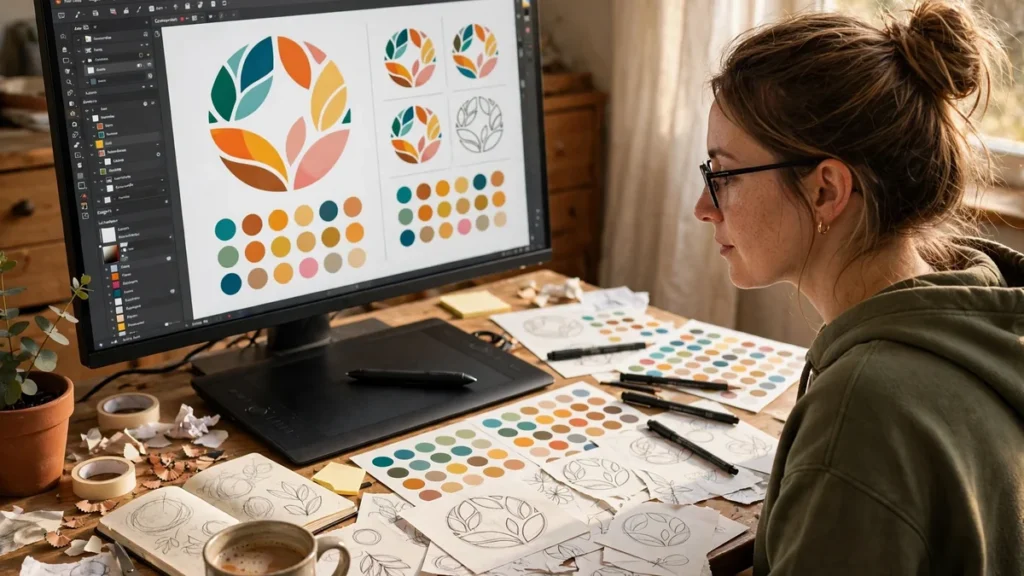
Graphic design is everywhere you look: the logo on your coffee cup, the poster for a film, the packaging of a product, the website you are reading right now. Someone designed every one of those things, and in 2026 that someone could be you. You do not need an art degree or expensive equipment to start. What you need is a trained eye, working knowledge of the main design tools, and a portfolio that proves you can solve visual problems.
What Does a Graphic Designer Actually Do?
A graphic designer creates visual concepts that communicate ideas, inspire people, and sell products. The work covers a wide range: logos and brand identity, social media graphics, posters, packaging, book covers, websites, advertisements and presentations. Most designers work on a brief, a short description of what a client needs, who the audience is, and what the design must achieve. The designer’s job is to turn that brief into visuals that work.
A typical week mixes creative and practical work. You take briefs, research competitors and the target audience, sketch ideas, and build the strongest ones into finished designs. You present your work, take feedback, and revise, often several times. You also prepare files for print or for the web, which means knowing sizes, colour modes and file formats. Deadlines are real: a poster for an event cannot be late, and a product launch will not wait.
There are three common ways to do this job. In-house designers work for one company and know its brand deeply. Agency designers handle several clients at once, which means variety and faster learning but more deadlines. Freelance designers choose their own clients and hours and keep the full fee, but they also handle their own sales, invoicing and taxes.
How Much Do Graphic Designers Earn in 2026?
The Bureau of Labor Statistics puts the median annual wage for graphic designers at 62,960 dollars, or 30.27 dollars an hour, in May 2025. The lowest tenth earned less than 39,520 dollars a year, and the highest tenth earned more than 104,910 dollars. Those are the official numbers for employed designers; freelancers earn differently, since their income depends on their clients rather than a salary.
Pay varies by industry. In May 2025, the median wage was 63,780 dollars in specialized design services, 62,970 dollars in information, 61,200 dollars in advertising, public relations and related services, and 51,670 dollars in manufacturing. Experience matters too: junior designers start near the bottom of the range, while senior designers and art directors earn far more. The fastest way to raise your income is to specialise in work clients pay well for, such as brand identity, packaging or web design, and to build a portfolio that proves you can deliver it.
| Pay level | Annual wage, May 2025 |
|---|---|
| Lowest 10 percent | Less than 39,520 dollars |
| Lower quarter | 49,040 dollars |
| Median | 62,960 dollars |
| Upper quarter | 81,830 dollars |
| Highest 10 percent | More than 104,910 dollars |
Demand is steady rather than booming. The Bureau of Labor Statistics counted about 253,100 graphic designer jobs in 2025 and projects employment to fall slightly, by about 2 percent, to 248,800 by 2035. Designers who combine graphic design with web design, motion graphics or user interface work stay in strong demand. The plan here is built around that reality: learn the core craft, add one adjacent skill, and prove it with real projects.
The Skills You Need to Become a Graphic Designer
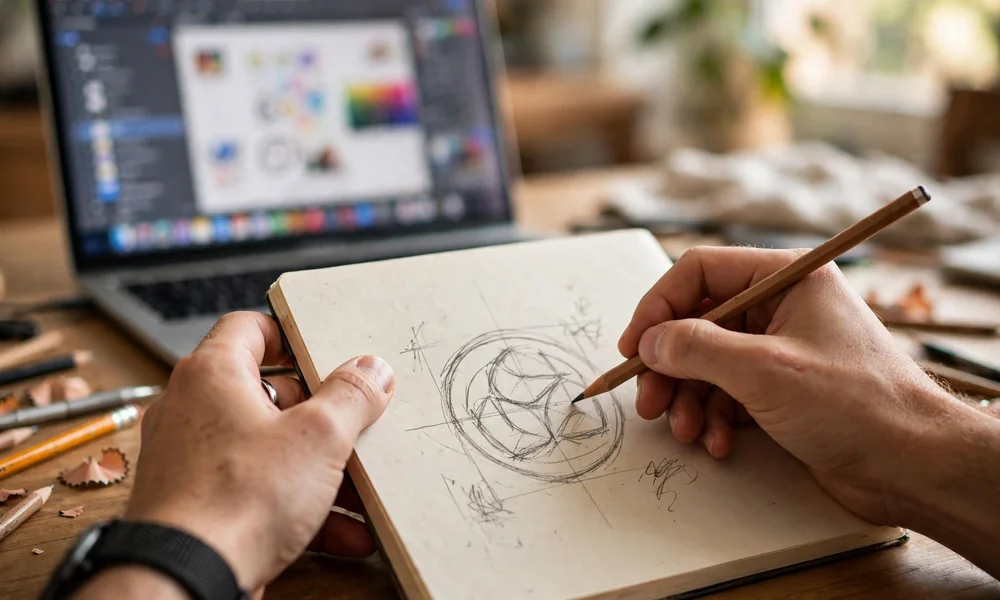
The job rests on five core skills. The first is visual design: typography, colour, layout, spacing and hierarchy, the principles that make a design look professional instead of accidental. The second is drawing and sketching. You do not need to be a fine artist, but you do need to sketch ideas quickly on paper before opening any software, because the best ideas usually start as rough thumbnails.
The third skill is communication. Design is problem-solving, and you must explain your choices to clients who are not designers, in language they understand. The fourth is attention to detail: a misaligned logo, a wrong colour code or a typo in a headline can sink an otherwise good design. The fifth is time management. Designers juggle several projects at once, each with its own deadline, and the work falls apart without a system.
Three softer skills separate the designers who keep clients from those who lose them: curiosity, because styles and tools change every year; resilience, because your work will be criticised and revised constantly; and taste, which is not a gift but a habit, built by studying good design every day.
The Tools Graphic Designers Use in 2026
The toolset is smaller than beginners fear. Adobe Illustrator is the industry standard for logos and vector work, and Adobe Photoshop is the standard for photo-based design. Figma has become essential for web and interface design, and many clients now expect it. Learn one tool deeply before collecting the rest: a designer who truly knows Illustrator is more employable than one who knows five tools shallowly.
You do not need to spend a fortune while learning. Adobe offers student pricing, and free alternatives such as Canva, Photopea and the free tier of Figma cover a surprising amount of beginner work. A drawing tablet helps for illustration, but a mouse and keyboard are enough to start. Hiring managers glance at your tool list for seconds and look at your portfolio for minutes.
Do You Need a Degree to Become a Graphic Designer?
No. Many graphic designers do not hold a design degree, and employers care far more about what you can show than about what you studied. A degree can help, especially for corporate roles, but it is neither required nor the fastest route. Clients hiring a freelancer almost never ask about education; they ask to see a portfolio and results.
There are three realistic learning routes. Self-study is nearly free and flexible, built from online courses, tutorials and practice, but it demands real discipline and takes most people six to twelve months to reach job-ready. A short specialist course costs a few hundred dollars and gives structure and feedback, usually over eight to sixteen weeks. A university degree takes years and costs far more. Whichever route you pick, the work that gets you hired is the same: structured learning plus real projects. If you want to build something of your own alongside design work, the best online business ideas of 2026 show what pairs well with design skills.
Your Step-by-Step Plan to Become a Graphic Designer
Here is the plan in order, for someone starting from zero and studying part-time. Most people reach their first paying client in six to twelve months.
Step 1: Learn the fundamentals, months 1 to 2
Start with design principles, not software. Learn typography, colour theory, layout, hierarchy and spacing, and study the work of designers you admire. Recreate posters and logos you like, not to copy them, but to understand how they are built. These foundations matter more than any tool, because software changes while principles last.
Step 2: Master one tool, months 2 to 4
Pick Illustrator first if you want to design logos and branding, or Photoshop if you lean toward photo and social media work. Follow the official tutorials, then rebuild real designs from scratch: a brand logo, a poster, a product label. Rebuilding teaches spacing, type and colour faster than any lecture.
Step 3: Run your first real projects, months 4 to 6
Design for real people, not imaginary briefs. Offer a logo to a local business, a poster to a community event, or a menu to a cafe. Real clients give you real constraints and real feedback, and that experience is worth more than any classroom exercise. Do two or three of these, even at a low price, and document the brief, your process and the final result.
Step 4: Build a portfolio of six to eight pieces, months 6 to 8
Turn your best work into a portfolio, on a website or a platform such as Behance. Include six to eight pieces across different types of work: a logo, a poster, a social media set, a packaging design. Each piece should show the brief, your thinking and the result. Quality beats quantity: six strong pieces open more doors than twenty average ones.
Step 5: Land your first paying client, months 8 to 10
Your first paying client is usually close by: a local shop, a restaurant, a charity or a friend’s small business. Offer a clear package, such as a logo plus social media templates, at a starting price based on the BLS hourly figure in this guide. Do excellent work, deliver on time, and ask for a testimonial and a referral.
Step 6: Specialise and raise your rates, months 10 to 12
Once you have a few clients, specialise. Pick the type of work where your results are strongest, such as brand identity, packaging or web design, and learn its language and its customers. Raise your rates with each new client, and build simple systems: templates and checklists that save hours.
Freelance, Full-Time or Agency?
Most beginners should aim for a full-time job or a small agency first. A steady salary, a team to learn from, and a senior designer reviewing your work will accelerate your growth more than anything else. Freelance graphic design can pay well once you have several clients, but it is a hard way to start: clients expect you to already know what you are doing, and a third of your week disappears into finding work, invoicing and admin. If freelancing appeals to you, compare it with the best freelance jobs of 2026 first.
Getting paid properly matters as much as getting hired. Freelancers need a simple way to invoice, track expenses and receive payments. Before you take your first client, set up a payment routine and a place to track what you earn. The best money apps of 2026 can help you manage income, expenses and savings while you build the business.
Key Takeaways
- You do not need a design degree; a portfolio of six to eight strong pieces matters far more than any qualification.
- The median graphic designer earned 62,960 dollars a year in May 2025, according to the Bureau of Labor Statistics, with the top tenth earning more than 104,910 dollars.
- Learn design principles first, then master one tool deeply: Illustrator for logos and branding, Photoshop for photo work, Figma for web design.
- Real projects with real clients beat classroom exercises: design for a local business, document the process, and build your portfolio from the evidence.
- Expect six to twelve months from zero to your first paying client, start with a local business, then specialise and raise your rates.
Frequently Asked Questions
How long does it take to become a graphic designer?
Most beginners reach their first paying client in six to twelve months part-time.
Can I become a graphic designer without a degree?
Yes. Many graphic designers do not have a design degree; employers and clients hire on portfolio quality, not qualifications. Six to eight strong pieces open more doors than a diploma alone.
Is graphic design still a good career in 2026?
Yes. The median pay is 62,960 dollars a year, and designers who add web design, motion graphics or interface skills stay in strong demand even as the occupation’s total headcount edges down slightly.
Do I need expensive software to learn graphic design?
No. Free tools such as Canva, Photopea and the free tier of Figma cover much of what a beginner needs, and Adobe offers student pricing. A mouse and keyboard are enough to start; a drawing tablet can wait.
How much does it cost to learn graphic design?
Self-study can cost under 500 dollars for courses and basic tools. The biggest cost is your time: consistent daily practice for several months.
The Bottom Line
Becoming a graphic designer in 2026 is realistic for anyone willing to put in six to twelve months of work. Learn the principles, master one tool, design for real clients, and build a portfolio of six to eight strong pieces.

Keep what speaks to you.
Leave room for your own perspective.