
Dog Groomer Salary in 2026: Pay by State and Setting
Dog grooming has grown from a niche trade into a booming service business. Millions of households now treat their dogs like family, and they pay professionals to wash, cut, and style them. A good groomer can build a loyal book of clients, work in a salon, run a mobile van, or open a shop of their own. But what does the job actually pay? The honest answer starts with a quirk in the official data: the U.S. Bureau of Labor Statistics has no job code for dog groomers. It counts them as animal caretakers, a group that also includes kennel attendants, shelter workers, and zookeepers. That group earned a median of $35,360 a year, or $17.00 an hour, in May 2025. It is the closest official figure for groomer pay, and it is the number this guide uses throughout. The real story is in the range: where you work and how you work can move your earnings by thousands of dollars a year.
Key takeaways
- The Bureau of Labor Statistics counts dog groomers as animal caretakers, who earned a median of $35,360 a year ($17.00 an hour) in May 2025.
- The middle half of animal caretakers earn between $29,820 and $40,050 a year, while the top 10 percent earn more than $50,060.
- Washington, D.C. pays the most at $44,210 a year; Mississippi pays the least at $26,970.
- Self-employed groomers, including mobile operators and booth renters, are not counted in the official wage figures, and about 25 percent of animal caretakers are self-employed.
- Employment of animal caretakers is projected to grow 12.1 percent from 2025 to 2035, with about 62,800 openings a year.
Dog groomer salary at a glance
The Bureau of Labor Statistics reported 266,910 animal caretakers on employer payrolls in May 2025, at a median wage of $17.00 an hour. The full range shows how far the job can go. The lowest 10 percent earned less than $27,250 a year ($13.10 an hour), the 25th percentile sat at $29,820 ($14.34 an hour), the 75th percentile reached $40,050 ($19.26 an hour), and the highest 10 percent earned more than $50,060 a year ($24.07 an hour). Two important limits apply to these figures. First, the survey counts wage and salary jobs only, so it leaves out the self-employed, and the Bureau of Labor Statistics says about 25 percent of animal caretakers work for themselves. Mobile groomers, booth renters, and shop owners are a large part of the trade, and their earnings sit outside these numbers entirely. Second, the figures are medians for the whole animal caretaker group, not groomers alone, so kennel and shelter workers pull the average in ways that have nothing to do with a salon. Tips are another gap: many clients tip their groomer, and tips sit on top of the base wage rather than inside it, so a busy groomer with generous clients can take home noticeably more than the median suggests.
| Pay level | Per hour | Per year |
|---|---|---|
| Lowest 10 percent | $13.10 | $27,250 |
| 25th percentile | $14.34 | $29,820 |
| Median (50th percentile) | $17.00 | $35,360 |
| 75th percentile | $19.26 | $40,050 |
| Highest 10 percent | $24.07 | $50,060 |
All figures are Bureau of Labor Statistics Occupational Employment and Wage Statistics, May 2025, for animal caretakers (SOC 39-2021), the occupation that includes dog groomers, covering wage and salary workers only.
Dog groomer pay by setting
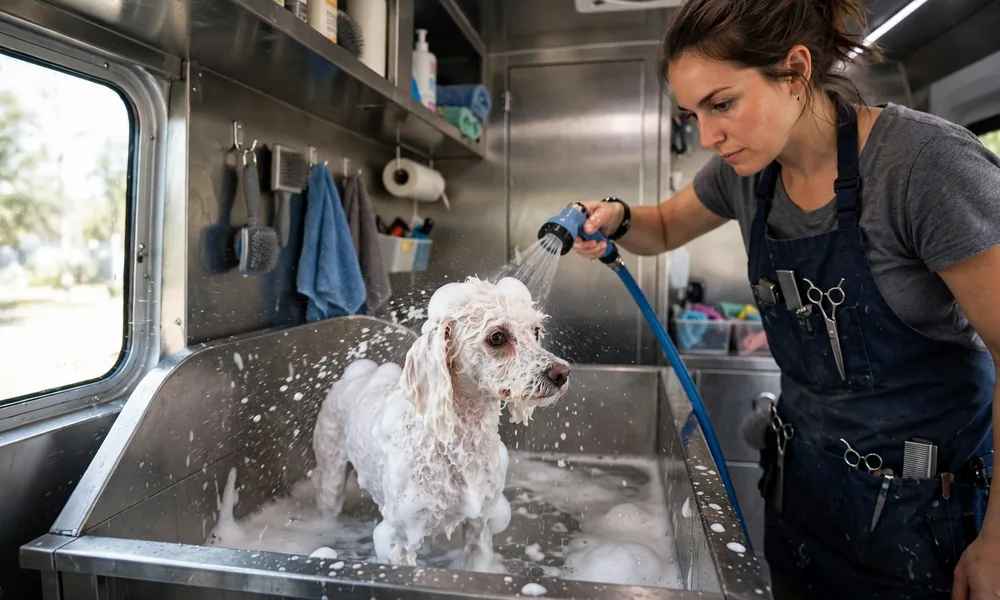
Three settings dominate dog grooming, and each one pays differently. Grooming salons employ the most groomers. In the official data, the industry group that contains grooming salons, other personal services, pays a median of $35,190 a year ($16.92 an hour), a touch below the all-industry median of $35,360. Salon groomers usually work a steady schedule, groom a set number of dogs a day, and earn a base wage plus commission or tips. The trade-off is control: the salon sets the prices, keeps the client list, and takes the largest share of each groom. Mobile grooming is the second setting, and it is the one with the highest earning ceiling. A mobile groomer drives a fitted-out van to clients’ homes, charges a premium for the convenience, and keeps far more of each groom after fuel and van costs. The work is physical and the day is long, with driving between appointments, but experienced mobile groomers with a full book are among the best-paid people in the trade. Pet stores are the third setting. Large chains hire groomers as employees, offer steady hours and benefits, and train new groomers from scratch, which makes them the most common entry point into the trade. The pay starts near the bottom of the range, but the training is free and the pipeline into a salon or mobile role is short.
Dog groomer salary by state
State makes a large difference to groomer pay. The District of Columbia leads the country with a median of $44,210 a year ($21.25 an hour) for animal caretakers, followed by Washington at $40,570 ($19.51 an hour), Hawaii at $40,130 ($19.29 an hour), Massachusetts at $39,650 ($19.06 an hour), and California at $38,700 ($18.60 an hour). At the other end, Mississippi pays a median of $26,970 a year ($12.97 an hour), Louisiana $27,910, Alabama $28,330, West Virginia $28,550, and Oklahoma $28,940. The spread between the top and the bottom is more than $17,000 a year. High pay states tend to be expensive places to live, and they also tend to have more dogs per household and more owners willing to pay for premium grooming. California has the most animal caretaker jobs in the country, with 25,710, followed by Texas with 20,450, Florida with 17,210, New York with 12,470, and Illinois with 11,070. Big job counts mean more salons, more competition for workers, and more choice for a groomer looking for the right employer. If you are choosing where to build a grooming career, the table below shows the ten best-paying and five lowest-paying states.
| State | Median per hour | Median per year |
|---|---|---|
| District of Columbia | $21.25 | $44,210 |
| Washington | $19.51 | $40,570 |
| Hawaii | $19.29 | $40,130 |
| Massachusetts | $19.06 | $39,650 |
| California | $18.60 | $38,700 |
| Arizona | $18.35 | $38,180 |
| New York | $18.19 | $37,840 |
| Colorado | $18.00 | $37,430 |
| Connecticut | $17.94 | $37,310 |
| Maine | $17.90 | $37,230 |
| Oklahoma | $13.92 | $28,940 |
| West Virginia | $13.73 | $28,550 |
| Alabama | $13.62 | $28,330 |
| Louisiana | $13.42 | $27,910 |
| Mississippi | $12.97 | $26,970 |
State figures are Bureau of Labor Statistics Occupational Employment and Wage Statistics, May 2025, median wages for animal caretakers (SOC 39-2021), the occupation that includes dog groomers. Annual figures assume a full-time 2,080-hour year.
What affects how much a dog groomer earns
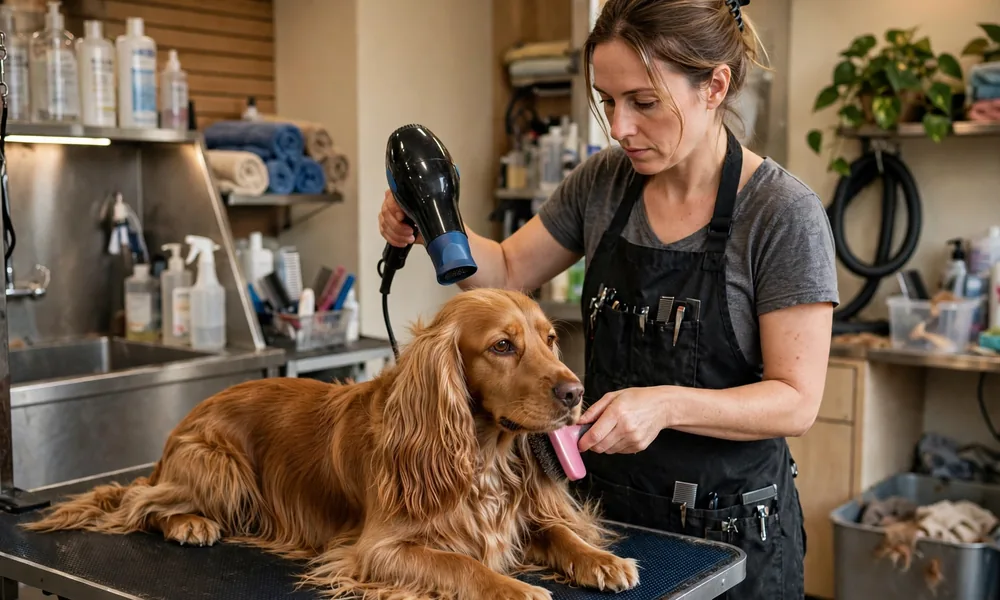
Five factors set a groomer’s pay. Location comes first: the same work pays $44,210 in Washington, D.C. and $26,970 in Mississippi, and the gap is even wider once tips and the cost of living are counted. Setting comes second. A mobile groomer who owns the van and the client list keeps a far larger share of each groom than a salon employee, while a pet store groomer trades pay for free training and steady hours. Experience comes third. A new groomer is slow, and speed is money in this trade: an experienced groomer can finish more dogs a day, handle difficult coats and anxious animals without fuss, and keep clients coming back. Breed skill matters too. Poodles, doodles, spaniels, and terriers need scissoring and styling that a simple bath-and-brush dog does not, and groomers who can do a proper breed cut can charge more for it. Employment type comes fourth. Employees get a wage, while commission groomers earn a share of each groom and booth renters pay the salon a flat fee and keep the rest. The best structure depends on how full your book is: commission suits a groomer building clients, and booth rent or self-employment suits one with a full diary. Tips come fifth. They are not in the official figures, but they are real money for most groomers, and a friendly manner with owners as well as dogs is what earns them.
How to earn more as a dog groomer
The clearest path to higher pay is to get faster and more skilled. Speed comes with practice: a groomer who can finish six dogs a day instead of four earns half as much again on the same hours. Certification helps too. Grooming schools and industry bodies offer credentials in breed styling, safety, and handling, and certified groomers can charge more and win the trust of owners with nervous or difficult dogs. Specializing in high-maintenance breeds is another lever. Doodle and poodle owners need grooming every six to eight weeks and pay premium prices for a groomer who can do the cut properly, so a book full of those clients is worth far more than a book of short-coated dogs. Moving to mobile grooming is the biggest single jump. It needs a van and an upfront investment, but it removes the salon’s cut and lets you set your own prices and hours. Building a loyal client base is what makes every other lever work: regular clients book ahead, tip well, and send their friends. For groomers who want income beyond the table, the best freelance jobs in 2026 can add flexible earnings, and the best online business ideas in 2026 include options such as selling grooming guides or pet care content. Short courses are worth a look as well: the best money apps in 2026 can help a self-employed groomer track income, tips, and expenses, which is the unglamorous work that turns a good week into a good year.
Job outlook for dog groomers
The outlook for dog groomers is strong. Employment of animal caretakers, the group that includes groomers, is projected to grow 12.1 percent from 2025 to 2035, rising from 365,300 jobs to 409,400, with about 62,800 openings projected each year. That growth is driven by pet ownership: more households keep dogs, owners spend more on them, and grooming has become a routine expense rather than a luxury. The trade is also hard to automate. A dog needs hands-on care, and owners want a person they trust handling their pet. New groomers can enter the field with a high school diploma and short-term on-the-job training, and many pet store chains will train a complete beginner.
Frequently asked questions
How much does a dog groomer make an hour in 2026?
The Bureau of Labor Statistics median for animal caretakers, the occupation that includes dog groomers, is $17.00 an hour in May 2025. The middle half earn between $14.34 and $19.26 an hour, and the top 10 percent earn more than $24.07 an hour, before tips.
Which state pays dog groomers the most?
Washington, D.C. pays the most, with a median of $44,210 a year ($21.25 an hour). Among the fifty states, Washington leads at $40,570 a year, followed by Hawaii at $40,130 and Massachusetts at $39,650.
Do mobile groomers earn more than salon groomers?
Usually, yes. Mobile groomers charge a premium for coming to the client’s home and keep a larger share of each groom, since there is no salon taking a cut. The trade-off is the cost of the van, fuel, and driving time between appointments, and the income depends on keeping the diary full.
Do dog groomers get tips?
Yes, tipping is common in dog grooming, and tips sit on top of the base wage rather than inside the official figures. The amount varies by area and by client, and a groomer with a loyal book of regulars can add a meaningful sum to the median wage through tips alone.
How long does it take to become a dog groomer?
Most groomers start with a high school diploma and short-term on-the-job training, often through a pet store chain or a grooming school course lasting a few weeks.
The bottom line
A dog groomer in the United States earns a median of $35,360 a year in 2026, measured through the animal caretaker occupation that holds the trade. That figure is only the starting point. The best-paying state offers more than $17,000 a year above the worst, mobile groomers can out-earn salon staff by a wide margin, and tips add income the official figures never capture. With employment growing 12.1 percent over the next decade, grooming is a trade with room to grow. If you are entering the field, get trained, build speed and breed skills, fill a loyal book of clients, and aim for mobile or self-employed work.

Keep what speaks to you.
Leave room for your own perspective.


