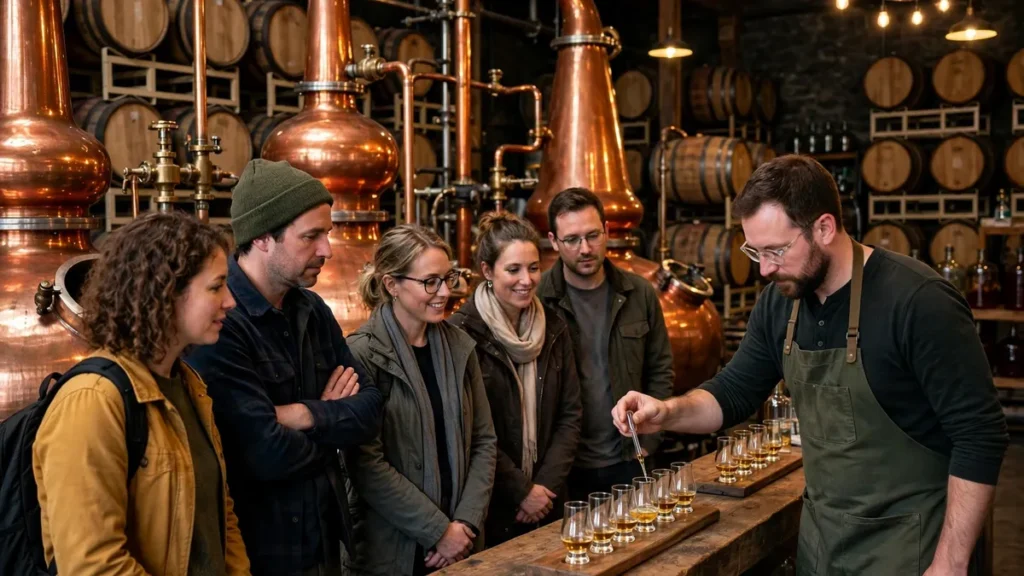
A distillery tour startup sells an afternoon that guests remember long after the last sip: a guide leading a small group past gleaming copper stills, the warm smell of oak and grain in the air, and a tasting table where strangers compare notes on a whiskey they watched being made an hour earlier. The best AI tools for distillery tour startups in 2026 help a founder turn that experience into a real business without hiring a large team first, covering everything from checking whether a town can support another tour to planning the route, selling seats, keeping distillery partners happy, and answering guest questions at midnight.
The first year of a distillery tour company is unforgiving in quiet ways. There is no shopfront to catch passing trade, no second chance with a guest who waited at the wrong meeting point, and no way to fix a tasting once the group has already moved on to the next stop. Founders who guess at demand, price by instinct, or run a route they have never timed with real pours usually discover the mistake in their reviews, after the money is spent. A tour that is too long leaves guests tired before the final tasting. A tour that is too short leaves them feeling short-changed. A tour that ignores transport timing, distillery opening hours, or a guest who does not drink alcohol can turn a happy group into a serious problem in minutes.
AI tools do not remove that risk, but they make it visible earlier, when it is still cheap to fix. They help a founder test demand in a region, compare tasting fees, write clear route notes, keep distillery partners paid on time, and reply to guests before a rival tour takes the booking. This guide compares nine tools that fit a distillery tour business specifically, judged on what they do for a founder with a small team and a tight budget, how much they cost to start, and where they fit in the first ninety days. Use it to build a lean stack, spend only on tools that earn their cost back, and open with a tour guests want to recommend to friends.
Key takeaways
- Start with one tool for bookings, one for guest messages, and one for marketing, and add more only when a clear bottleneck appears in your launch plan.
- Validate demand and drive the full route with real pours and real timing before you spend on branding, because a beautiful website for a tour nobody wants is the most expensive mistake a founder can make.
- Lock in distillery partners, tasting fees, and opening hours in writing before you sell a single seat, and share a clear sheet with every guide and driver before each departure.
- Keep groups small enough that everyone can hear the guide, taste at every stop, and ask questions without holding up the route.
- Measure every tool by the same standard: hours saved each week, extra seats sold, and whether guests actually notice better timing, clearer directions, and smoother service.
Why Distillery Tours Need AI in 2026
A distillery tour company sells a guided day built around spirits, transport, and timing, and that simple fact shapes every tool choice. Unlike a software startup, you cannot fix a bad tasting with an update, and unlike a restaurant, your customers all arrive at the same meeting point at the same time and expect spirits that are poured, a driver who knows the roads, and a guide who can talk about mash, fermentation, and ageing without reading from a card. The founder needs tools that handle the business before the first tour, the creative work of building the route, and the daily rhythm of seats once guests start booking. A tool that only helps with one of those three jobs is a luxury; a tool that helps with two is a genuine asset.
The booking and operations side has much in common with other guided drinks experiences, and the lessons in the AI tools for brewery tour startups show how route-based businesses handle manifests, meeting points, and seasonal demand. A distillery tour founder can borrow that discipline without copying the beer-first model, because the differences matter. A brewery tour worries about taprooms, flights, and food pairings; a distillery tour founder worries about distillery opening hours, tasting fees, transport licences, responsible service of alcohol, and partners who may be busy running their own stills when the group arrives. The still room is a working production floor, not a bar, so the tour has to fit around real production schedules.
There is also a useful contrast with the production side of the spirits world. The AI tools for distillery startups cover stills, mash bills, and bottling, which is a different business from moving guests between distilleries. A tour founder does not need to know how to make whiskey; the founder needs to know how to sell seats, keep a route on time, and make every distillery on the route glad the group came. Keeping that boundary clear stops a founder from buying production software when what is actually needed is a booking system and a good itinerary.
Best AI Tools for Distillery Tour Startups at a Glance
| Tool | Best for | Standout feature |
|---|---|---|
| Checkfront | Online bookings and availability | Real-time availability with automated confirmations |
| Xola | Bookings plus distribution | Listings that reach travellers on major channels |
| Ventrata | Ticketing and channel management | One inventory shared across every sales channel |
| Circuit | Planning multi-stop tour routes | Route optimisation that saves driving time and fuel |
| Intercom | Guest messaging and support | AI answers to common booking questions, day and night |
| ActiveCampaign | Email marketing and automation | Automated journeys that turn one-time guests into repeat bookers |
| Notion AI | Planning, SOPs, and route notes | AI drafting for guides, scripts, and checklists |
| Typeform | Tasting preferences and feedback | Conversational forms guests actually finish |
| Wave | Invoicing and small-business accounting | Free invoicing with simple expense tracking |
The 9 Best AI Tools for Distillery Tour Startups in 2026
The tools below are ordered the way a founder would actually adopt them: bookings first, then routes, then the guest relationship, marketing, and money. Each one solves a specific problem inside a distillery tour business, and each one works well alongside the others.
1. Checkfront for Online Bookings and Availability
Checkfront is built for tour and activity operators, which shows in the details. Guests see live availability, pick a departure time, choose add-ons such as a private group option, a tasting flight upgrade, or a bottle to take home, and pay in the same flow. The system sends confirmations and reminders automatically, so the founder is not copying names from an inbox into a spreadsheet the night before a tour. For a distillery tour, where a seat is also a place in a small tasting room, that live availability is the difference between a smooth day and an overbooked one.
The part that matters most for a distillery tour is capacity control. A tour has hard limits: the van seats twelve, the distillery can host eighteen in the still room, the tasting closes at six. Checkfront enforces those limits in real time, so two guests can never book the last two seats at the same moment. That single feature prevents the awkward phone call no founder wants to make, and it protects the relationship with the distillery, which will not forgive a group that arrives larger than agreed.
Checkfront also handles the small jobs that pile up around bookings. Waivers can be collected at checkout, dietary and non-drinking notes can be captured on the booking form, and guides can see the day’s manifest on a phone. Reporting is straightforward, with clear views of which departure times sell out and which ones sit empty, so pricing and scheduling decisions rest on real numbers instead of gut feel. There are trade-offs. Checkfront is a booking platform first, so it does not try to be a full marketing suite or a route planner, and a founder will still need separate tools for email or route planning. Pricing is built around booking volume, which is fair for a growing company but worth checking against a quiet first season. For a distillery tour startup that wants bookings to run themselves, though, Checkfront is the most dependable starting point.
Best for: tour operators who want reliable online bookings with live availability. Standout feature: real-time availability with automated confirmations and reminders.
2. Xola for Bookings Plus Distribution
Xola pairs a solid booking system with distribution that a small startup could never build alone. A distillery tour listed through Xola can appear in front of travellers who are already planning a trip, comparing activities, and booking experiences for the weekend. That matters because a new tour company has no reputation yet, and being found where travellers already search is often faster than waiting for a new website to rank. The booking calendar stays in sync across channels, so a seat sold on a partner site is a seat that cannot be sold twice.
Inside the business, Xola covers the daily work well. Guests book online or by phone, pay securely, and receive tickets and reminders without the founder touching anything. Guides get a clean manifest for each departure, including add-ons and special notes, and the founder can see which channels actually produce bookings instead of guessing where marketing money should go. For a distillery tour, the gift and private-booking options are useful too: birthdays, stag groups, and corporate outings are a large share of early revenue, and Xola handles private departures and group pricing without a separate spreadsheet.
Best for: new tour companies that need bookings from traveller marketplaces from day one. Standout feature: listings that reach travellers on major channels with synced availability.
3. Ventrata for Ticketing and Channel Management
Ventrata is built for attractions and tours that sell the same seats through many channels at once, and that is exactly the problem a growing distillery tour faces. The same Saturday departure might be sold on the company website, through a hotel concierge, on a marketplace, and over the phone, and Ventrata keeps one shared inventory behind all of them. When a seat sells anywhere, it disappears everywhere else, which removes the double-booking risk that haunts a tour with small groups and fixed tasting-room capacity.
The ticketing side is equally practical. Guests receive mobile tickets with clear meeting-point details, and guides can scan them at the door instead of working from a printed list. That sounds minor until the first rainy morning when twelve guests arrive at once and the guide needs to know in seconds who is booked, who paid for the premium tasting, and who is a non-drinker. Ventrata also supports timed entry, which helps when a distillery can only take one group into the still room at a time, and it keeps the schedule honest across the whole route.
Ventrata is a more serious system than a simple booking form, and that is both its strength and its cost. Setup takes longer, and the founder needs to think through channels, ticket types, and capacity rules before the first sale. Smaller operators may find it more than they need in month one. But for a distillery tour startup that plans to grow into hotel partnerships and marketplace sales, starting on a system that already handles multi-channel inventory saves a painful migration later. It is the tool to choose when the founder can see the second year clearly and wants the plumbing to be ready for it.
Best for: tour companies selling the same seats through websites, hotels, and marketplaces at once. Standout feature: one inventory shared across every sales channel.
4. Circuit for Planning Multi-Stop Tour Routes
Circuit turns a scattered list of distillery stops into a tight, sensible route, and that is where a distillery tour quietly makes or loses money. A route that backtracks across town wastes fuel, eats tasting time, and leaves guests sitting in a van instead of standing in a still room. Circuit takes the stops, the time each one needs, and the order that makes sense, and produces a route that a driver can actually follow, with clear stop times and notes for each arrival. The founder can test a new route on paper before ever driving it.
The day-to-day value is in the details. Drivers get turn-by-turn directions and a stop list on their phone, guides see how long each stop should run, and the founder can adjust the route when a distillery changes its opening hours or a road closes. For a distillery tour, timing is not a nice extra: the group has to arrive when the still room is free, leave before the next group arrives, and still reach the final tasting while guests are fresh. Circuit keeps that chain visible, and when a stop runs long, the rest of the route can be re-planned in minutes rather than by guesswork.
Best for: founders running multi-stop routes who need driving time kept tight. Standout feature: route optimisation that saves driving time and fuel.
5. Intercom for Guest Messaging and Support
Intercom answers the questions that arrive at midnight, and for a tour company those questions are almost always the same: where do we meet, what time do we leave, is there a non-drinking option, can I bring my teenager, what happens if it rains. Its AI assistant can answer those from the founder’s own help content, take a booking enquiry, and hand over to a human when the question is genuinely unusual. That means a guest who is deciding between two tours at 11pm gets an answer from this company, not silence until morning.
The value goes beyond the website chat box. Intercom keeps every guest conversation in one place, so the founder can see the whole history when a guest messages again the day before the tour. It can send proactive messages too, such as a meeting-point reminder the evening before departure, or a weather note when the forecast changes. For a distillery tour, where a missed meeting point means a missed tour, that kind of timely message is worth more than any advert. Guests who feel looked after before the tour even starts arrive relaxed and ready to enjoy it.
Best for: tour companies that get frequent guest questions and want fast answers around the clock. Standout feature: AI answers to common booking questions, day and night.
6. ActiveCampaign for Email Marketing and Automation
ActiveCampaign turns a one-time guest into a repeat booker, and that is where a distillery tour makes its real money. A guest who enjoyed a whiskey tasting is a natural candidate for a gin tour next season, a gift voucher at Christmas, or a private tasting for a birthday. ActiveCampaign builds automated journeys around that: a thank-you email the evening after the tour, a review request a day later, a seasonal offer when a new departure opens, and a reminder when a past guest has not booked in a year. Once the journey is set up, it runs without the founder remembering to send anything.
The segmentation is what makes it work for tours. Guests can be grouped by which spirit they tasted, whether they drank or not, whether they came as a couple or a group, and whether they bought a bottle. Each group then gets offers that actually fit, instead of the same generic newsletter going to everyone. A non-drinker who loved the still-room tour gets the behind-the-scenes experience, not a discount on whiskey. That kind of relevance is what keeps emails opened instead of unsubscribed from, and it is the difference between a list that grows and a list that shrinks.
ActiveCampaign is more powerful than a basic newsletter tool, and it asks a little more of the founder in return. The automation builder has a learning curve, and the founder needs to keep the guest list clean and permissioned. But for a tour company whose best customers are its past guests, it is one of the highest-return tools in this guide. A single repeat booking per month often covers the cost, and everything after that is profit built on guests who already trust the brand.
Best for: founders who want past guests to book again and recommend the tour to friends. Standout feature: automated journeys that turn one-time guests into repeat bookers.
7. Notion AI for Planning, SOPs, and Route Notes
Notion AI is where the tour itself gets written down properly. Every distillery tour needs a set of documents: the route sheet for each departure, the script a guide follows at each stop, the safety notes for the still room, the tasting notes for each spirit, and the checklist for the van. Notion AI drafts those from a short brief, summarises long partner emails into action points, and turns a rambling voice note after a route test into a clean set of timings. The founder stops keeping the tour in their head and starts keeping it in a place any guide can read.
That matters because a tour company lives or dies on consistency. A guest who books because a friend raved about the guide expects the same quality on their own day, and that only happens when the guide has a clear, current script and route sheet. Notion AI also helps with the business side: launch plans, partner trackers, content calendars, and a simple CRM of distilleries and hotels can all live in one workspace, each page linked to the next. When a distillery changes its tasting fee or its opening hours, the founder updates one page and every guide sees the change.
Notion AI is not a booking system, a route planner, or an accounting tool, and it should not be forced into those jobs. Its strength is thinking and writing: turning rough notes into usable documents quickly. The free tier covers much of what a new tour company needs, and the AI add-on is cheap compared with the hours it saves. For a founder who wants the tour documented, the guides prepared, and the launch plan visible in one place, Notion AI is the quiet tool that holds the whole operation together.
Best for: founders who need guides, scripts, and route notes written clearly and kept current. Standout feature: AI drafting for guides, scripts, and checklists.
8. Typeform for Tasting Preferences and Feedback
Typeform collects the two kinds of information a distillery tour needs most: what guests want before the tour, and what they thought afterwards. Before the tour, a short conversational form asks about spirit preferences, non-drinking guests, dietary needs, and special occasions, and the answers land in the guide’s manifest automatically. After the tour, the same style of form asks for a rating and a few honest words, while the experience is still fresh. Guests finish Typeform surveys at far higher rates than they finish dull grid questionnaires, because each question feels like a conversation rather than a chore.
The pre-tour form is where the real value sits. A guide who knows that three guests prefer gin, two do not drink, and one is celebrating a fiftieth birthday can shape the tasting around the group instead of delivering the same script to everyone. That personal touch is what turns a good review into a great one. Typeform’s logic jumps help too: a non-drinker sees questions about the tour and the food, not about which whiskey they liked best, and a private-group booker sees questions about timing and pick-up points that a single ticket buyer never needs.
After the tour, the feedback form feeds directly into the review strategy. A happy guest can be invited to leave a public review with one click, while an unhappy guest’s answers go straight to the founder before they become a public complaint. That loop is how a new tour company learns fast and improves every month. Typeform is not free at the level a growing company needs, and the founder should keep forms short: every extra question costs completions. But for a business where guest knowledge is the product, a tool that guests actually answer is worth paying for.
Best for: founders who want to know their guests before the tour and hear from them after it. Standout feature: conversational forms guests actually finish.
9. Wave for Invoicing and Small-Business Accounting
Wave handles the money side for a distillery tour startup, and it does so largely for free. Invoices for private tours, corporate bookings, and partner commissions can be created and sent in minutes, with payment links included so the client pays without a round of emails. Expenses such as fuel, tasting fees, and van hire can be logged on the day they happen, and at the end of the month the founder can see, in one place, what the tours earned and what they cost. For a business where margins are thin in the first year, that clarity is not a luxury.
The real benefit is discipline. A tour company that invoices late, forgets a tasting fee, or loses track of who has paid will run out of cash long before it runs out of guests. Wave keeps the paper trail clean: every booking has an invoice, every distillery partner has a record, and every expense has a receipt attached. When tax time arrives, the books are already in order instead of being rebuilt from a pile of emails. Wave also connects to a bank account, so transactions can be matched to invoices without manual entry, which removes the weekly bookkeeping session that founders dread.
Best for: small tour companies that need clean invoicing and expense tracking without a monthly fee. Standout feature: free invoicing with simple expense tracking.
Distillery Tour Startup Launch Checklist
- Walk the route yourself with real pours and real timing, and confirm every distillery’s opening hours, tasting fee, and group limit in writing.
- Choose one booking tool, such as Checkfront or Xola, and sell your first seats through it before buying anything else.
- Set up guest messaging with clear answers for meeting points, non-drinkers, and cancellations, so no enquiry waits overnight.
- Build the guide pack: route sheet, tasting notes, safety notes, and a script for each stop, and test it with a small group of friends first.
- Send the feedback form after every tour for the first month, read every answer, and fix the single most common complaint before the next departure.
- Review the numbers weekly: seats sold, no-shows, cost per tour, and repeat bookings, and change one thing at a time based on what the numbers say.
Frequently Asked Questions
How much does it cost to start a distillery tour company with AI tools?
A lean start costs a few hundred dollars a month in software once the basics are in place, plus the real costs of the business: the vehicle, insurance, tasting fees, and licences. The booking tool is the largest software cost, while tools such as Wave and the free tier of Notion AI cost little or nothing. The expensive mistake is buying everything before the first tour; start with bookings, messaging, and one marketing tool, then add tools only when a clear bottleneck appears.
Do I need a licence to run a distillery tour?
Yes, in most places. The exact requirement depends on the region, but a tour that moves guests between licensed premises and serves alcohol usually needs a transport licence, a business licence, and an arrangement with each distillery that covers responsible service. Talk to the local licensing authority before selling a single seat, and keep the paperwork with the guide pack so every guide knows the rules.
How do I handle guests who do not drink alcohol?
Plan for them from the start, not as an afterthought. Capture the information on the booking form, tell the distillery in advance, and make sure the tasting includes a proper non-alcoholic option rather than a glass of water. Non-drinkers often book for the story, the still room, and the company, and they leave the best reviews when they feel genuinely included instead of tolerated.
How many distilleries should a tour visit?
Two or three is the right number for a half-day tour. One stop feels thin, while four or more leaves guests rushed and tired, and the driving time eats into the tasting time. Three stops with a proper tasting at each, plus a short break, fills an afternoon well and leaves guests wanting to come back rather than wanting to go home.
How do I find distillery partners for a new tour?
Visit in person, taste the spirits, and explain what the tour offers the distillery: regular groups, guests who buy bottles, and no extra work for their staff. Small craft distilleries are often the best partners because they welcome the visitors and the sales, while larger ones may already have their own tours. Agree tasting fees, group limits, and opening hours in writing before the first booking.
Can a distillery tour work in a small town as well as a big city?
Yes, and sometimes better. A small town with two or three craft distilleries can support a tour built around local character, and guests often prefer the unhurried pace. The same route discipline that works for the AI tools for wine tour startups applies here: a tight route, honest timing, and partners who are glad the group came matter far more than the size of the town.
The Bottom Line
A distillery tour startup does not need the most tools; it needs the right few, used well. One booking platform that protects capacity, one route tool that keeps the day on schedule, one messaging tool that answers guests fast, one marketing tool that brings past guests back, and one money tool that keeps the books honest will carry a new company through its first year. The nine tools in this guide cover those jobs, and a founder can start with three of them and add the rest as the business grows.
The tour itself is still the product. No software can replace a guide who knows the stills, a route that runs on time, and a tasting that guests remember. The tools exist to clear the way for that experience: to handle the bookings, the messages, and the money in the background, so the people on the tour get the founder’s full attention. Build the stack lean, walk the route before you sell it, listen to every guest, and the business will grow one five-star review at a time.

Keep what speaks to you.
Leave room for your own perspective.


