
The best AI tools for countertop installation startups in 2026 turn a small crew, a van, and a rented shop corner into a business that measures precisely, quotes in minutes, cuts without waste, and installs on the day it promised. A countertop job is unforgiving in a way that most home improvement work is not. Stone cannot be uncut, a template taken from cabinets that are not yet level will not fit, and a slab ordered in the wrong colour or with the wrong edge profile is a loss that no amount of careful fitting can rescue. The startups that win are the ones that remove guesswork from every step between the first phone call and the final seal, and the right software is what makes that possible when the team is still small.
A new countertop installation startup faces a particular kind of pressure. Homeowners compare your work with the flawless stone they see in showrooms and online, they expect a firm price before they commit, and they want the install finished in a day with no dust left behind. At the same time, you are templating kitchens where the walls are never square, nesting sink and hob cutouts onto expensive slabs, and coordinating with cabinet installers and plumbers. Doing all of that from spreadsheets, text messages, and memory is how good installers lose money on jobs they should have won.
This guide compares the AI tools that fit a countertop installation startup, not a general kitchen remodeler and not a large stone fabricator with its own factory. It focuses on the work a young countertop company actually does: turning a homeowner’s ideas and a site measure into a digital template, pricing quartz, granite, and porcelain accurately, nesting cutouts onto slabs to cut waste, scheduling the template and install visits in the right order, fitting and sealing the stone, and collecting reviews that bring in the next kitchen. Every tool was judged on the same practical questions: does it save time on a real countertop job, does it work from a phone on a job site, does it pay for itself in won jobs and avoided mistakes, and can a small team learn it in a week?
Key takeaways
- Start with one digital templating tool, one quoting and job management platform, and one AI messaging tool. Those three carry most of the revenue for a new countertop installation startup.
- Measure digitally and quote from the template, not from a tape and a guess. A laser template and an instant quote win jobs and stop the expensive remeasures that eat stone margins.
- Nest every cutout onto the slab before you order it. AI slab layout turns one saved slab a month into real profit for a small countertop crew.
- Get every approval in writing inside the same system. Signed selections for stone, edge profile, sink, and hob cutouts prevent the misunderstandings that lead to remakes.
- Keep the stack small and the job record single. One record per countertop, with every template, quote, slab photo, and change in the same place, stops double-bookings and forgotten orders.
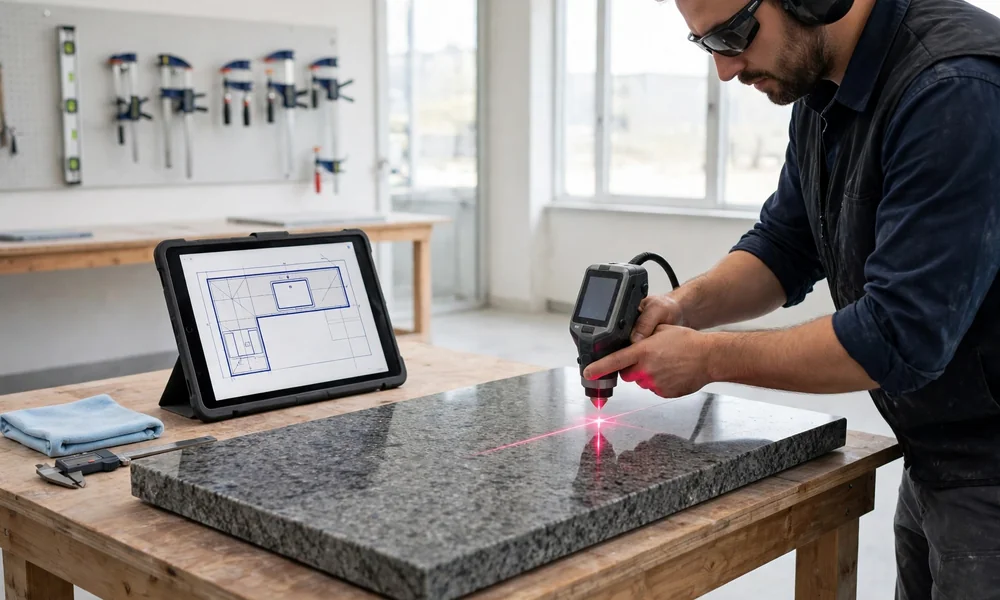
Best AI tools for countertop installation startups at a glance
| Tool | Best for | Standout AI feature | Good fit if |
|---|---|---|---|
| CounterGo | Countertop quoting and estimating | AI-assisted takeoffs from drawings and templates | You want accurate stone quotes in minutes, not hours |
| Moraware JobTracker | Job scheduling and slab inventory | Smart scheduling and remnant tracking | You run several installs a week and track slab stock |
| SlabSmith | Slab layout and nesting | AI nesting that fits cutouts onto fewer slabs | Stone cost is your biggest margin risk |
| Laser Products LT-2D3D | Digital laser templating | Laser measurement that builds a CAD-ready template | You template kitchens where no wall is square |
| Prodim Proliner | Digital templating and CAD | Point-to-point digital measuring with instant files | You need templates the saw can trust |
| ETemplate | Templating software and layout | Template-to-cut layout and edge detailing | You template and cut in the same workflow |
| MeasureSquare | Takeoffs and estimating from plans | AI measurement of plans in seconds | You price from drawings before the site visit |
| FieldPulse | Crew scheduling, dispatch, and invoicing | AI scheduling suggestions and route planning | Your install crews need a clear day, every day |
| Housecall Pro | Booking, payments, and customer follow-up | Automated reminders and review requests | You want bookings and payments without office admin |
| Podium | Lead replies, reviews, and messaging | AI agent that answers leads instantly | Missed calls are costing you countertop jobs |
How a countertop installation startup really works
A countertop installation startup earns its living from precision, not volume. Monday might bring a quartz kitchen template in a new-build house where the cabinets are level but the walls lean, a granite island measure where the homeowner wants a waterfall edge, and a bathroom vanity top that has to fit around existing plumbing. Tuesday might be a fabrication day: nesting the cutouts onto two slabs, checking the sink and hob positions against the template, and cutting the stone that cannot be cut twice. Wednesday is install day, and everything depends on the work done on Monday and Tuesday. One wrong measurement or one slab ordered short, and the install crew is standing in a customer’s kitchen with stone that does not fit.
The founder is usually the salesperson, the templater, the scheduler, and the installer all at once, and that is the hardest part of the first year. While you are on your knees templating a kitchen, the phone rings with a new lead. While you are driving to the stone supplier, a customer texts to ask whether the edge profile can change. Every interruption is a chance to win work or lose it, and the tools that help most are the ones that answer, record, price, and schedule without needing you to stop what you are doing.
Stone itself shapes the business in a way that other trades never face. A slab is expensive before a single cut is made, and every offcut is money sitting in the yard. Remnants have value only if you know where they are, what size they are, and which job they fit, which is why slab inventory matters from the very first month. Seams matter too: a well-placed seam disappears, a badly placed one is the first thing a homeowner sees every morning. The best AI tools for a countertop installation startup are therefore judged not only on how they handle a single install, but on how they protect the stone, the template, and the schedule that connect every job to the next one.
Relationships with the trades around you matter as much as relationships with homeowners. Cabinet installers, builders, kitchen designers, and plumbers all send countertop work to the company they trust, and they stop sending it the moment an install is late or a template has to be redone. A clear digital record helps here: when a builder asks where a job stands, you can answer in seconds with the template, the slab status, and the install date in one place. That reliability is what turns a one-off install into a steady flow of referrals, and it is worth more than any single advert. The wider countertop business rewards the same discipline, and the guide to AI tools for countertop companies shows how established firms organise the same work at a larger scale.
What to look for in AI tools for a countertop installation startup
Start with templating. A countertop template is the foundation of the whole job, and a tool earns its place if it captures the kitchen exactly as it is, including the out-of-square corners, the bowed walls, and the overhangs the homeowner asked for. Look for digital measuring that exports a clean file your saw or your fabricator can use without redrawing, for sink and hob cutout positions that stay tied to the template, and for edge profiles and seam positions recorded against the same drawing. If a tool forces you to remeasure on paper after a digital visit, it has not saved you anything.
Quoting comes next, and countertop quotes are unusually unforgiving. The price has to cover the slab, the fabrication, the edge work, the cutouts, the delivery, the install, and the sealing, and a quote that misses one of those lines is a loss disguised as a win. A good tool turns a template or a drawing into a tidy, itemised quote, remembers your usual prices for quartz, granite, and porcelain, and sends the quote before a competitor replies. Look for templates for the jobs you do most often, such as straight runs, L-shaped kitchens, islands, and vanity tops, and for the ability to show the customer exactly what is included so the price is trusted rather than questioned.
Scheduling needs to fit the countertop sequence, not a generic calendar. The template visit must happen after the cabinets are level, the fabrication must happen after the template is approved, and the install must happen after the slab is cut and the sink has arrived. Software built for all-day single visits will fight you every day, while a tool that links the template, the cut, and the install as one chain will keep crews busy and customers informed. Check that it handles short template visits, full install days, and travel time between them, and that it warns you when a job is booked before its template is ready.
Slab management deserves its own attention, because stone is your largest cost and your largest risk. A tool should track every slab from delivery to offcut, show you which remnants fit the next small job, and tie the slab to the customer who paid for it. AI nesting, which fits sink cutouts, hob cutouts, and vanity tops onto the fewest slabs, can save a slab a month for a busy startup, and that saving goes straight to profit. If you are still tracking slabs on a whiteboard or in your head, a single ordering mistake will cost more than a year of software.
Finally, check the practical details before you commit. The tool must work from a phone on a job site with patchy signal, it must store photos of templates, slabs, and finished installs against the right job, and it must let you take payment on the spot. Ask for a trial on a real job, not a demo with perfect data, and watch whether the whole crew actually uses it by the end of the week. The best tool for a countertop installation startup is the one your templater, your cutter, and your installer all open every day without being reminded.
The best AI tools for countertop installation startups in 2026
CounterGo
CounterGo is built specifically for countertop estimating, and that focus shows in every screen. You draw the kitchen, add the sink and hob cutouts, choose the edge profile, and the software prices the job from your own material and labour rates, including the fabrication steps that general estimating tools always miss. Its AI-assisted takeoffs read drawings and templates quickly, so a quote that used to take an evening takes under an hour, and the customer gets a clear, itemised price while they are still excited about the stone.
For a startup, the real value is consistency. Every quote uses the same rates and waste allowances, so you stop underpricing simple-looking jobs. CounterGo also records every quote, won or lost, showing which stone types and job sizes actually make money. Pair it with a digital template and your quote is built from real measurements, not a tape reading on the back of a business card.
Moraware JobTracker
Moraware JobTracker is the job management system that many stone shops grow up with, and it fits a startup that already has more work than one person can hold in their head. It tracks each countertop from first enquiry to template, fabrication, install, and final payment, with a calendar that shows every crew, every delivery, and every install slot in one place. Its slab inventory records every slab and remnant, so you know what is in the yard before you promise a customer a particular stone.
The AI side is practical rather than flashy: smart scheduling that flags clashes between template and install visits, reminders that chase approvals and deposits, and reports that show which jobs are profitable. For a small countertop crew, JobTracker replaces the whiteboard, the spreadsheet, and the group chat with a single record that everyone can trust.
SlabSmith
SlabSmith is the specialist tool for the problem every countertop startup feels in its wallet: fitting cutouts onto expensive slabs without waste. You load the slab sizes you have, add the pieces each job needs, and its AI nesting finds the layout that uses the fewest slabs and leaves the most usable remnants. It handles sink cutouts, hob cutouts, vanity tops, and splashbacks in the same run, and it shows the vein direction so the finished kitchen looks like one piece of stone rather than a patchwork.
The saving is easy to measure. If nesting saves one slab a month, that is often a four-figure saving for a small shop, and the software costs a fraction of that. SlabSmith also shows the customer the layout in advance, settling the two questions every homeowner asks: where will the seam be, and will the veins match across the island? Answering with a picture, before the stone is cut, builds trust and stops expensive arguments about a seam in the wrong place.
Laser Products LT-2D3D
The LT-2D3D from Laser Products Industries is the laser templating system that many countertop installers consider the standard for digital measuring. You set the laser on the cabinets, capture the kitchen in three dimensions, and the software builds a CAD-ready template that records every wall, corner, overhang, and cutout position with millimetre accuracy. There is no paper template to fold, tear, or misread, and no second visit to check a measurement you are unsure about.
For a startup, the LT-2D3D changes what a template visit looks like. The templater works faster, the fabricator receives a file rather than a sketch, and the install crew arrives knowing the stone will fit. The system is an investment, and it needs training, but it removes the single most expensive failure in countertop work: a template that is wrong.
Prodim Proliner
The Prodim Proliner is a point-to-point digital measuring device that has become a familiar sight in stone shops and on install vans. You touch the probe to each corner, edge, and cutout, and the Proliner records the exact positions and builds a digital template as you walk around the kitchen. It handles curves, angles, and irregular shapes that a tape measure struggles with, and it exports files that fabrication software can use directly.
What makes the Proliner a good fit for a startup is its simplicity on site. One person can template a kitchen quickly, the device is portable enough to carry up stairs and into tight utility rooms, and the template it produces is ready for the saw without redrawing. Its software also keeps a library of past templates, so a repeat job or a matching vanity top can be checked against the original measure in seconds.
ETemplate
ETemplate is templating software that connects the digital measure to the cutting layout in one workflow, which is exactly the gap that costs small countertop firms time. It takes a template file, lets you add edge profiles, seam positions, and cutout details, and produces a layout that the fabricator can work from without guesswork. Its tools for detailing overhangs, radius corners, and splashbacks mean the drawing the customer approves is the drawing the stone is cut from.
For a startup without a separate drawing office, ETemplate keeps the whole chain in one pair of hands. The templater captures the kitchen, the layout is finished the same day, and the customer signs off on a drawing that shows the finished countertop rather than a rough sketch. That speed matters when a homeowner is choosing between you and a competitor, and it matters even more when the install date is fixed and the slab is already on order.
MeasureSquare
MeasureSquare is the takeoff tool for countertop startups that price from plans before they ever visit the site. You load a drawing or a floor plan, and its AI measurement traces the runs, counts the cutouts, and calculates the stone area in seconds, including the waste allowance you set for each material. That means a builder or a designer can send you a plan in the morning and have a sensible budget price by lunchtime, which is often the difference between being invited to measure and being forgotten.
The tool earns its keep on larger jobs and on new-build work, where several kitchens need pricing from the same set of drawings. It also keeps a clean record of what was measured and how, so when a plan changes, you can remeasure in minutes rather than starting over. For a startup that wants builder and developer work alongside homeowner jobs, MeasureSquare turns plan pricing from a chore into a repeatable process.
FieldPulse
FieldPulse is the scheduling and dispatch platform for install crews that need a clear day, every day. It holds every template visit, install, and sealing appointment on one calendar, assigns crews and vans, and sends the customer a reminder with the arrival window and the name of the installer. Its AI scheduling suggestions spot the clashes that a paper diary misses, such as an install booked before its template is approved, or two crews sent to opposite ends of town on the same morning.
For a countertop startup, the dispatch view is the part that matters most. You can see at a glance which crew is templating, which is installing, and which van is carrying the stone, and you can move a job with a drag when a customer calls to change the date. FieldPulse also handles invoicing and payment, so the installer can take the final payment on site and the office record updates itself.
Housecall Pro
Housecall Pro is the all-round booking, payment, and follow-up system for small trade businesses, and it suits a countertop startup that wants the office work handled without hiring office staff. Customers can book a measure online, receive an automatic confirmation and reminder, and pay a deposit by card, while you keep the whole history of the job in one customer record. Its automated follow-ups chase the quotes that go quiet, which matters in countertop work, where a homeowner often takes a week to choose a stone.
The review side is where Housecall Pro quietly earns its fee. After the install and the sealing, it asks the customer for a review at the moment they are happiest with their new kitchen, and those reviews bring in the next street of customers. It also stores photos of the finished work against each job, giving you a portfolio to show the next homeowner without digging through a phone gallery.
Podium
Podium is the AI messaging tool that answers countertop leads while you are templating, cutting, or installing, and that timing is the whole point. A homeowner who messages three countertop companies usually books a measure with the one that replies first, and Podium’s AI agent answers instantly, asks the right questions about the kitchen size and the stone type, and books the visit into your calendar. It also pulls your reviews together and sends payment links, so the conversation that starts on a phone ends in a booked job.
For a startup, Podium protects the leads that a busy crew would otherwise lose. The templater does not have to stop work to answer the phone, the evening is not spent replying to messages, and no enquiry sits unread until the customer has already chosen someone else. Its review requests go out after the install, when the kitchen looks its best, and a steady flow of five-star reviews is the cheapest marketing a countertop business will ever have.
How to choose and combine your countertop tool stack
Choosing software for a countertop installation startup is different from choosing software for a general builder, because the stone itself creates the risks. A cabinet ordered one inch too wide can be adjusted on site, but a countertop cut one inch too short is a remake. A seam in the wrong place cannot be hidden, and a sink cutout in the wrong position cannot be moved. The tools that matter most are the ones that catch those mistakes before the saw starts, and that keep the homeowner informed enough to approve the template and the layout quickly.
For most countertop startups, those steps are the template, the quote, the slab nesting, and the install schedule, so buy tools that protect those four steps first. A sensible starter stack is a digital templating tool such as the LT-2D3D or the Proliner, a quoting and job platform such as CounterGo with Moraware JobTracker, and a nesting tool such as SlabSmith, with Podium or Housecall Pro answering leads and chasing reviews. Check that the tools share data cleanly, that the template file flows into the quote and the layout without redrawing, and that the pricing grows with the number of jobs rather than the number of users you do not yet have.
Finally, keep the number of tools small and give the stack a month to settle. A startup with four systems that everyone actually uses will beat a startup with nine systems that nobody updates, and the crew will tell you quickly which tool is slowing them down. Add specialist tools only when a clear gap appears, such as plan takeoffs for builder work or a second crew that needs dispatch. The neighbouring trades face the same choices in their own way, and the guide to AI tools for tile installation startups shows how fitting crews organise scheduling and quoting when every job is measured on site. Learn from them, but buy for stone, not for tile, and judge every tool by the same question: does it make the next countertop fit first time?
Countertop installation startup checklist
- Template digitally after the cabinets are level, and record every cutout, overhang, and edge profile against the same drawing.
- Quote from the template with an itemised price that covers stone, fabrication, edge work, cutouts, delivery, install, and sealing.
- Nest every cutout onto the slab before ordering, check the seam positions with the customer, and confirm the vein direction across the island.
- Schedule the template, the cut, and the install as one linked chain, and never book an install before its template is approved.
- Photograph the template, the slab, and the finished install against the same job record, and get the customer to sign off in writing.
- Seal the stone, walk the customer through the care instructions, and ask for a review while the new kitchen looks its best.
Frequently asked questions
What is the best AI tool for a countertop installation startup?
There is no single best tool, because a countertop job needs templating, quoting, nesting, and scheduling, and no one product does all four well. Most successful startups start with CounterGo for quoting, a digital templating device such as the LT-2D3D or Proliner, and Moraware JobTracker for jobs and slab stock. That combination covers the template, the price, and the schedule, and you can add SlabSmith for nesting once stone costs become your biggest worry.
How much should a countertop startup spend on software?
A small countertop crew should expect to spend a modest monthly amount on its core stack, roughly the cost of a single saved slab or one won job, and the templating hardware is a separate one-off investment. The right way to judge the spend is against the mistakes it prevents: one avoided remake, one saved slab, or one lead answered in time usually pays for a month of software. Start with the tools that protect the template and the quote, and add the rest only when the work justifies it.
Can AI really measure a kitchen for countertops?
AI does not replace the templater, but laser and digital templating tools capture a kitchen far more accurately than a tape measure, including walls that are not square and corners that are not ninety degrees. The software builds a CAD-ready template from those measurements, and the templater still checks the cutouts, the overhangs, and the seam positions before the file goes to the saw. Think of it as a precise assistant, not a replacement for a skilled pair of eyes.
How do I reduce stone waste in a countertop business?
Reduce waste by nesting every cutout onto the slab before you order, using the remnants from one job for vanity tops and splashbacks on the next, and keeping an accurate record of every offcut in the yard. AI nesting tools such as SlabSmith find layouts that a human would miss, and a good slab inventory stops you ordering a new slab when a remnant would do. Over a year, the saving is often several slabs, which is real profit for a small shop.
What should a countertop quote include?
A countertop quote should itemise the stone, the fabrication, the edge profile, every sink and hob cutout, the delivery, the installation, and the sealing, so the customer can see exactly what they are paying for. It should also state the template and install dates, the seam positions, and what happens if the customer changes the stone or the edge after approval. A clear quote prevents the arguments that follow a vague price, and it helps the customer trust the figure rather than shop it around.
How do countertop startups win work from kitchen remodelers?
Countertop startups win remodeler work by being reliable: templating on the promised day, fitting first time, and keeping the builder informed with a clear job record. Remodelers send work to the installer they trust, and they stop sending it after one late install or one template that has to be redone. The guide to AI tools for kitchen remodeling startups explains the remodeler’s side of the same jobs, including how they schedule countertops alongside cabinets, plumbing, and tiling, and a countertop crew that understands that sequence is the one that gets called back.
The bottom line
The best AI tools for countertop installation startups in 2026 do not replace the skill of templating, cutting, and fitting stone. They remove the guesswork around it, so the template is right, the quote is trusted, the slab is used well, and the install happens on the day it was promised. Start with digital templating, honest quoting, and one clear job record, add nesting when stone costs demand it, and let AI answer the leads while your crew does the work.

Keep what speaks to you.
Leave room for your own perspective.


