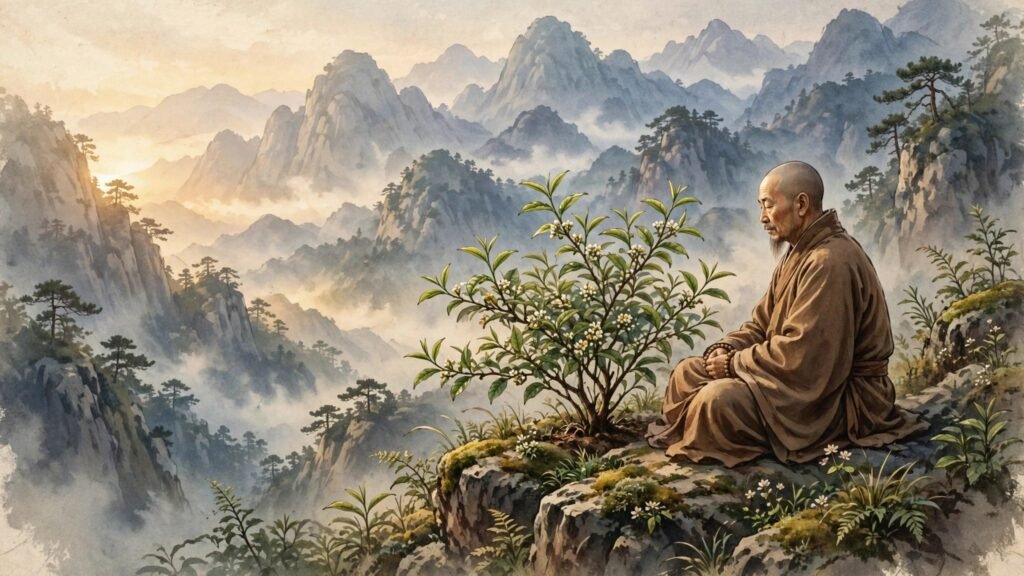
Every cup of tea carries a story, and one of the oldest stories about it begins with a monk who could not stay awake. The Indian legend regarding the discovery of tea tells how Bodhidharma, the Indian prince who became a Buddhist monk and travelled to China, fell asleep during nine years of meditation and, in his anger at his own weakness, cut off his eyelids. Where they fell to the ground, the story says, the first tea plants grew — a plant whose leaves would help monks stay awake for centuries to come.
It is a strange, vivid tale, and it has been told in India, China, Japan and the West for hundreds of years. People ask about it because it connects something ordinary — a morning cup of chai — with something ancient: meditation, discipline, and the search for a drink that keeps the mind clear. The legend is also a good window into how tea travelled across Asia, changing its meaning as it moved from monastery to market, from ritual to everyday habit.
This guide from Face Zem explains the legend step by step: who Bodhidharma was, what the story says, where it came from, how it differs from the older Chinese story of Emperor Shennong, and how it spread to Japan and then the world. Legend and history are different things, and this article keeps them separate while honouring both — because the story matters even though it is not literally true.
Key takeaways
- The Indian legend says Bodhidharma cut off his eyelids during meditation, and the first tea plants grew where they fell.
- Bodhidharma was a real historical figure — a monk who brought Zen Buddhism from India to China in the 5th or 6th century.
- The eyelid story is a legend, not history; it was recorded centuries later, mainly in Japanese and Chinese retellings.
- An older Chinese legend credits Emperor Shennong with discovering tea around 2737 BCE, when leaves fell into his boiling water.
- Tea spread through Buddhist monasteries, reached Japan in the 9th century, and became a global drink long after the legend was born.
1. Who Was Bodhidharma?
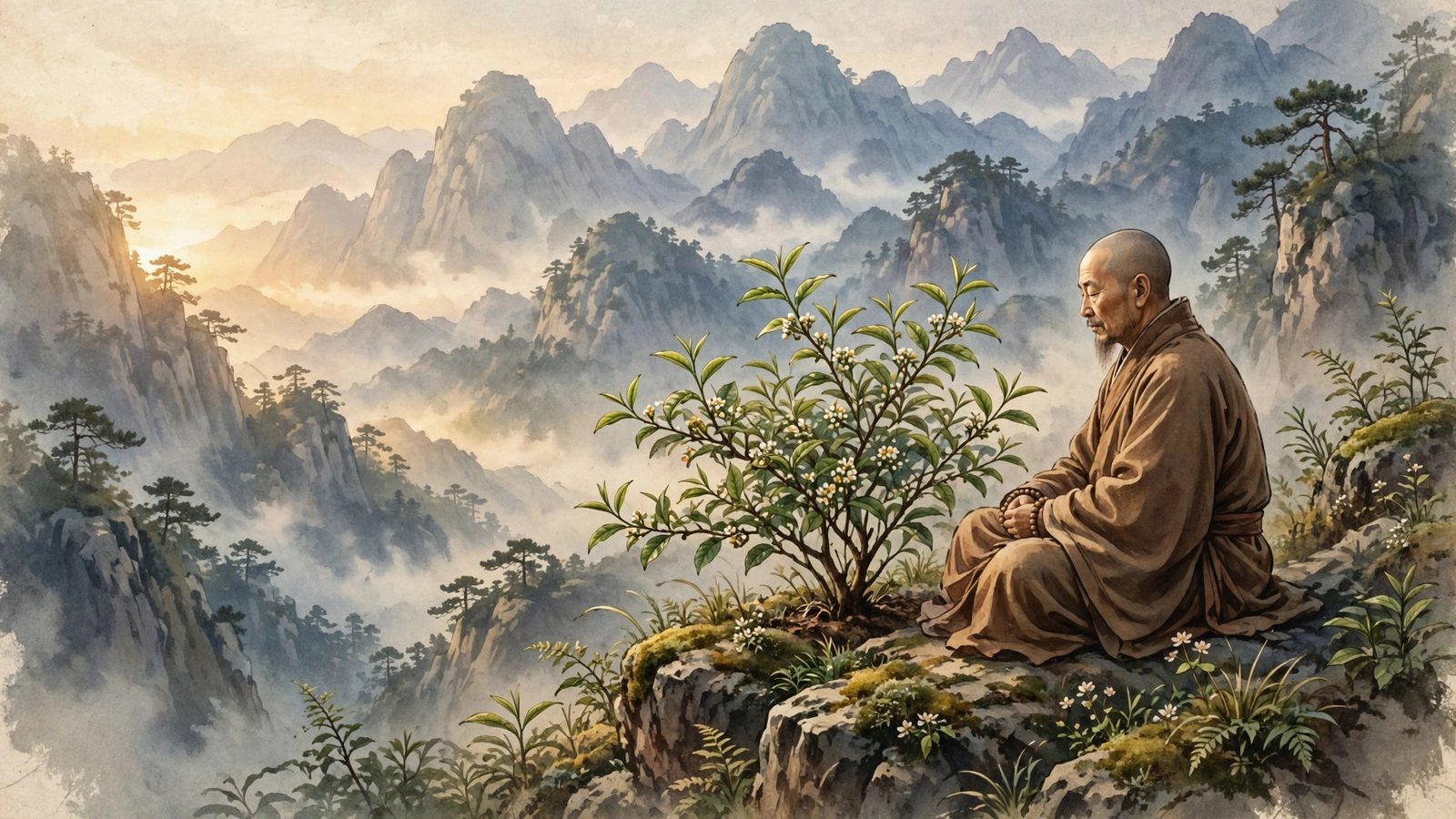
Bodhidharma was a Buddhist monk, traditionally said to be a prince from southern India, who travelled to China in the 5th or 6th century CE. In Chinese he is known as Damo, and in Japanese as Daruma. He is remembered as the founder of Zen Buddhism — the school of Buddhism that stresses meditation, direct experience and discipline over scripture and ritual. His journey from India to China is one of the great crossings in religious history, and it made him a hero figure in China, Korea and Japan.
What we know about the historical Bodhidharma is thin. The earliest records describe him as a meditation master who arrived in China, taught at the Shaolin Temple, and sat facing a wall in meditation for nine years. Later accounts added colour: the famous story that he cut off his eyelids so he could never sleep again, and that tea grew from them. Historians treat the nine years of wall-gazing as legend too, but Bodhidharma himself — the travelling monk who carried a form of Buddhism east — is accepted as a real person.
For the tea legend, the important thing is what Bodhidharma represents: endurance, wakefulness and discipline. Tea, a drink that sharpens the mind and keeps sleep away, fits perfectly with his image. That is why the story attached itself to him, and why it survived for more than a thousand years.
2. The Legend, Told in Full
The legend runs like this. Bodhidharma had vowed to meditate for nine years without sleeping. He sat facing a wall at the Shaolin Temple, but as the years passed his eyelids grew heavy and he fell asleep. When he woke, he was furious with himself for breaking his vow. In his anger, he tore off his eyelids and threw them to the ground — so that he could never close his eyes again.
Where the eyelids fell, plants sprang up. They had dark green leaves, shaped a little like eyelids themselves. Bodhidharma chewed the leaves and found that they cleared his mind, chased away sleep, and let him meditate without rest. From that day on, he drank an infusion of the leaves, and the monks around him did the same. That plant was tea.
Some versions of the story add that the tea plants grew only on the spot where the eyelids landed, on a mountainside in China, and that monks gathered the leaves there for generations. Other versions say the plants spread quickly through the monasteries, because every monk who tasted tea wanted to grow it. The details change with the telling, but the heart of the story — eyelids, wakefulness, tea — stays the same.
3. Why Eyelids? The Symbolism of the Story
To modern ears, cutting off one’s eyelids sounds grotesque, and it is. But legends often use shocking images to make a point that a gentler story would lose. The eyelids stand for sleep itself: the body’s demand for rest, the weakness that interrupts prayer and meditation. By removing them, Bodhidharma is shown as a man who refused to let the body rule the mind.
There is also a visual pun in the story. Tea leaves are oval and pointed, and a fresh tea leaf does resemble an eyelid in shape. In a culture that loved wordplay and visual likeness, the idea that leaves grew from eyelids would have felt natural — almost obvious. The story explains both where tea came from and what it looks like.
Finally, the legend gives tea a holy origin. It was not found by accident or invented by a trader; it was born from the sacrifice of a saint. That made tea more than a drink. For the monks who told the story, tea was a gift of discipline, a helper on the path to enlightenment. That sacred framing helped tea spread through monasteries long before it reached the wider public.
4. The Chinese Origin of the Story
Although the legend is often called an Indian legend — because Bodhidharma was Indian — the eyelid story itself was most likely composed in China or Japan, centuries after Bodhidharma lived. The earliest Chinese records of Bodhidharma say nothing about tea or eyelids. The story appears in later texts, and it is most fully developed in Japanese sources, where Daruma (Bodhidharma) became a beloved folk figure.
In Japan, Daruma dolls — round, red, weighted figures that always right themselves when knocked over — are symbols of perseverance. The tea legend fits the same spirit: fall down, get up, never give up. Japanese Zen monks drank tea as part of their practice, and the story of tea growing from Daruma’s eyelids was told in monasteries as a kind of origin myth for the tea ceremony itself.
So the legend is best understood as a Chinese and Japanese story about an Indian monk, rather than an Indian story in origin. It travelled in the opposite direction from Bodhidharma himself: he carried Buddhism from India to China, and the legend of his eyelids travelled back through the Buddhist world, picking up new meanings in each country.
5. Emperor Shennong and the Older Chinese Legend
Bodhidharma is not the only figure credited with discovering tea. An older and more famous Chinese legend names Emperor Shennong, the mythical Divine Husbandman, who is said to have lived around 2737 BCE. According to this story, Shennong was boiling water under a tea tree when a few leaves drifted down into the pot. He drank the water, found it refreshing, and realised he had discovered a new drink.
The Shennong story is very different in tone from the Bodhidharma legend. It is gentle and accidental: no sacrifice, no anger, just a curious emperor and a breeze. It also fits the Chinese idea that great discoveries come from attentiveness to nature rather than from force. Shennong is credited with discovering many herbs and medicines in the same way — by tasting plants and recording their effects — so tea fits naturally into his story.
Historians believe tea was indeed first used in southwestern China, in the region of modern Yunnan and Sichuan, and that it was known as a medicinal drink long before it became a daily beverage. The Shennong legend probably grew up around that real history. The Bodhidharma legend, by contrast, explains tea’s role in monasteries. Together, the two stories cover tea’s two great worlds: medicine and meditation.
6. Legend at a Glance: The Two Discovery Stories Compared
The two great legends of tea’s discovery are often confused, so it helps to set them side by side. They come from different eras, different heroes and different ideas about how discovery happens — but both end with the same drink in the cup.
| Detail | Bodhidharma legend | Shennong legend |
|---|---|---|
| Hero | Bodhidharma, an Indian Buddhist monk | Emperor Shennong, the Divine Husbandman |
| Date in the story | 5th or 6th century CE | Around 2737 BCE |
| How tea was found | Tea plants grew from his eyelids | Leaves fell into boiling water |
| Theme | Discipline, sacrifice, wakefulness | Curiosity, nature, medicine |
| Where the story comes from | Later Chinese and Japanese Buddhist retellings | Ancient Chinese tradition |
| What it explains | Why monks drink tea to stay awake | Why tea is a healthy drink |
| Historical basis | Bodhidharma was real; the eyelids are legend | Tea was used in southwest China; Shennong is mythical |
7. How the Story Spread to India
If the legend began in China or Japan, how did it become known as an Indian legend? The answer lies in the way stories travel along trade and pilgrimage routes. Indian monks, merchants and scholars visited China and Japan, heard the story there, and carried it home — where, because its hero was Indian, it felt like a native tale. By the time tea itself reached India in the 19th century, the Bodhidharma legend was already part of the shared Buddhist folklore of Asia.
Tea’s arrival in India is a separate story. The British East India Company, eager to break China’s monopoly on the tea trade, began growing tea in Assam in the 1830s, using plants smuggled out of China and local wild tea bushes. Within a few decades, India became one of the world’s great tea producers. The drink that had been a monastic aid in China became, in India, a national habit — chai, brewed strong with milk, sugar and spices.
Today, when Indians ask about the legend of tea’s discovery, they are often asking about Bodhidharma because he is the Indian figure in the story. The legend has come full circle: an Indian monk, a Chinese tale, a Japanese retelling, and a question asked in modern India. That journey is itself a small history of Asia.
8. Tea in Japan: From Monasteries to the Tea Ceremony
Japan is where the Bodhidharma legend reached its fullest flowering. Tea arrived in Japan in the 9th century, brought by Buddhist monks returning from China, and it was first used as a medicine and a meditation aid. By the 12th century, the monk Eisai had written a book praising tea’s health benefits, and tea drinking was spreading through Zen monasteries.
Over the following centuries, tea in Japan became something far larger than a drink. The tea ceremony — chanoyu — turned the simple act of making and serving tea into an art form, with rules about the room, the utensils, the movements and the spirit of the host. The ceremony embodies the values Bodhidharma is said to have lived by: attention, discipline, simplicity and presence. It is no accident that the legend of his eyelids was told most lovingly in the country where tea became a spiritual practice.
The Daruma doll, the red round figure that rights itself when pushed over, is still sold in Japan as a charm for perseverance and good luck. It is a reminder of the same story: a monk who would not give up, and a plant that grew from his refusal to sleep. For many Japanese people, Daruma and tea belong together in the imagination, even if they know the legend is not literal history.
9. What History Actually Says About Tea’s Discovery
Strip away the legends, and what do we actually know? Tea comes from the plant Camellia sinensis, which grows wild in the forests of southwestern China, northern Myanmar and northeastern India. People in that region almost certainly chewed or brewed its leaves for a very long time before anyone wrote about it — possibly thousands of years before the Shennong legend’s supposed date.
The earliest reliable written records of tea come from China in the Han dynasty (206 BCE – 220 CE), where tea is mentioned as a medicinal drink. By the Tang dynasty (618–907 CE), tea was a common beverage, and Lu Yu’s Classic of Tea (around 760 CE) described how to grow, pick, prepare and serve it in detail. Tea reached Japan in the 9th century, Korea earlier still, and Europe only in the 17th century, carried by Dutch and Portuguese traders.
Bodhidharma, if he lived in the 5th or 6th century, would have known tea as it was used in China at the time — as a medicinal and monastic drink. He did not discover it, and his eyelids did not become plants. But the legend captures a real truth: tea and Buddhism spread together across Asia, and monks were among tea’s first and most devoted drinkers. The story is false in its details and true in its picture.
10. Why the Legend Still Matters Today
Legends survive because they do work that facts alone cannot. The Bodhidharma story gives tea a meaning: it is not just a stimulant but a companion to discipline, a drink for people who are trying to stay awake to their lives. In a world of energy drinks and endless notifications, that is a gentler idea of alertness — attention as a practice, not a product.
The story also reminds us how connected Asia’s cultures are. An Indian monk, a Chinese drink, a Japanese ceremony, an Indian question — the legend belongs to no single country, and that is its point. Tea itself is the same: grown in Assam and Darjeeling, drunk in Beijing and Kyoto, sold in London and New York. Every cup is a small act of cultural exchange.
Finally, the legend is simply a good story, and good stories are worth keeping. Parents tell it to children, tea shops print it on their walls, and travellers hear it in monasteries. As long as people drink tea and wonder where it came from, Bodhidharma’s eyelids will keep growing into leaves.
11. How to Enjoy the Legend Yourself
You do not need to be a monk to appreciate the story. The next time you make a cup of tea, try slowing down for a few minutes: watch the leaves unfurl, notice the steam, and think about the journey the drink has made — from a wild bush in the forests of Yunnan, through monasteries and markets, to your own kitchen. That small pause is, in its own way, the spirit of the legend.
If you want to go further, visit a tea house or a Buddhist temple where tea is served, and ask about the local stories. Every tea-growing region has its own legends, and they are often told best by the people who grow and serve the tea. In Darjeeling, in Uji, in Wuyi, the stories differ — but the respect for the leaf is the same.
Reading about tea’s history is also rewarding. Lu Yu’s Classic of Tea is available in translation, and modern histories of tea trace its journey from China to the world with wonderful detail. The legends are the doorway; the history behind them is just as fascinating.
12. Checklist: Remembering the Legend of Tea
Use this short checklist to keep the story straight — and to share it accurately the next time someone asks.
- Remember the hero: Bodhidharma, the Indian monk who brought Zen Buddhism to China.
- Remember the story: he cut off his eyelids during meditation, and tea plants grew where they fell.
- Remember the purpose: the leaves kept monks awake and clear-minded for meditation.
- Remember the source: the tale was recorded later, mainly in Chinese and Japanese retellings.
- Remember the other legend: Emperor Shennong discovered tea when leaves fell into his boiling water.
- Remember the history: tea comes from Camellia sinensis, first used in southwestern China as a medicine.
Frequently Asked Questions
What is the Indian legend regarding the discovery of tea?
The legend says that Bodhidharma, an Indian Buddhist monk meditating in China, fell asleep during nine years of meditation. Angry at himself, he cut off his eyelids and threw them to the ground, and the first tea plants grew where they fell. The leaves helped monks stay awake, which is why tea became the monks’ drink.
Was Bodhidharma a real person?
Yes, Bodhidharma is accepted as a historical figure — a monk from India who travelled to China in the 5th or 6th century and became the founder of Zen Buddhism. However, the details of his life, including the nine years facing a wall and the eyelid story, are legends added by later generations.
Did tea really grow from Bodhidharma’s eyelids?
No. The eyelid story is a legend, not history. Tea comes from the plant Camellia sinensis, which grows wild in southwestern China and neighbouring regions. The story is a symbolic tale that explains why monks drank tea and gives the drink a holy origin.
What is the Shennong legend about tea?
The older Chinese legend credits Emperor Shennong, around 2737 BCE, with discovering tea when leaves from a tea tree fell into his boiling water. He tasted the water and found it refreshing. It is a gentler story about curiosity and nature, and it reflects tea’s early use as a medicinal drink.
How did tea spread from China to the rest of the world?
Tea spread first through Buddhist monasteries to Korea and Japan, where monks used it as a meditation aid. It reached Europe in the 17th century with Dutch and Portuguese traders, and the British began growing it in Assam, India, in the 1830s. India is now one of the world’s largest tea producers.
Why is the legend called Indian if it was told in China and Japan?
Because its hero, Bodhidharma, was Indian. The story travelled back along Buddhist routes to India, where it felt like a native tale. It is best understood as a shared Asian legend — an Indian monk, a Chinese setting, and Japanese retellings — rather than the story of one country alone.
Bottom line
The Indian legend regarding the discovery of tea is the story of Bodhidharma, the monk who cut off his eyelids so he could never sleep, and the tea plants that grew where they fell. It is not literal history — the tale was composed centuries later, mainly in China and Japan — but it captures a real truth: tea and Buddhism travelled together across Asia, and monks were among tea’s first devoted drinkers. Alongside the older Shennong legend, it gives tea two origin stories, one of discipline and one of curiosity, and both are worth knowing. For more on building a life of focus and good habits, see How to Build Wealth in Your 20s, Best Books on Passive Income, and How to Make Money With AI.
Note: This article is a general cultural guide to the legends and history of tea. The Bodhidharma and Shennong stories are legends, not verified history, and dates given for them are traditional rather than exact. For the historical record, tea comes from Camellia sinensis and was first used as a medicinal drink in southwestern China.

Keep what speaks to you.
Leave room for your own perspective.