A home-based business is any business you run mainly from the place you live. It might be a spare room turned into an office, a kitchen table where you pack orders, or a garage workshop. In 2026, it is one of the cheapest ways to start a business: there is no shop rent, no commute, and you can keep your day job while you test the idea.
This guide covers the home side of starting a business: the idea, the legal checks you must do before you open, the licences and permits, setting up a real workspace in a spare room, the home office tax deduction, insurance, and finding customers without foot traffic.
Key Takeaways
- Check the rules first: zoning, your lease or HOA, and local licences can stop a home business before it starts.
- Pick an idea that fits your home: desk-based services clear the rules easiest, while food, childcare, and anything noisy or smelly need extra permits.
- Set up a real workspace: a defined room or corner, used only for work.
- Keep business money separate from household money from day one, and keep records of every expense tied to the business.
What Is a Home-Based Business?
A home-based business is any income-generating activity run mainly from your residence: consulting, freelancing, online sales, tutoring, crafts, baking under cottage food rules, or light making and packing. Your home is a private place, and turning part of it into a workplace changes how the law, your landlord, and your insurer see it.
The appeal is clear. Startup costs often stay under a few thousand dollars, you keep your day job while testing demand, and the tax rules still allow legitimate home office deductions when you meet the IRS tests.
Step 1: Pick an Idea That Fits Your Home
Start with an idea that fits the space, the noise, and the traffic your home can handle. Desk-based services clear the rules easiest: consulting, freelancing, digital marketing, online tutoring, virtual assistance, bookkeeping, and design all need little more than a desk, a laptop, and a quiet room.
Ideas that involve visitors, deliveries, noise, smells, or chemicals need more thought. Food, childcare, hairdressing, repairs, and anything involving chemicals or heavy equipment trigger extra permits, inspections, and sometimes a different location altogether.
Step 2: Check Zoning, Your Lease, and HOA Rules First
This is the step to do before you spend a dollar. Local zoning ordinances divide land into residential, commercial, and industrial zones, and your neighbourhood’s classification controls what you can legally do on your property. Most residential zones allow some form of home-based business, but with conditions: no large exterior signage, no employees reporting to the home, limited client visits, no retail foot traffic, and no noise or odours that reach neighbours.
Next, read your lease or your homeowners association rules. Many leases prohibit commercial use outright, and some require written landlord approval before you operate a business from the property. HOA covenants can ban customer traffic, signage, and outdoor storage.
Step 3: Choose a Structure and Register
A sole proprietorship is the simplest structure: you and the business are the same legal entity, and no formation filing is needed beyond local licences if you operate under your own name. It is fine for testing an idea. Most people move to a limited liability company, or LLC, once revenue appears, because it separates personal and business liability. The Small Business Administration notes that registration costs are usually under $300, though fees vary by state.
File with your state’s Secretary of State, usually online, and get a free EIN from the IRS if you form an LLC or plan to hire. The best remote jobs for beginners in 2026 can be a useful way to test which kind of home-based work suits you before you commit to a structure and a name.
Step 4: Get Your Licences and Permits
Almost every municipality requires a general business licence before you can legally operate, even from home. These licences are typically inexpensive and serve as the city’s way of tracking business activity and enforcing zoning compliance. Fees vary widely by jurisdiction but commonly fall between $50 and $150 for a standard home-based operation.
Beyond the general licence, your industry may require more. A home bakery must comply with cottage food laws and obtain health department permits. A home-based daycare needs a childcare licence. Health service providers need professional licences from state regulatory boards. Federal licensing applies to regulated goods such as firearms or alcohol.

Step 5: Set Up Your Spare Room as a Workspace
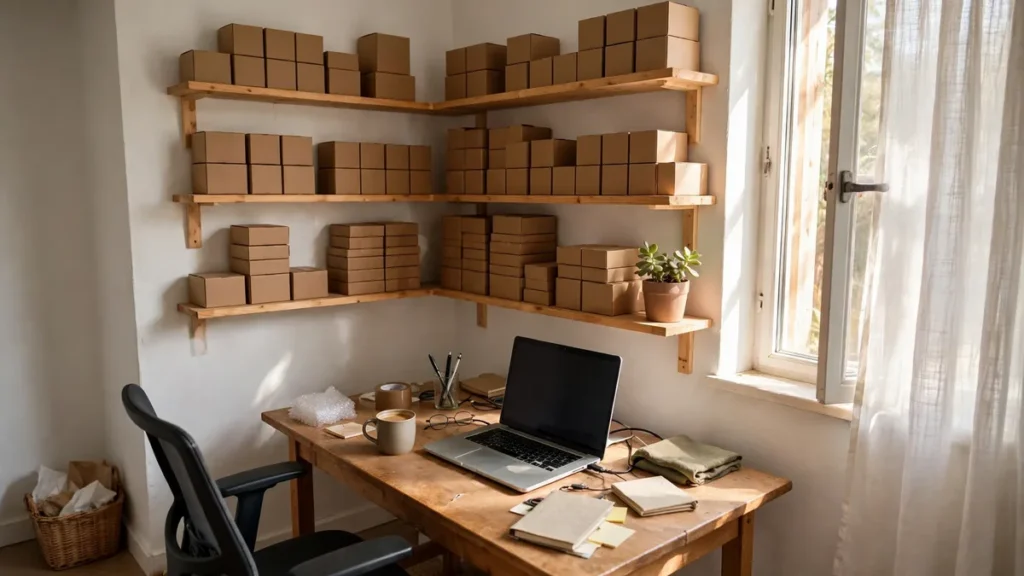
A home business needs a real workspace, not a laptop on the sofa. Pick one room, or one clearly defined corner, and make it the business. A spare bedroom is ideal. Clear it properly, add a desk at the right height, a chair that supports a full working day, good light, and shelving for stock and supplies. Keep the door closable: when the door is shut, you are at work, and when it is open, you are at home.
Think about storage and workflow. Products need shelves, not piles on the floor. Packing needs a flat surface, tape, labels, and boxes within reach. Paperwork needs a filing box or a drawer. Keep business things in the workspace and household things out of it.
Step 6: Understand the Home Office Tax Deduction
Self-employed people can deduct expenses for the part of the home used for business, but the IRS tests are strict. The space must be used regularly and exclusively for business. Exclusive means the room, or the defined part of a room, is used only for the business, not as a guest room, a playroom, or a home gym as well. Regular means you use it often for business, not once in a while.
There are two ways to work out the deduction. The simplified method gives a fixed amount per square foot of office space, up to a set limit. The regular method deducts the business share of actual costs: rent or mortgage interest, utilities, insurance, repairs, and maintenance, worked out by the share of your home’s floor area used for business. The best online courses for making money in 2026can help new owners keep clean records from the start.
Step 7: Protect the Business With Insurance
A standard home insurance policy usually does not cover business activity. Business equipment, stock, and liability for customers or deliveries are often excluded, and a claim tied to the business can be refused. Tell your home insurer that you run a business from the property, and ask what your policy covers.
Most home-based businesses need general liability insurance, and many also need professional liability insurance if they give advice or provide a service. A Business Owner’s Policy, often called a BOP, bundles liability and property cover and is inexpensive for many small home operations. If you hold stock, check that it is covered for theft, fire, and water damage while stored at home.
Step 8: Separate Your Money and Keep Records
Open a separate business bank account as soon as the business starts earning, and run every business payment through it. Mixing personal and business money is the most common bookkeeping mistake home-based owners make, and it causes trouble at tax time, with lenders, and if the business is ever audited.
Keep records of everything: income, expenses, receipts, mileage for business trips, and the bills tied to the home office. A simple spreadsheet is enough in the first months, and accounting software is worth the small monthly cost once sales become regular. Keep receipts for stock, packaging, equipment, and home office costs, because each one supports a deduction or explains a payment.
Step 9: Find Customers Without Foot Traffic
A home business usually cannot rely on passing trade, so your customers have to find you another way. Pick one marketing channel and work it properly for the first three months. If your customers search for solutions, that channel is search and helpful content on your website. If they scroll social media, it is short video or posts on the platform they use most.
Your first ten customers matter more than your first thousand visitors. Talk to them, ask how they found you, what nearly stopped them buying, and what they would tell a friend. Their answers will improve your offer, your website, and your marketing faster than any course.
Step 10: Grow Without Outgrowing Your Home
Growth is the goal, but growth inside a home has limits. Watch for the signs: stock filling every cupboard, deliveries blocking the driveway, packing taking over the kitchen, or neighbours noticing the traffic. When those signs appear, you have options before renting a shop. A storage unit, a fulfilment service, or a co-working desk can help.
Plan the next step before you need it. The best freelance jobs in 2026 show how many skilled people you can hire for a few hours a week, which is often cheaper than doing everything yourself as the business grows.
Common Mistakes to Avoid
The most common mistakes are easy to name. Skipping the zoning and licence checks and discovering the problem after you have launched. Mixing personal and business money in one account. Using the whole house as an office and losing the home office deduction. Undercharging because the business is at home and it feels less real than a shop.
Another mistake is keeping the business invisible. A home business still needs a website, a way to take payments, and a way for customers to find you. Build the same professional presence a shop would have, and let the work speak for itself.
Frequently Asked Questions
Do I need a licence to run a business from home?
Almost always, yes. Most cities require a general business licence, and many require a home occupation permit as well. Your industry may need more, such as a health permit for food or a childcare licence. Check with your city or county before your first sale.
Can I claim a home office deduction if I rent?
Yes, renters can claim it. The same IRS tests apply: the space must be used regularly and exclusively for business. You can deduct the business share of your rent and utilities, using either the simplified or the regular method.
How much of my home can I use for business?
Zoning rules often limit the share of floor area used for business, commonly to 25 percent or less of the home. Check your local zoning code, because the limit varies by city. The home office deduction also depends on the measured area used exclusively for business.
Can my HOA stop me running a business from home?
Yes, in many cases. HOA covenants are private rules attached to your property, and they can ban customer visits, signage, and outdoor storage, or restrict business use entirely. Read your covenants before you start, and get written approval from the HOA if your rules require it.
How much money do I need to start a home-based business?
It depends on the idea. A desk-based service can start for the cost of a website, a few tools, and a licence, often a few hundred dollars. A product business needs stock, packaging, and storage, so the starting cost is higher.
The Bottom Line
Starting a home-based business in 2026 comes down to doing the home checks first: pick an idea that fits your space, verify zoning, your lease, and HOA rules, choose a structure, get your licences, set up a real workspace in a spare room, understand the home office deduction, insure the business, and keep your money separate. Do the checks, set up the room, and let paying customers decide what grows next.

Keep what speaks to you.
Leave room for your own perspective.


