
Key Takeaways
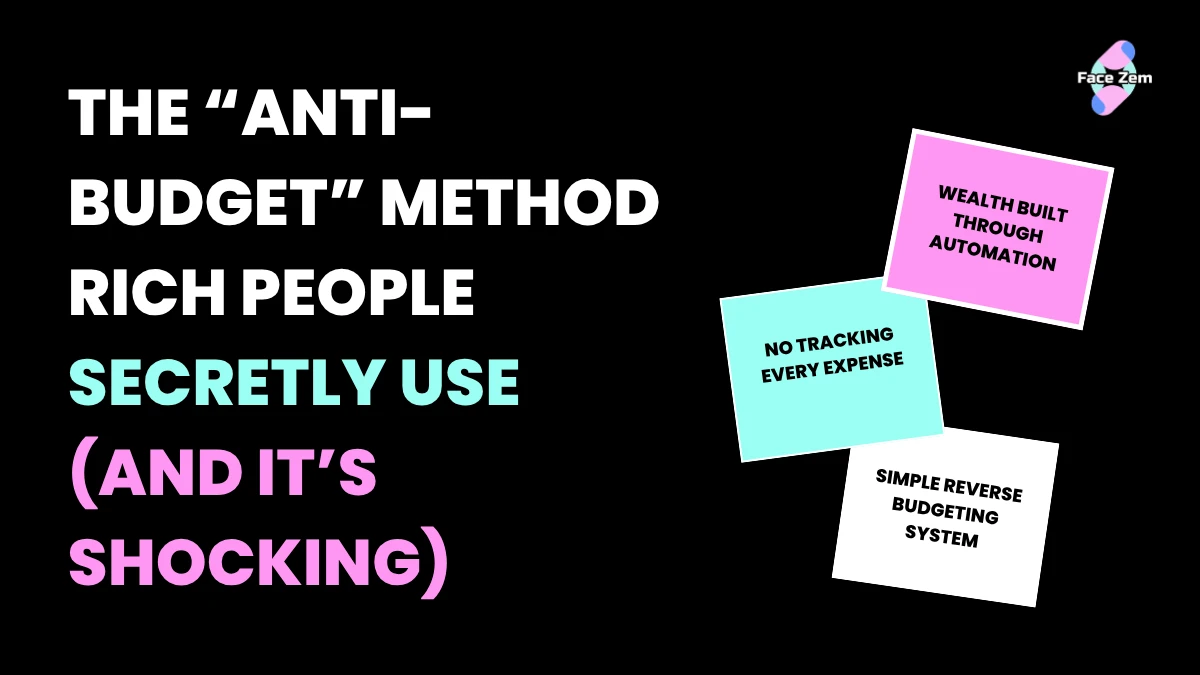
- Prioritize automated savings before any spending begins
- Spend remaining income freely without tracking every expense
- Use separate accounts to isolate investing and lifestyle money
- Focus on high-level wealth building instead of small expense control
- Reduce financial stress through fully automated money systems
Most people assume that building significant wealth requires tracking every single penny on a complex, tedious spreadsheet. But if you look closely at how rich people manage money, you will find that the wealthiest individuals rarely spend their weekends categorizing grocery receipts.
Instead, they rely on a stress-free financial framework known as the anti budget method.
The anti budget method is a highly effective, reverse-engineered approach to personal finance where you pull out your savings and investment goals the moment you get paid, leaving you completely free to spend the rest of your income without guilt or tracking.
At Facezem, we specialize in breaking down the psychological shifts and practical strategies that build true financial freedom.
If you are ready to stop stressing over minor expenses and start building wealth like a seasoned investor, this deep dive into the anti budget method will completely transform your relationship with money.
AI Overview
The Anti-Budget Method is a wealth strategy where savings and investments are automatically deducted first, and the remaining income is spent freely without tracking every expense. It emphasizes automation, financial simplicity, and consistent investing. By removing budgeting stress and focusing on future goals, it helps build long-term wealth while reducing money anxiety.
What Exactly is the Anti Budget Method?
Traditional money management models force you to look backward, reviewing past mistakes and agonizing over why you spent an extra twenty dollars on dinner last week. This reverse strategy does the exact opposite by focusing entirely on your future goals.
When you adopt the anti budget method, you do not care where your day-to-day cash goes, provided that your primary financial obligations are met first. You treat your investments, retirement contributions, and emergency reserves as your primary fixed costs.

Once those critical allocations are automatically transferred out of your main account, the remaining balance is yours to use as you please.
This simple mental shift completely removes the friction that causes most traditional budgets to fail. It changes your focus from forced deprivation to intentional, automated growth, which is exactly how rich people manage money over the long term.
How the Wealthy Reverse-Engineer Wealth
High-net-worth individuals value their time and mental energy above almost everything else.
Spending hours manually tracking small expenses is an inefficient use of cognitive energy that could otherwise be spent generating new income streams or scaling businesses.
The Power of Frictionless Automation
The secret to sustainable wealth building is removing human willpower from the equation.
Wealthy individuals establish deeply automated financial systems that route capital to asset accounts before they ever have the chance to spend it. By automating the process, consistency becomes the default setting rather than a monthly chore.
Focusing on Macro Growth Over Micro Cuts
Cutting out small daily luxuries rarely moves the needle when it comes to true, long-term financial security.
The ultra-wealthy understand that maximizing their earning potential and increasing their overall savings rate yields far greater results than obsessing over minor expenses. This macro-focused philosophy is at the absolute core of the entire reverse-budgeting system.
The Strategic Allocation Framework

To understand how this functions in real life, let’s examine an estimated allocation strategy for an individual earning a net income of $8,000 per month after taxes.
| Allocation Priority | Target Percentage | Estimated Monthly Amount | Purpose |
| Priority 1: Automated Wealth | 35% | $2,800 | Index funds, real estate, retirement accounts |
| Priority 2: Fixed Essentials | 40% | $3,200 | Housing, insurance, basic utilities, transportation |
| Priority 3: Guilt-Free Lifestyle | 25% | $2,000 | Dining out, travel, hobbies, entertainment |
By securing your automated wealth targets first, the remaining $2,000 can be spent entirely down to zero dollars without causing a single bit of financial damage or anxiety.
Step-by-Step Guide to Implement the System
Transitioning to this modern framework requires setting up a highly organized, automated infrastructure. Follow these clear steps to build a bulletproof financial machine that works tirelessly in the background.
- Determine Your Exact Wealth Target: Calculate a specific, realistic percentage of your income that you want to save and invest each month, keeping an estimated baseline of at least fifteen to twenty percent for optimal long-term growth.
- Establish Separate Financial Buckets: Open distinct accounts for your lifestyle spending and your long-term investments, keeping them at entirely separate banking institutions if you need to eliminate the temptation to transfer money back.
- Automate Your Core Transfers: Set up automatic transfers with your bank to deploy your wealth target funds to your brokerage or retirement accounts the exact same day your paycheck hits your account.
- Spend the Remaining Balance Freely: Use whatever money is left over in your primary checking account for your daily life, enjoying total freedom without opening a single tracking app or spreadsheet.
Why Traditional Budgets Fail Young Professionals
Most conventional personal finance advice is deeply outdated and fails to account for modern behavioral psychology. Forcing yourself to track every single transaction creates a constant state of financial anxiety and decision fatigue.
Eventually, most people suffer from budget burnout and abandon the process entirely, sliding back into old, unorganized spending patterns.
The anti budget method eliminates this cycle by removing the constant micro-decisions. It allows you to maintain a healthy, enjoyable lifestyle while your wealth builds quietly in the background.

At Facezem, we believe that financial advice must be practical and easy to sustain over decades. When studying how rich people manage money, it becomes obvious that simplicity and consistency will always beat complex, restrictive rules that are impossible to maintain over time.
Key Benefits of Going Anti-Budget
Shifting to a reverse-engineered financial model provides profound psychological and practical advantages that extend far beyond your bank statement.

- Total Elimination of Money Guilt: Because your future is already fully funded, you can purchase luxury items or enjoy expensive dinners without feeling like you are sabotaging your long-term goals.
- Dramatic Reductions in Financial Anxiety: You no longer need to stress over minor price fluctuations or daily spending variables, as long as your primary wealth bucket has been filled at the start of the month.
- Inbuilt Protection Against Lifestyle Creep: As your income grows over time, you can simply scale up your automated savings percentage, ensuring that your wealth scales up faster than your personal lifestyle expenses.
Common Misconceptions to Keep in Mind
While the anti budget method offers incredible freedom, it is important to clarify what this strategy is not. It is not an open invitation to completely ignore your basic financial realities or accumulate high-interest consumer debt.
You still need to ensure that your fixed living costs do not completely overwhelm your income. If your rent, utilities, and debt payments consume eighty percent of your paycheck, you will not have enough space left to fund your wealth targets or enjoy your lifestyle.
This framework requires you to maintain a reasonable control over your fixed overhead costs so the rest of the engine can run smoothly.
The Long-Term Wealth Trajectory
Adopting the anti budget method puts your personal finances on autopilot, transforming wealth accumulation from an exhausting chore into a passive habit. Over a period of five, ten, or twenty years, these automated contributions compound into significant, life-changing assets.
By mimicking how rich people manage money, you stop trading your valuable time for tedious tracking and start focusing your energy on expanding your career, launching creative projects, or building alternative income streams.
The simplicity of the system ensures that you will actually stick with it for the long haul.
Conclusion
The anti budget method completely reshapes the way we think about financial discipline. By prioritizing your future self first and automating your investment goals, you unlock a life of true financial freedom and guilt-free spending.
True financial success is not about constant restriction; it is about building a system that works efficiently for you.
Take a look at your income today, determine your core wealth targets, and let Facezem help you optimize your path to effortless financial independence.
Frequently Asked Questions
What is the primary difference between a traditional budget and the anti budget method?
Traditional budgets require you to track and categorize every single expense after you spend it. The reverse approach focuses entirely on pulling out your savings goals first, allowing you to spend the remaining balance freely without any tracking.
How much should I automatically save using this system?
While individual goals will vary based on current income and debt levels, an estimated baseline of fifteen to twenty percent of your take-home pay is a highly effective target for long-term wealth building.
Does this strategy work if I have significant credit card debt?
Yes. If you have open debt, your debt repayment schedule simply becomes your primary wealth target. You automate your aggressive debt payments first, and then spend the remaining funds without guilt.
How often should I review my automated financial plan?
You only need to review your system when you experience a major life change, such as a significant raise, a new job, or a major change in your fixed monthly living costs.