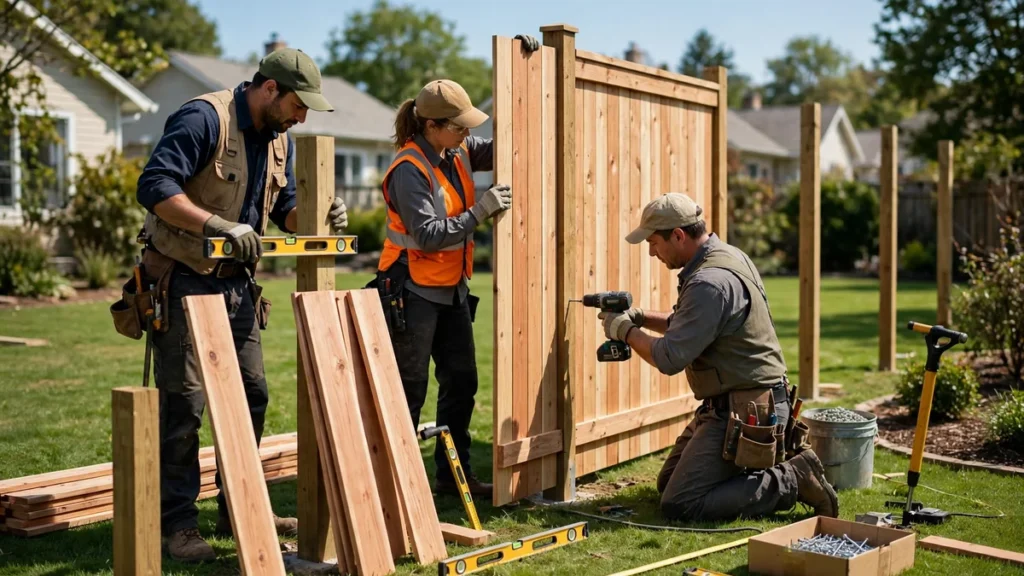
The best AI tools for fence companies in 2026 do far more than answer the phone. They quote jobs from a photo, schedule crews around the weather, chase unpaid invoices, and turn one finished fence into five new enquiries. For a trade where the owner often measures the yard in the morning, builds the fence in the afternoon, and does the paperwork at night, that kind of help is not a luxury. It is the difference between a business that grows and a business that stays stuck at the same handful of jobs every week.
Fence companies face a very specific set of problems. Every job is different, because every yard is a different length, slope, and soil type. Customers want a firm price quickly, but a careless quote can wipe out the profit on a whole installation. Materials such as timber, vinyl, chain link, and ornamental metal all move in price, and a supplier delay can throw a whole week of installs off schedule. Add in missed calls while the crew is on site, no-shows, and paperwork that piles up, and it is easy to see why so many good fence installers feel permanently busy without feeling any richer.
This guide compares the strongest AI tools for fence companies across the jobs that matter most: quoting and estimating, scheduling and dispatch, customer messaging, marketing, and money management. Each tool below was judged on how well it fits a real fence business, how quickly a small team can learn it, and whether its AI features save hours every week rather than adding another dashboard to check. The result is a practical shortlist you can use to build a simple AI stack that quotes faster, books more work, and keeps crews moving.
Key takeaways
- AI quoting tools cut estimate time from hours to minutes by turning photos, measurements, and material lists into a priced proposal a customer can approve on the spot.
- Field-service platforms with AI scheduling keep crews, trucks, and materials in step, so fewer days are lost to double bookings, bad routes, and missing panels.
- AI messaging and review tools answer enquiries while the crew is on site, follow up on open quotes, and turn finished jobs into fresh five-star reviews.
- The best stack for most fence companies pairs one field-service hub with one AI writing assistant and one smart CRM, rather than buying ten separate apps.
- Start with the bottleneck that costs the most money, usually slow quotes or missed calls, and add the next tool only once the first one is paying for itself.

How We Compared the Best AI Tools for Fence Companies
Every tool in this guide was compared against the same five tests, because a fence company does not need clever software for its own sake. It needs software that survives contact with mud, rain, measurements, and customers who change their minds. The first test was quoting speed: how quickly can the tool turn a site visit or a set of photos into a clear, priced proposal. The second was scheduling strength: can it plan multi-day installs, move jobs when the weather turns, and keep every crew member informed without a dozen phone calls.
Price mattered, but value mattered more. A cheap tool that saves nobody any time is expensive, while a pricier platform that books two extra jobs a month pays for itself many times over. Roofing companies face the same on-site estimating challenge as fence installers, and the AI tools for roofers we compared show how field-service software handles measurements, materials, and crews in a very similar trade. That overlap is useful, because the best tools for fence companies are usually the best tools for outdoor trades in general, tuned to the way fence jobs are measured and sold.
The Best AI Tools for Fence Companies at a Glance
The table below gives a quick comparison of the ten tools in this guide. Read it to narrow the field to two or three options, then read the detailed reviews that follow before you commit. The right choice depends on the size of your company, whether you run one crew or five, and whether your biggest pain is quoting, scheduling, or winning new work.
| Tool | Best For | Standout AI Feature | Starting Price |
|---|---|---|---|
| Jobber | Overall field service | AI quote and invoice drafting | From around $39 per month |
| Housecall Pro | Scheduling and dispatch | AI dispatch and smart scheduling | From around $49 per month |
| ServiceTitan | Larger fence companies | AI call handling and dispatch | Custom pricing |
| HubSpot | CRM and sales follow-up | AI sales assistant and lead scoring | Free plan, paid from around $20 per month |
| Zoho CRM | Affordable AI CRM | Zia AI predictions and writing | From around $14 per user per month |
| ChatGPT | Quotes, emails, and estimates | Photo-based takeoffs and drafting | Free plan, paid from around $20 per month |
| Jasper | Marketing content | Brand-voice AI writing | From around $39 per month |
| Podium | Reviews and messaging | AI replies and review requests | Custom pricing |
| Calendly | Booking site visits | AI scheduling and routing | Free plan, paid from around $10 per month |
| QuickBooks Online | Bookkeeping and invoicing | AI categorisation and cash-flow insight | From around $30 per month |
Best AI Tools for Fence Companies 2026: Detailed Reviews
The ten tools below cover the full job, from the first phone call to the final invoice. Some are field-service platforms built for trades, while others are general AI tools that happen to fit fence work extremely well. You do not need all ten. Most fence companies do best with one field-service hub, one AI writing assistant, and one system for reviews and follow-up, chosen from the reviews below.
1. Jobber: Best Overall Field-Service Platform for Fence Companies
Jobber is the most complete single platform for a small to mid-sized fence company, and its AI features are aimed squarely at the paperwork that eats an owner’s evenings. The AI assistant drafts quotes and invoices from job details, suggests follow-up messages for customers who have gone quiet, and helps write clear job descriptions that customers actually understand. Instead of starting every quote from a blank page, the owner starts from a sensible draft and edits the numbers.
Quoting is where Jobber earns its keep for fence work. A site visit can be turned into a line-item quote with materials, labour, gate hardware, and removal of the old fence, and the customer can approve it online with a deposit. Scheduling shows every crew, truck, and job on one calendar, and the mobile app lets installers see the day’s jobs, customer notes, and photos without phoning the office. Invoicing follows automatically once a job is marked complete, which means fewer jobs sit unpaid because the invoice went out a week late.
2. Housecall Pro: Best for Scheduling and Dispatch
Housecall Pro is built around the working day of a trade crew, and its AI scheduling is its strongest feature for fence companies. The system learns how long different fence jobs take, spots clashes before they happen, and suggests the best order for jobs across the week. When a customer cancels or the weather closes in, the schedule can be reshuffled in minutes instead of through a morning of phone calls and crossed-out diary pages.
The dispatch tools are equally practical. Crews receive job details, maps, customer contact details, and photos on their phones, and the office can see where every team is without ringing round. Customers get automatic text updates when the crew is on the way, which cuts down on “when will you arrive” calls and makes the company look organised. Online booking lets homeowners request a site visit at a time that suits them, and the job is already on the calendar when the office opens in the morning.
3. ServiceTitan: Best for Larger Fence Companies
ServiceTitan is the heavyweight option, designed for trade businesses that have outgrown spreadsheets and simple scheduling apps. Its AI handles incoming calls, books jobs, and routes them to the right crew, while dispatch tools balance workload, drive time, and technician skill across the whole business. For a fence company with several crews, a sales team, and an office staff, that level of coordination is hard to replicate with lighter tools.
The platform shines on the commercial side of fence work. Multi-site quotes, phased installs, and long projects with staged payments are all handled in one place, and managers can see real-time profit per job, per crew, and per material type. AI call summaries mean nothing important from a customer conversation is lost, and follow-up tasks are created automatically. Marketing tools track which advertising channels bring in the best fence jobs, so the company can spend more on what works and stop paying for what does not.
4. HubSpot: Best CRM and AI Sales Follow-Up
HubSpot is the best choice when the problem is not doing the fence work but winning it and keeping track of every lead. Its free CRM records every enquiry, quote, phone call, and email in one timeline, so no lead is ever forgotten in a notebook or a text thread. The AI sales assistant drafts follow-up emails, scores leads by how likely they are to buy, and suggests the next step for each open quote, which is exactly the discipline most busy fence companies lack.
For fence companies, HubSpot works best as the sales brain sitting alongside a field-service tool. A lead comes in from the website or a directory, HubSpot logs it and starts a polite follow-up sequence, and once the job is won the details pass to the scheduling system. AI content tools help write service pages, seasonal offers, and email campaigns without hiring a copywriter, and the reporting shows which fence types and neighbourhoods bring in the most profitable work.
5. Zoho CRM: Best Affordable AI CRM for Fence Companies
Zoho CRM with its Zia AI assistant is the best value CRM for fence companies that want smart sales tools without a big monthly bill. Zia predicts which quotes are most likely to close, flags deals that have gone quiet, and suggests the best time to contact each customer. It also drafts emails and summaries, so the owner can send a professional follow-up in a minute between jobs.
Zoho’s strength is how much it covers for the price. Lead capture from the website, quote tracking, customer records, email campaigns, and simple automation are all included, and the system connects to Zoho’s own invoicing and books tools for companies that want an all-in-one setup. Custom fields fit fence work well, with space for fence type, linear footage, gate count, material, and site notes, so every quote carries the details the crew will need later.
6. ChatGPT: Best AI Assistant for Quotes, Emails, and Estimates
ChatGPT is the most flexible AI tool on this list, because it can help with almost any office task a fence company faces. It drafts quote emails, writes job descriptions, turns rough site notes into a clean proposal, and answers awkward customer questions in a calm, professional tone. With a photo of a yard or an old fence, it can help list the materials and steps a job is likely to need, which makes it a useful second pair of eyes during estimating.
The practical way to use ChatGPT in a fence business is to build a small set of repeatable prompts. One prompt turns site measurements into a tidy quote summary, another writes a polite follow-up for an open estimate, and a third drafts a social media post from a finished job photo. The owner still checks every number, because AI can misjudge a slope, a gate, or a removal cost, but the drafting time drops sharply. Custom instructions can store the company’s pricing style, service area, and tone of voice, so every draft sounds like the business rather than a generic template.
7. Jasper: Best AI Content Tool for Fence Company Marketing
Jasper is built for businesses that need a steady flow of marketing content, and it suits fence companies that want to be found online without writing every page themselves. Its brand-voice feature learns how the company talks, then produces service pages, blog posts, email campaigns, and social media captions in that same voice. The result is marketing that sounds consistent, which matters when customers compare three fence companies before they call anyone.
For fence work, Jasper is most useful for local search content. It can draft pages for each fence type and each town served, write seasonal campaigns for spring installs and storm repairs, and turn a single finished job into a case study, a social post, and an email to past customers. Templates keep the output structured, and the built-in editing tools help the owner tighten a draft quickly rather than starting from scratch.
8. Podium: Best AI Tool for Reviews and Customer Messaging
Podium wins fence companies more work by handling the two moments that matter most after a job: the review request and the next enquiry. Its AI drafts replies to customer messages, suggests responses to reviews, and sends a well-timed text asking a happy homeowner to leave a review while the new fence is still fresh in their mind. That timing is the difference between a company with twelve reviews and one with two hundred.
The messaging inbox pulls texts, web chats, and directory messages into one place, so an enquiry never sits unanswered in an app nobody checks. AI summaries show the office what each customer needs at a glance, and suggested replies keep the tone friendly and professional even when the owner is on a ladder. Payment links can be sent by text, which helps fence companies collect final balances quickly after an install is finished.
9. Calendly: Best AI Tool for Booking Fence Site Visits
Calendly solves a small problem that costs fence companies a surprising amount of money: the back-and-forth of booking a site visit. Instead of three emails to find a time that suits both sides, the customer picks a slot from a live calendar, answers a few questions about the fence they need, and the visit is booked. AI routing sends different job types to the right estimator, and reminders cut no-shows sharply.
The questions a customer answers before the visit are quietly valuable. Fence type, approximate length, gate needs, and access notes arrive with the booking, so the estimator turns up prepared instead of discovering the job is twice the size expected. Team scheduling handles several estimators at once, and the system connects to the main calendars and CRMs a fence company already uses.
10. QuickBooks Online: Best AI Bookkeeping and Invoicing for Fence Companies
QuickBooks Online is the money system behind many small trade businesses, and its AI features take much of the bookkeeping pain out of running a fence company. The AI categorises expenses, matches bank transactions to invoices, flags unusual spending, and gives a clear view of cash flow, so the owner can see whether the business is actually making money this month. That clarity matters in a seasonal trade, where a busy spring can hide a thin margin.
For fence companies, the practical wins are invoicing and job costing. Invoices can be sent from the job site with photos attached, deposits and staged payments are tracked, and material costs can be assigned to each job so the owner learns which fence types are the most profitable. Late-payment reminders go out automatically, which is far more effective than a handwritten note to chase an invoice at the end of the month. Payroll and supplier bills can be handled in the same place as the company grows.
AI Quoting and Estimating for Fence Jobs
Quoting is the single most valuable place to use AI in a fence company, because a fast, accurate quote wins jobs that a slow one loses. The best AI quoting workflow starts with good inputs: clear photos of the yard, the linear footage, the fence height and style, the number of gates, and any slopes, trees, or access problems. From those inputs, an AI assistant can draft the material list, flag items that are easy to forget, such as concrete, post caps, and gate hardware, and produce a clean proposal the customer can read without a phone call to explain it.
Accuracy still depends on the person doing the measuring. AI can estimate materials from a photo, but it cannot feel a slope, spot a buried pipe, or notice that the only access is through a narrow side gate. The right balance is to let AI handle the drafting and the arithmetic while the estimator owns the measurements and the final price. Companies that follow that balance quote faster without the expensive mistakes that come from trusting a machine with a job it has never walked.
AI Scheduling, Dispatch, and Route Planning
A fence install is a multi-day puzzle of crews, trucks, materials, and weather, and AI scheduling keeps the pieces in order. The system weighs how long each fence type takes, how far apart the jobs are, and which crew has the right skills, then builds a week that wastes the least driving time. When a job runs long or a delivery slips, the schedule updates and the affected customers are told before they have to ask. That kind of communication is what turns a delay from a complaint into a shrug.
Landscaping crews run similar multi-crew days with the same mix of sites, materials, and weather, and the AI tools for landscapers show how outdoor trades use smart scheduling to keep teams productive across a full week. Fence companies can borrow the same habits: plan the week on Friday, confirm materials on Monday, and let the scheduling tool handle the changes that arrive midweek. The companies that do this well spend their mornings building fences instead of rebuilding the diary.
AI Marketing That Fills the Fence Calendar
Most fence companies get work from referrals, local search, and a strong review profile, and AI helps with all three. A steady flow of local content, such as pages for each fence type and town, helps the company appear when a homeowner searches for an installer nearby. AI writing tools draft that content quickly, while the owner adds the local knowledge and the photos that make it believable. Review tools then turn each finished job into a fresh review, which is often the deciding factor when a customer compares two similar quotes.
House painting businesses win repeat work in much the same way, through local visibility and a strong reputation, and the AI tools for house painters offer a useful parallel for fence companies that want to market smarter. The lesson is the same in both trades: be easy to find, be easy to trust, and follow up with past customers before the busy season starts. A fence company that does those three things well rarely needs to discount its prices to stay busy.
AI for Materials, Inventory, and Supplier Orders
Materials are the biggest cost on most fence jobs, and AI helps keep that cost under control. Simple inventory tools track panels, posts, concrete, and hardware across the yard and the trucks, and flag when stock is running low before a crew discovers it on site. AI forecasts based on past jobs can suggest how much timber or vinyl to order for the coming month, which reduces both emergency supplier runs and piles of unused material gathering dust.
Ordering itself can be partly automated, with low-stock alerts and repeat orders for the items a fence company always needs. The goal is not to remove the owner from ordering entirely, but to remove the surprises: the missing gate hinges, the short delivery of posts, or the concrete that never arrived. A crew that starts the day with everything it needs finishes the day on schedule, and a company that finishes on schedule gets paid on schedule.
How to Choose the Right AI Stack for Your Fence Company
Choosing AI tools starts with naming the bottleneck. A company that loses jobs because quotes take a week needs quoting help first, while one that misses calls while the crew is digging post holes needs messaging and booking help first. A company that is busy but broke needs job costing and invoicing help first. Picking the tool that matches the bottleneck gives the fastest return and the clearest proof that AI is worth the money.
Finally, choose tools that connect to each other. A quoting tool that cannot talk to the scheduling system creates double entry, and double entry creates mistakes. Before buying, check that the field-service platform, the CRM, and the bookkeeping tool share data cleanly, and that the team is willing to use them every day. The best AI stack is the one the crew actually opens in the morning, not the one with the longest feature list.
Fence Company AI Checklist
Use this checklist to roll out AI in your fence company without disrupting the jobs already on the calendar. Work through it in order, and do not move to the next step until the current one is working in daily use.
- Pick one bottleneck to fix first, such as slow quotes, missed calls, or late invoices, and choose the tool that solves that problem directly.
- Set up the field-service hub with your real fence types, material prices, and crew details, so quotes and schedules use your numbers from day one.
- Write three reusable AI prompts for quote emails, open-quote follow-ups, and review requests, and test each one on a real job before relying on it.
- Connect the CRM, calendar, and bookkeeping tools so every lead, booking, and invoice flows through without retyping the same details twice.
- Train the crew on the mobile app with a real job, showing them how to see the day’s work, add photos, and mark a job complete.
- Review the numbers after thirty days, including quote speed, booking rate, and profit per job, and keep only the tools that clearly earned their cost.
Frequently Asked Questions
What is the best AI tool for fence companies?
Jobber is the best all-round choice for most fence companies, because it covers quoting, scheduling, invoicing, and customer messages in one system with useful AI drafting built in. Larger companies with several crews may prefer ServiceTitan for its deeper dispatch and reporting, while a one-crew business can start with Housecall Pro and add ChatGPT for drafting. The best tool is the one that fixes your biggest bottleneck and that your team will actually use every day.
How can AI help a fence company quote faster?
AI helps quoting by turning site photos, measurements, and material lists into a clean draft proposal in minutes instead of hours. The estimator still measures the yard and checks the numbers, but the writing, the line items, and the follow-up message are drafted automatically. That speed matters, because customers often accept the first clear, professional quote they receive, and a quote that arrives the same day is far more likely to win the job than one that arrives a week later.
Can AI estimate fence materials from a photo?
AI can give a useful starting estimate from a clear photo, including a rough material list and the steps a job is likely to need, but it should never be the final word on price. Slopes, soil, access, and hidden obstacles can only be judged on site, and a wrong estimate can erase the profit on a whole installation. The safest approach is to use AI for the draft and the checklist, then let the estimator confirm the measurements and the final price before the quote goes out.
How much do AI tools for fence companies cost?
Most fence companies can build a useful AI stack for roughly $100 to $250 per month, depending on the tools chosen. A field-service platform typically costs $39 to $49 per month, an AI writing assistant around $20 per month, and a CRM from free to around $20 per month. Larger platforms such as ServiceTitan and Podium use custom pricing, so the cost depends on the size of the business. In most cases, a single extra booked job covers the whole monthly cost.
Will AI replace fence estimators or installers?
No, AI will not replace estimators or installers, because fence work depends on judgement, measurements, and skilled hands that no software can copy. What AI replaces is the paperwork around the job: drafting quotes, chasing follow-ups, scheduling crews, and sending invoices. The companies that benefit most are the ones where AI handles the office work and people handle the fences, the customers, and the decisions that need a human on site.
What is the easiest way for a small fence company to start with AI?
The easiest start is to pick one AI writing assistant, such as ChatGPT, and use it for quote emails and follow-ups for two weeks, while keeping the rest of the business exactly as it is. Once that habit is saving time every day, add a field-service platform to handle quoting and scheduling in one place. This step-by-step approach keeps the change small, the cost low, and the team on board, which is far more effective than buying five tools at once and using none of them properly.
The Bottom Line
The best AI tools for fence companies in 2026 are the ones that give an owner their evenings back and give a crew a clearer week. Jobber leads for most small and mid-sized fence businesses, Housecall Pro leads on scheduling, ServiceTitan leads for larger operations, and ChatGPT plus a good CRM covers the writing and follow-up that wins jobs. Start with the bottleneck that costs the most money, prove the return in thirty days, and build from there. A fence company that quotes fast, answers fast, and finishes on schedule does not need to be the cheapest in town, because it is already the easiest to hire, and that is the advantage AI is really selling.

Keep what speaks to you.
Leave room for your own perspective.


